Algeria
 Egypt
 Libya
 Morocco
 Sudan
 Tunisia
 Benin
 Burkina Faso
 Cabo Verde
 Côte d'Ivoire
 Ghana
 Guinea
 Guinea-Bissau
 Liberia
 Mali
 Mauritania
 Nigeria
 Senegal
 Sierra Leone
 The Gambia
 Togo
 Cameroon
 Central African Republic
 Chad
 DR Congo
 Equatorial Guinea
 Gabon
 Republic of the Congo
 São Tomé and Príncipe
 Burundi
 Comoros
 Djibouti
 Eritrea
 Ethiopia
 Kenya
 Madagascar
 Malawi
 Mauritius
 Mozambique
 Rwanda
 Seychelles
 Somalia
 South Sudan
 Tanzania
 Uganda
 Angola
 Botswana
 Eswatini
 Lesotho
 Namibia
 South Africa
 Zambia
 Zimbabwe
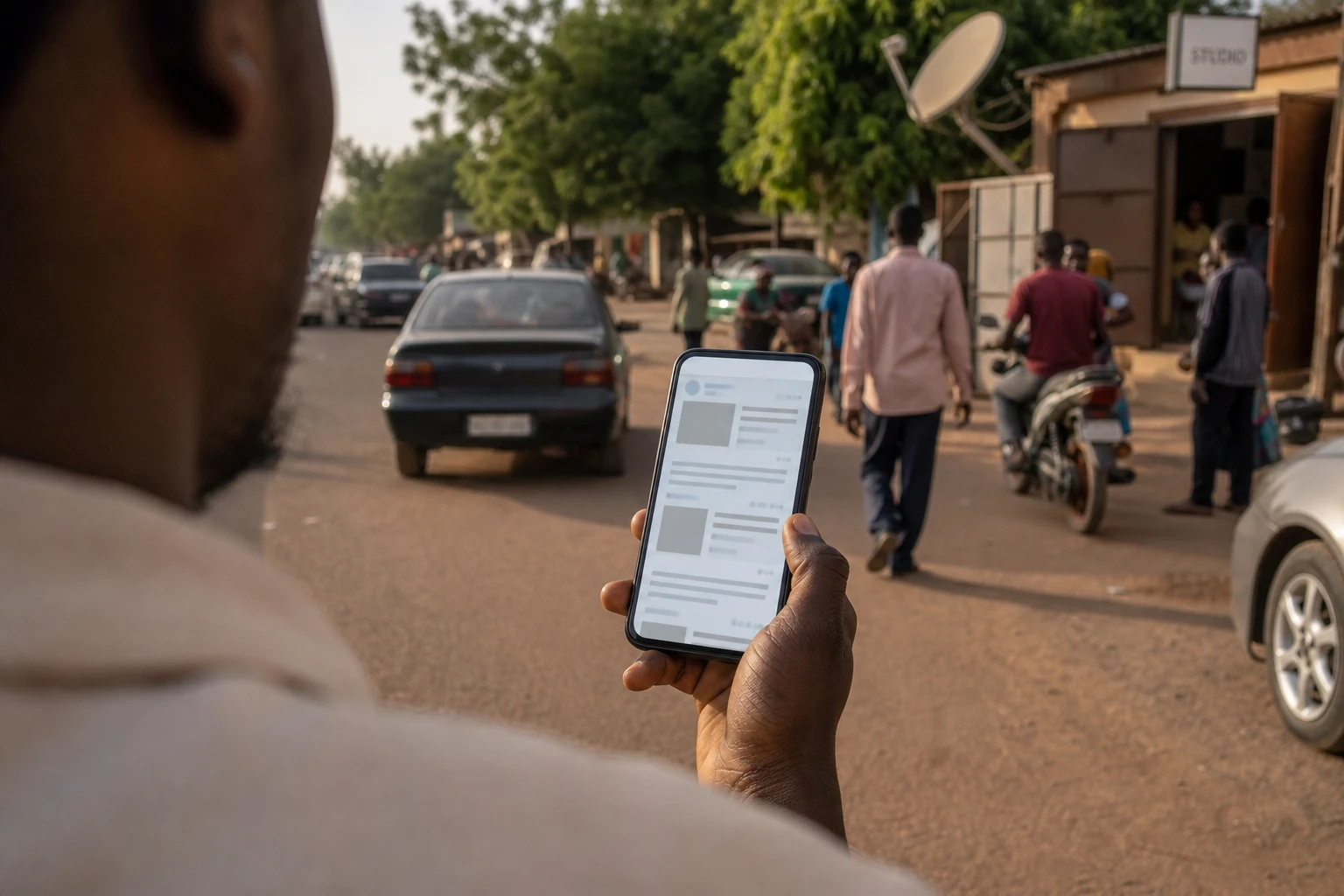
In Niamey, the silence surrounding Moussa Kaka has now spread beyond his family. Since Monday 31 August 2026, the Nigerien journalist has been missing after leaving the premises of Radio-Télévision Saraounia, which he runs. No authority has publicly confirmed his arrest or said where he might be.
A disappearance with no official explanation
Moussa Kaka left his office at about 7pm in the Nigerien capital to go home. He never arrived. Since then, his relatives and colleagues say they have had no reliable information about his fate.
His elder brother, Mahamadou Kaka, has described a «total blackout» surrounding the disappearance. The family is asking the authorities to mobilise the necessary resources to find the journalist and establish the precise circumstances of what happened.
The director of Radio-Télévision Saraounia is a familiar figure in Niger’s media landscape. For several decades, he has reported on the country’s political, social and security affairs. He has also been a correspondent for Radio France Internationale and Reporters Without Borders.
At this stage, no publicly available information establishes who took him, under what circumstances or for what reason. Caution is therefore necessary. Human rights organisations have nevertheless raised the possibility of an enforced disappearance: a deprivation of liberty attributed to state agents, followed by a refusal to acknowledge the detention or disclose the person’s whereabouts.
Reporters Without Borders calls for an investigation into Moussa Kaka’s disappearance. The organisation notes that the Nigerien authorities have so far publicly announced neither judicial proceedings nor an administrative inquiry.
A case emerging after a tense political episode
The disappearance came two days after a failed attempt to overthrow the authorities in Niamey on 29 August 2026. The proximity of the two events has fuelled questions, but does not prove a connection.
People close to the journalist, quoted by several media outlets, say there is currently nothing to link his work to recent political events. Human Rights Watch, for its part, says the circumstances raise fears of an enforced disappearance, without presenting evidence establishing the identity of those responsible.
This distinction is essential. In a politically tense climate, dates that coincide may shape the questions being asked. They are not enough to identify a perpetrator or motive. Only an independent investigation, with access to detention registers, CCTV footage and available testimony, could clarify the case.
Alioune Tine, founder of the Senegalese think-tank Afrikajom, is calling on the Nigerien authorities to provide concrete information. He says the family, journalists and the public must know where Moussa Kaka is and what condition he is in.
Nigerien media operating in a narrowing space
The case comes amid a media environment that has been significantly reshaped since the coup of 26 July 2023. The National Council for the Safeguard of the Homeland, led by General Abdourahamane Tiani, has gradually tightened its control over public communication.
The authorities present these measures as responses to security threats, disinformation campaigns and risks to national cohesion. Human rights organisations, by contrast, see them as reducing pluralism and increasing pressure on critical voices.
On 8 May 2026, Niger’s National Observatory of Communication suspended nine foreign media outlets in the country. The Nigerien Press Agency reported that the decision targeted France 24, RFI, Agence France-Presse, TV5 Monde, Jeune Afrique and Mediapart, among others. The regulator cited the protection of public order, institutional stability and the morale of the defence and security forces.
The decision does not directly concern Radio-Télévision Saraounia. It nevertheless illustrates the climate in which Nigerien media operate. Journalists have to contend with security-related constraints, administrative restrictions and increased scrutiny of political topics.
Moussa Kaka’s own past adds to the concern. In 2007, he was arrested and charged over allegations related to his contacts with Tuareg rebels. He was eventually released after lengthy proceedings. The case is a reminder that his professional career has already unfolded under considerable political and security pressure.
Regional realignment complicates pressure mechanisms
The case also comes amid a reshaping of West Africa. Niger, Mali and Burkina Faso officially left the Economic Community of West African States, ECOWAS, on 29 January 2025. The regional organisation co-ordinates economic affairs, the free movement of people and certain political mediation mechanisms.
The three countries have meanwhile consolidated the Alliance of Sahel States, now a confederation focused on security, diplomatic and economic co-operation. The move reflects their desire to reduce dependence on regional frameworks they consider too close to former partner powers.
For journalists and human rights defenders, this shift changes the avenues for seeking redress. ECOWAS remains a regional point of reference, but Niger’s withdrawal reduces the scope for direct institutional pressure. African human rights organisations, journalists’ unions and the African Commission on Human and Peoples’ Rights therefore take on particular importance.
Nigerien society is the first to be affected. An unexplained disappearance touches the journalist’s family, but also his colleagues, the employees of his media group and citizens who rely on local outlets to understand current affairs. In the capital and across the regions, uncertainty can encourage self-censorship and weaken the flow of verified information.
What happens next
The priority now is to establish whether Moussa Kaka is being held by a public service, was abducted or whether another possibility should be investigated. A credible inquiry should clarify the last known hours, identify witnesses and check official places of detention.
The Nigerien authorities have not publicly announced that such an inquiry has been opened. The lack of communication is fuelling concern and leaving room for rumours. On its own, however, it does not make it possible to conclude that the state is involved.
Beyond the individual case, the affair will test Niger’s ability to guarantee the safety of media professionals during a period of political transition. It will also be watched by the AES’s regional partners, African institutions and international human rights organisations.