
 Algeria
 Egypt
 Libya
 Morocco
 Sudan
 Tunisia
 Benin
 Burkina Faso
 Cabo Verde
 Côte d'Ivoire
 Ghana
 Guinea
 Guinea-Bissau
 Liberia
 Mali
 Mauritania
 Nigeria
 Senegal
 Sierra Leone
 The Gambia
 Togo
 Cameroon
 Central African Republic
 Chad
 DR Congo
 Equatorial Guinea
 Gabon
 Republic of the Congo
 São Tomé and Príncipe
 Burundi
 Comoros
 Djibouti
 Eritrea
 Ethiopia
 Kenya
 Madagascar
 Malawi
 Mauritius
 Mozambique
 Rwanda
 Seychelles
 Somalia
 South Sudan
 Tanzania
 Uganda
 Angola
 Botswana
 Eswatini
 Lesotho
 Namibia
 South Africa
 Zambia
 Zimbabwe
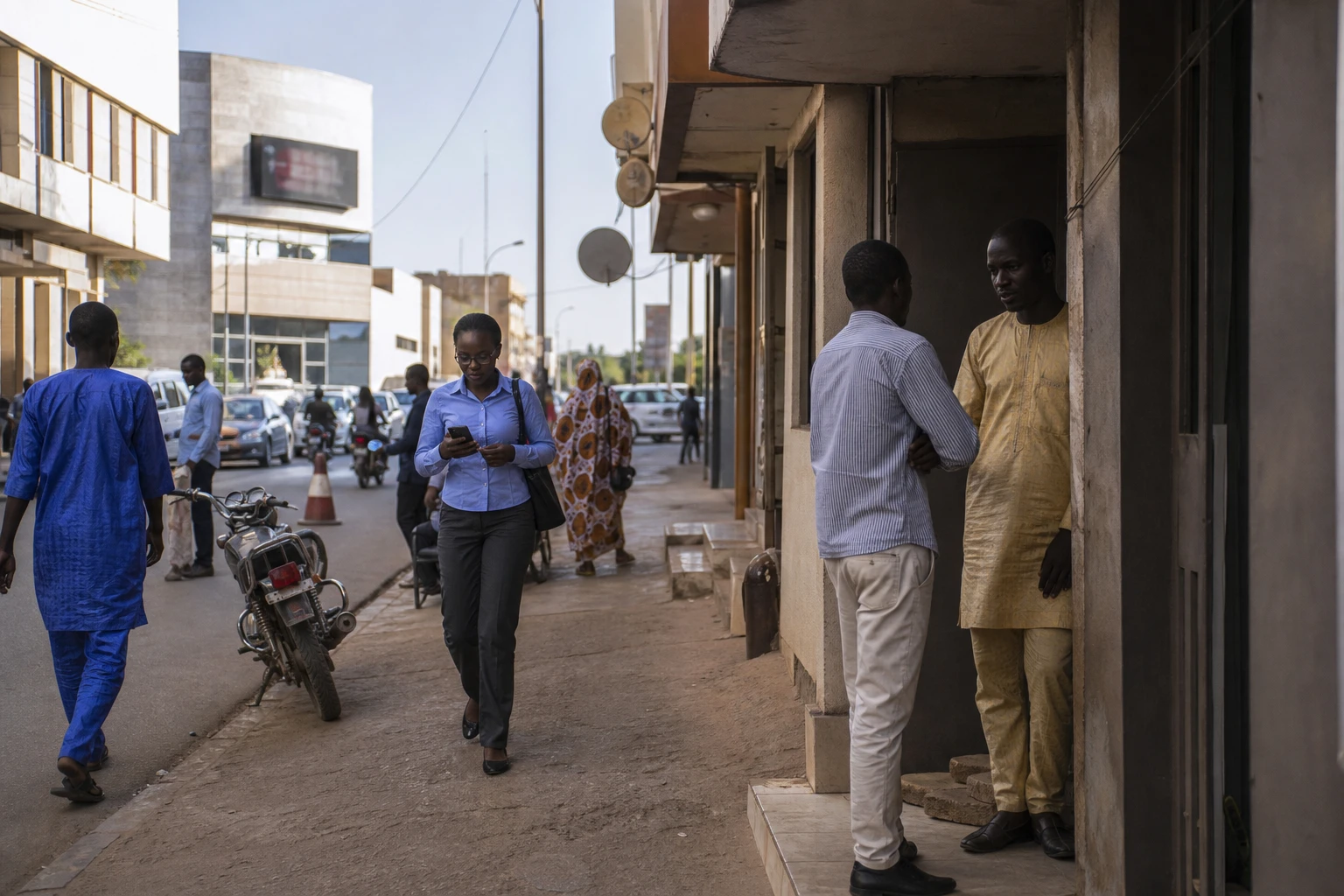
In Niamey, a disappearance that goes beyond one name
In Niger, the disappearance of a journalist never affects only a newsroom. It also says something about the state of the country, the limits of its freedoms and the trust between the authorities and citizens. When a well-known professional, based in Niamey and associated with local news for years, stops making contact, concern quickly takes on a political dimension.
The case of Moussa Kaka carries particular weight because it comes amid heightened security and institutional tensions in Niger since the July 2023 coup. Since then, Reporters Without Borders (RSF) says violations of press freedom have worsened significantly, with more arrests, editorial pressure and a more repressive legal framework.
In this context, the disappearance of a media director based in the Nigerien capital does not look like a simple news item. It affects the right to inform, but also families’ right to know, and the authorities’ duty to respond swiftly when a citizen goes missing.
A country under strain, a press under scrutiny
Niger has been in a particular political phase since the military seized power in 2023. The country’s regional framework has also changed profoundly. Niger, Mali and Burkina Faso’s withdrawal from ECOWAS took effect on 29 January 2025, after a year-long transition. This reshaped the West African landscape and reduced the diplomatic and institutional channels available for applying pressure.
For the Nigerien press, the break is not only regional. It is also domestic. RSF recalls that the Maison de la Presse was ordered to cease its activities in January 2024, after denouncing violations of press freedom. The organisation also notes that the cybercrime law, amended in June 2024, is regularly used against journalists.
In this environment, every arrest, every summons and every enforced silence carries greater weight. The country still has dynamic private media outlets, but they operate amid economic fragility, political pressure and self-censorship on some sensitive issues. The question, then, is not only that of a missing journalist. It is that of a shrinking public sphere.
What is known about Moussa Kaka
Moussa Kaka, director of Radio Télévision Saraounia, has not been heard from since 31 August, according to information verified by RSF. The organisation says he left his offices in Niamey at around 7pm to go home, but never arrived. Neither his relatives nor his colleagues have been able to reach him since.
RSF also says a vehicle linked to the journalist is reportedly missing, adding to concerns. The organisation is calling for an immediate investigation to establish where he may be detained, or to determine the exact circumstances of his disappearance. Human Rights Watch, for its part, has described the situation as potentially amounting to an enforced disappearance, while noting that a Nigerien journalist said that in the country, people can disappear because of their opinions.
Moussa Kaka is no newcomer to Niger’s media landscape. RSF and several media outlets recall that he was previously arrested, notably in 2007, and released in 2008 after a major campaign. That precedent matters because it shows how a journalist known to the public can become a recurring target during periods of political hardening.
The recent sequence of events is also significant. In October 2025, he was arrested with other journalists in Niamey in a case linked to a social media post about a press conference concerning a solidarity fund supporting the security forces. They were later released on bail, but the prosecutions left a lasting mark on the media community.
Why the case is causing concern beyond the profession
Rights and journalists’ organisations have reacted swiftly because the stakes go beyond Moussa Kaka himself. When information is lacking, rumours take the place of established facts. When the authorities are slow to respond, suspicion takes hold. And when journalists feel exposed, they avoid the most sensitive subjects. This is how press freedom deteriorates, sometimes without a sound.
In Niger, the case also touches on the relationship between the authorities, the press and the public. In cities, particularly Niamey, media professionals and listeners feel the effects of political tension more quickly. In rural areas, where access to independent information is already more limited, each additional restriction further reduces the circulation of local news. Citizens there do not merely lose a well-known name. They lose a source of alerts, verification and scrutiny.
The regional balance of power must also be considered. With its departure from ECOWAS, Niamey is no longer in the same institutional environment as before 2025. This does not remove Niger’s international human rights commitments, but it changes the influence of the dialogue and pressure mechanisms that previously surrounded the crisis. In a Sahel where juntas have tightened their control over civic space, the protection of journalists depends more heavily on national authorities and the vigilance of African professional networks.
The case of Moussa Kaka is also a reminder of a simple truth. When one voice disappears, the entire chain of information falters. Families want to know. Colleagues want to verify. The authorities must respond. And in a country where the media already work under constraint, official silence itself becomes a political fact.
A warning for Niger and the Sahel
This disappearance has significance beyond Niger’s borders. Across the Sahel, journalists face increasingly similar risks: arrests, accusations based on digital laws, security pressure and the closure of civic space. Niger is now one of the countries where press freedom is deteriorating most rapidly, according to RSF, which ranks it 120th in its 2026 index.
In this climate, the Moussa Kaka case is a test. It will show whether the Nigerien authorities choose transparency and a swift investigation, or allow another episode of opacity to take hold. It will also show whether African professional organisations, in Niger and elsewhere in the Sahel, can protect those who continue to document public life despite the pressure.
This case is therefore not just about a journalist who has gone missing in Niamey. It is a message to the whole of West Africa: when information becomes vulnerable, public life is vulnerable too.



