
 Algeria
 Egypt
 Libya
 Sudan
 Tunisia
 Benin
 Burkina Faso
 Cabo Verde
 Côte d'Ivoire
 Ghana
 Guinea
 Guinea-Bissau
 Liberia
 Mali
 Mauritania
 Niger
 Nigeria
 Senegal
 Sierra Leone
 The Gambia
 Togo
 Cameroon
 Central African Republic
 Chad
 DR Congo
 Equatorial Guinea
 Gabon
 Republic of the Congo
 São Tomé and Príncipe
 Burundi
 Comoros
 Djibouti
 Eritrea
 Ethiopia
 Kenya
 Madagascar
 Malawi
 Mauritius
 Mozambique
 Rwanda
 Seychelles
 Somalia
 South Sudan
 Tanzania
 Uganda
 Angola
 Botswana
 Eswatini
 Lesotho
 Namibia
 South Africa
 Zambia
 Zimbabwe
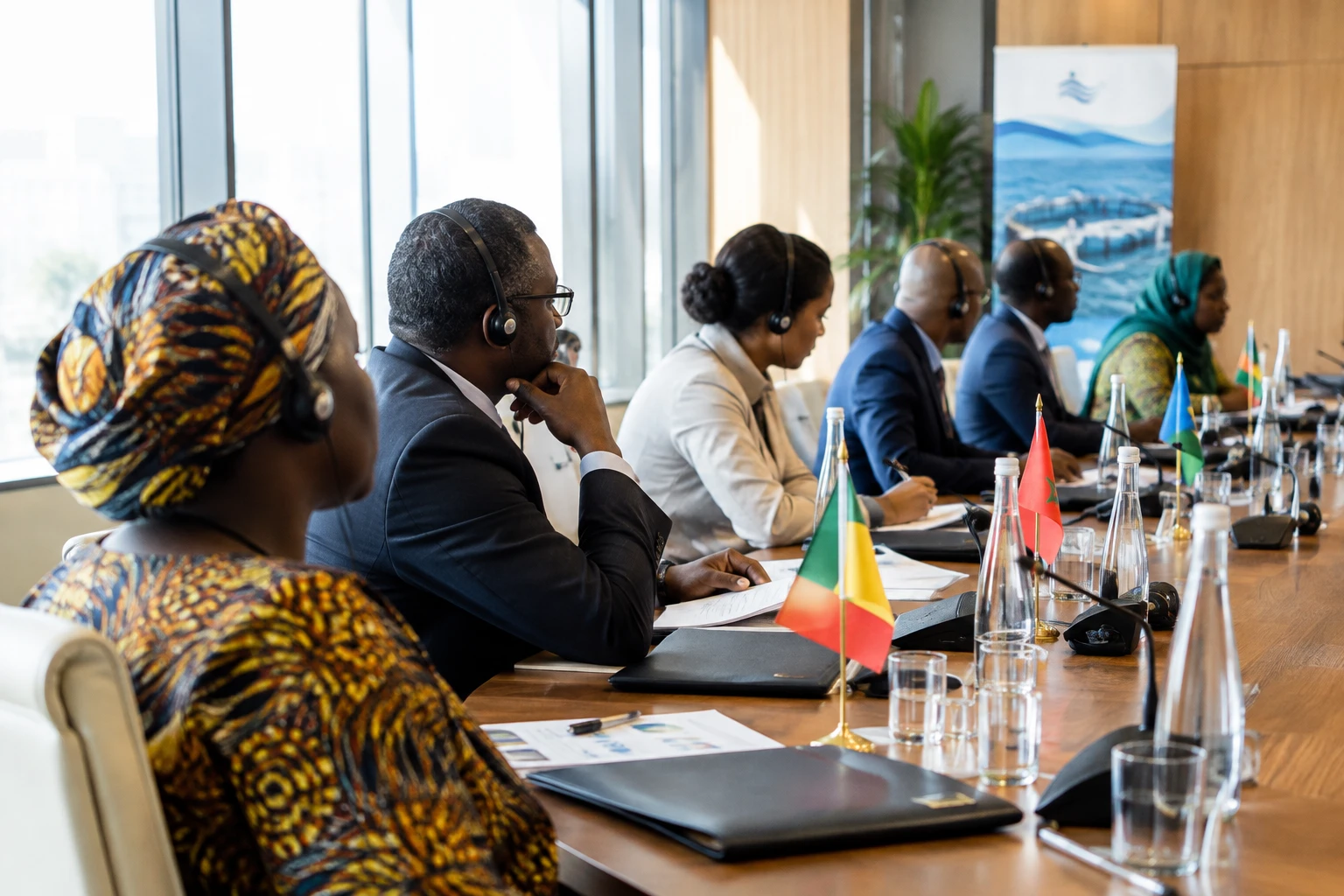
Off Sidi Ifni, four floating cages are intended to answer a practical question for Morocco: can open-sea fish farming become a sustainable activity, beyond a scientific experiment? The answer will influence the diversification of the fisheries sector and expected investment in coastal areas.
A growing sector, but capacity yet to translate into output
Capture fisheries remain the country’s main source of fishery products. Aquaculture, which includes the farming of fish, shellfish and algae, is nonetheless developing in stages. The stated potential is high, but the capacity envisaged by projects does not automatically translate into actual production.
In July 2026, the National Agency for the Development of Aquaculture (ANDA) said Morocco had 244 active aquaculture projects, representing a target capacity of close to 90,000 tonnes a year. These figures point to a growing project pipeline. They do not mean that this volume is already being produced or marketed.
The country has Atlantic and Mediterranean coastlines and a policy to develop the blue economy. But the sector must also organise access to equipment, juvenile fish and feed, as well as transport and marketing. For operators, these costs will determine whether the stated capacity can become a profitable business.
An open-sea demonstration project at Sidi Ifni
On 30 October 2026, a pilot fish farm was inaugurated at Sidi Ifni on the Atlantic coast by Ahmed El Mehdi Mezouari, Minister Delegate for Maritime Fisheries, according to several Moroccan media outlets. The National Institute for Fisheries Research (INRH) built the installation. The total investment announced is 50 million dirhams.
The farm is located about 13 kilometres from the port, on a 25-hectare concession. It comprises four floating cages, each 29 metres in diameter, designed to farm gilthead sea bream in waters 40 to 45 metres deep. Its stated capacity is 280 tonnes a year, or 70 tonnes per cage.
The project draws on trials conducted between 2021 and 2026. These examined the cages’ resistance to offshore conditions, the characteristics of the site and a complete farming cycle. INRH describes the installation as a means of gathering technical and scientific data. Its role is therefore also to reduce the uncertainties facing future investors.
The choice of the open sea distinguishes this experiment from installations in more sheltered coastal areas. The cages are more exposed to waves, currents and severe weather events. In return, currents can renew the water around the fish, and new marine areas can be assessed for farming.
Profitability remains to be proven
An annual capacity of 280 tonnes is not enough to establish the model’s viability. The costs of installation and maintenance, fish feed, logistics between the cages and the port, and the biological results of the farming operations will all need to be known. Sales conditions and consistency of production will also matter.
Large-scale equipment can increase volumes, but it requires substantial investment and the ability to operate at sea. For a private operator, a poor season or technical failure could weigh heavily on the accounts. The public-sector trial is therefore intended to generate benchmarks, without prejudging the economic returns of a larger-scale operation.
Local benefits will also depend on how the activity is organised. Sidi Ifni port could be involved in handling and supply operations. Jobs and business for service providers are possible, but they are not guaranteed by the farm’s opening. How benefits are shared among investors, workers and local stakeholders will be a practical issue if further concessions follow.
The project must also be part of careful management of the marine environment. Cage farming raises questions about water quality, waste management and fish health. Scientific monitoring of the site could help document these effects. At this stage, the available information mainly describes the pilot’s objectives and characteristics; it does not amount to a comprehensive assessment of its environmental impact.
A Moroccan test with relevance across Africa
For Morocco, the challenge is to move aquaculture from estimated potential to regular production, without confusing announced projects with achieved results. The Sidi Ifni farm could provide useful data for this transition. The next step will be to make the results of farming cycles and the conditions required for commercial operations public.
At the regional level, the experiment is of interest to Atlantic-facing countries that are also seeking to diversify their maritime activities. Morocco is a member of the African Union and the Arab Maghreb Union, a regional organisation in North Africa. The project’s continental significance, however, will depend less on its status as a pilot than on whether verifiable lessons can be shared on costs, the safety of installations and environmental effects.
Capacity figures do not yet show whether offshore fish farming will become a major branch of Morocco’s fisheries economy. They instead establish a starting point. Publication of technical and economic results, followed by possible participation from private operators, will make it possible to assess whether the Sidi Ifni trial can be replicated without placing excessive risks on investors, workers and the marine environment.



