
 Algeria
 Egypt
 Libya
 Sudan
 Tunisia
 Benin
 Burkina Faso
 Cabo Verde
 Côte d'Ivoire
 Ghana
 Guinea
 Guinea-Bissau
 Liberia
 Mali
 Mauritania
 Niger
 Nigeria
 Senegal
 Sierra Leone
 The Gambia
 Togo
 Cameroon
 Central African Republic
 Chad
 DR Congo
 Equatorial Guinea
 Gabon
 Republic of the Congo
 São Tomé and Príncipe
 Burundi
 Comoros
 Djibouti
 Eritrea
 Ethiopia
 Kenya
 Madagascar
 Malawi
 Mauritius
 Mozambique
 Rwanda
 Seychelles
 Somalia
 South Sudan
 Tanzania
 Uganda
 Angola
 Botswana
 Eswatini
 Lesotho
 Namibia
 South Africa
 Zambia
 Zimbabwe
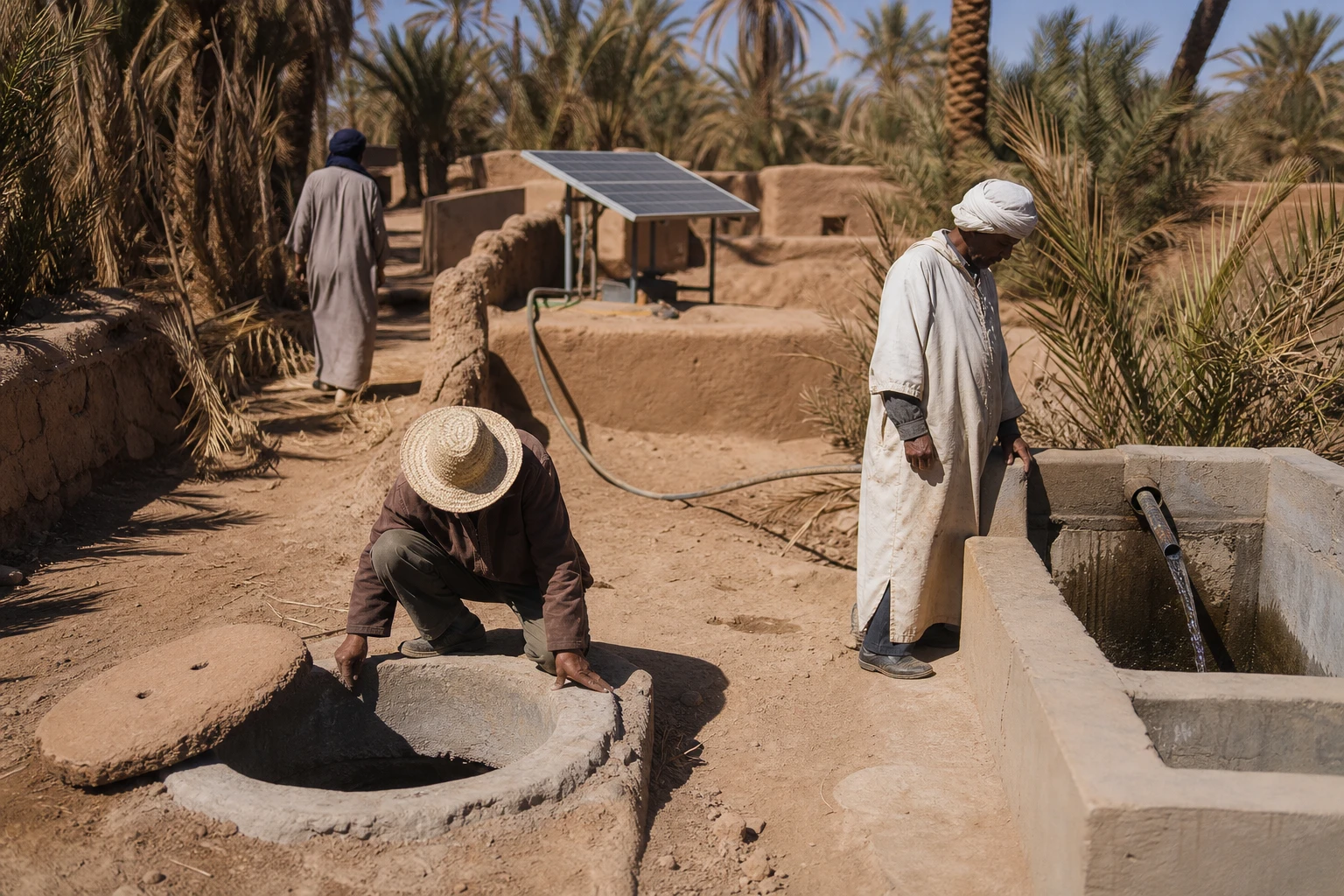
Water flowing beneath the dust
In Morocco’s oases, the challenge is not simply to bring water in. It must also be conserved, shared and conveyed without loss. This is where khettaras—hand-dug underground galleries—come into their own. They tell the story of a Moroccan way of living with aridity, without upsetting the fragile balance between cultivation, agriculture and a shared resource.
The issue goes far beyond the memory of the oases. In Morocco, pressure on water has become structural. The World Bank says the country is among the most water-poor in the world, with resources already classed as under severe water stress and the situation expected to worsen by 2030. The report also highlights the impact of excessive pumping on groundwater, a key factor in understanding the current fragility of the khettaras.
A hydraulic heritage at the heart of Morocco’s oases
Khettaras, also called khattara or rhettara depending on the region and usage, are gently sloping galleries that tap an underground aquifer or spring and carry water to the surface by gravity. UNESCO describes them as an ingenious management system adapted to oases and desert areas, where water is first and foremost a matter of collective organisation rather than engineering.
This know-how is rooted in a long history. In southern Morocco, it shaped the oases, palm groves and trade routes. In Figuig, the FAO recognised the oasis-ksour system in 2022 as a Globally Important Agricultural Heritage System. The organisation notes that khettara galleries bring water from the aquifer to the surface, after which it is distributed according to precise community rules.
Morocco has also taken more formal steps to safeguard this heritage. In 2026, UNESCO provided preparatory assistance for a nomination of khettara-related knowledge to the List of Intangible Cultural Heritage in Need of Urgent Safeguarding. The organisation cites three main threats: the depletion of underground reserves, the loss of knowledge transmission and the deterioration of the structures, exacerbated by episodes of drought and flooding.
What is threatening the system today
The leading cause of decline is well known: mechanised pumping. Boreholes and motor pumps draw water directly from aquifers, often faster than they can naturally recharge. The World Bank says groundwater withdrawals in Morocco exceed estimated renewable capacity, accelerating the drying up of traditional galleries designed for shallow aquifers.
The second factor is social. Khettaras require regular maintenance, teams, work rotations and master builders able to read the underground terrain. The FAO notes that traditional water-management systems are deteriorating in the oases of Drâa-Tafilalet as a result of climate change, demographic pressure and agricultural modernisation. The exodus of young people further weakens the transmission of knowledge.
Climate change acts as a crisis multiplier. Falling rainfall, irregular seasons and more frequent extreme events are reducing aquifer recharge. The World Bank and the FAO agree on this point: Morocco’s water security increasingly depends on careful resource management, in urban areas as well as in oasis territories.
Between living heritage and economic trade-offs
The real question, then, is not whether to choose tradition or modernity. It is which forms of modernisation strengthen the shared resource and which deplete it. In several oases, hybrid projects have emerged, combining solar pumps with khettaras or localised irrigation systems. A study indexed by the FAO describes this dilemma precisely: pump or disappear—that is, adapt the system without draining it of its collective logic.
This shift has a direct effect on local balances. For farmers, it can secure part of the harvest. For communities, it brings new costs and new rules. For those who hold this knowledge, it raises another question: if the water is still there but the practice disappears, what remains of the system? In Figuig and across southern Morocco, water management remains linked to community institutions such as the jmâa, the local assembly, and to technical figures responsible for allocating water turns.
Morocco is not alone in facing this dilemma. Across the Mediterranean and Sahel-Saharan regions, societies are seeking answers to water scarcity, falling groundwater levels and tensions between subsistence agriculture, urban growth and food security. But the khettaras offer a particularly telling case, showing how an ancient infrastructure can still inform contemporary thinking on water conservation.
What North Africa sees in this
The significance of this issue extends beyond Morocco. North Africa is entering a zone of acute water vulnerability, where states must weigh irrigation against drinking water and industrial use. The khettaras also show that an African response to the water crisis can draw on local knowledge, community institutions and a patient reading of the land. This is not a return to the past. It is a starting point for more sustainable and equitable policies.
Two developments now merit attention. On the heritage front, the nomination supported by UNESCO could raise international recognition of khettara-related knowledge. On the agricultural and hydraulic front, the continuation of rehabilitation projects in southern Morocco’s oases will show whether these galleries remain a frozen relic or a tool that still serves communities. In both cases, Morocco is walking a fine line: preserving the memory of water while reinventing its management.



