Algeria
 Egypt
 Libya
 Sudan
 Tunisia
 Benin
 Burkina Faso
 Cabo Verde
 Côte d'Ivoire
 Ghana
 Guinea
 Guinea-Bissau
 Liberia
 Mali
 Mauritania
 Niger
 Nigeria
 Senegal
 Sierra Leone
 The Gambia
 Togo
 Cameroon
 Central African Republic
 Chad
 DR Congo
 Equatorial Guinea
 Gabon
 Republic of the Congo
 São Tomé and Príncipe
 Burundi
 Comoros
 Djibouti
 Eritrea
 Ethiopia
 Kenya
 Madagascar
 Malawi
 Mauritius
 Mozambique
 Rwanda
 Seychelles
 Somalia
 South Sudan
 Tanzania
 Uganda
 Angola
 Botswana
 Eswatini
 Lesotho
 Namibia
 South Africa
 Zambia
 Zimbabwe
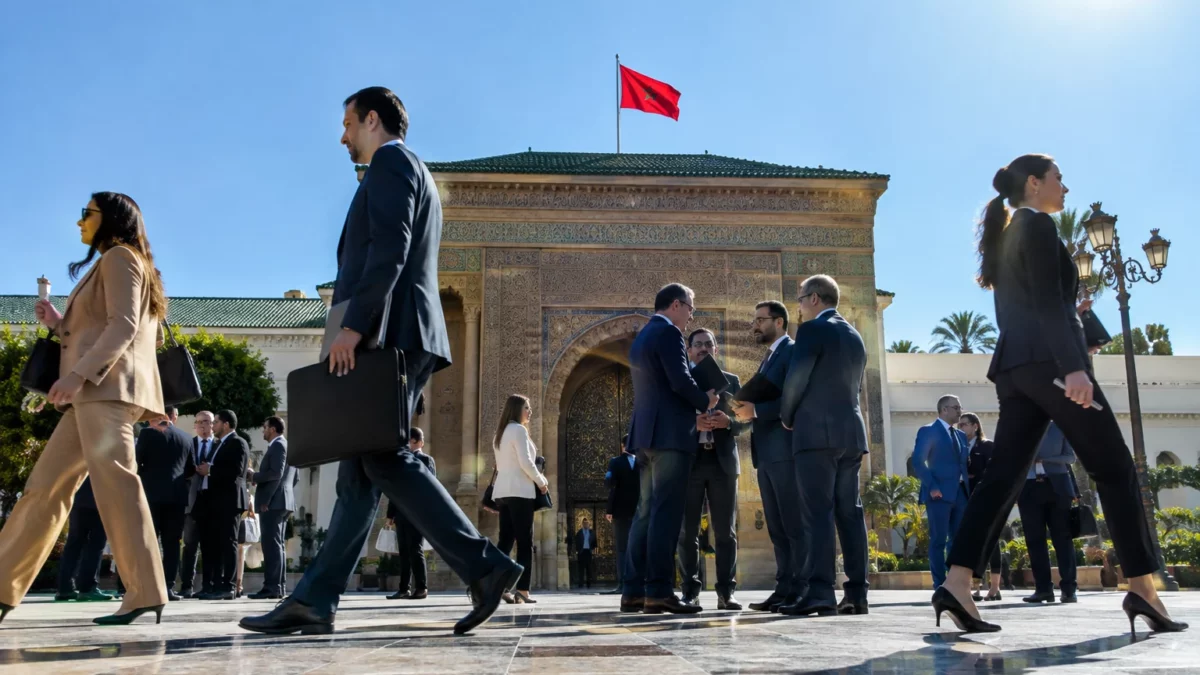
Making more defence equipment in Morocco is not just a matter of factories. It also requires capital, skills and markets. In Rabat, two agreements signed on 25 November 2026 laid the first financial foundations for a strategy with a 2035 target.
From public funding to private savings
King Mohammed VI presided over the ceremony at the Royal Palace in Rabat, in the presence of Crown Prince Moulay El Hassan. The two framework agreements are intended to support the national roadmap for the defence industry and involve businesses and financial institutions in its implementation.
The first agreement concerns funding for the strategy. The second sets out how to mobilise the private and financial sectors. Banks, public bodies, regulators, the stock market and employers’ organisations are among the signatories. The aim is to draw on several sources of funding rather than rely solely on the state budget.
Ali Seddiki, director-general of the Moroccan Agency for Investment and Export Development (AMDIE), announced that nearly 22 billion dirhams in public support had already been secured, equivalent to about $2.2 billion. This figure should not be confused with the initial 4 billion dirham allocation announced a week earlier, provided by the Hassan II Fund for Economic and Social Development. This public fund is one component of the scheme, while the 22 billion dirhams represents the overall public support announced on 25 November.
The roadmap sets three targets for 2035: meeting about 40% of the equipment needs of the Royal Armed Forces and security services, reaching annual revenues of 50 billion dirhams and generating more than 65% of those revenues from exports. It also envisages nearly 50,000 direct and indirect jobs. These figures are announced targets, not results already achieved.
An agency to coordinate ambitions
The scheme includes a strategic agency called DIFAA, an acronym for “Defense Industry Facilitation and Acceleration Agency”. Its role will be to monitor partners’ commitments and facilitate investment, support programmes and the development of a national industrial base.
The announced sectors include drones and autonomous systems, land and naval equipment, defence electronics, cyber defence and artificial intelligence. The roadmap also plans action on public procurement, industrial land, training and innovation. At this stage, the announcements set out a framework and priorities; they do not yet provide a full production timetable for each sector.
One point of context requires clarification: the initial material describes Fatima Ezzahra El Mansouri as head of government. The official statement says she attended the ceremony as a participant, but does not identify her as head of government. It also assigns operational oversight of the roadmap to Ali Seddiki, head of AMDIE.
An industrial bet, with conditions to meet
For the Moroccan authorities, the challenge is to reduce dependence on imports while building an export business. For companies, this direction could open up markets in demanding technology sectors. But the promise of jobs will depend on the ability to turn announced funding into contracts, production sites and lasting skills.
Small and medium-sized enterprises will have a crucial role. They can supply components, digital services or maintenance, but they need access to markets and financing. The presence of banks and market institutions among the signatories to the second agreement signals this intention. It does not, however, in itself guarantee that Moroccan SMEs will benefit from contracts or investment.
The challenge also lies in balancing domestic demand with exports. Procurement by the armed forces and security services can give manufacturers an initial degree of visibility. To achieve the plan’s target of more than 65% of revenue from exports, producers will then have to meet the needs of foreign buyers, comply with their technical requirements and join supply chains that are already highly competitive.
A defence strategy also raises questions of governance and transparency: how will results be measured, contracts allocated and the use of public funds monitored? Official announcements emphasise funding, industrial sovereignty and employment. The information available does not yet specify detailed arrangements for publishing results or the criteria for assessing projects.
Regional impact to be measured over time
Morocco places this initiative within a broader drive to move up the industrial value chain, with the ambition of developing technologies and expertise locally. Across North Africa, a more developed Moroccan industry could change equipment trade and industrial partnerships. But the announced export targets alone do not establish that regional markets have already been secured.
The region does not have an integrated defence market comparable to a fully operational common market. The Arab Maghreb Union (AMU), the North African regional framework, currently offers no industrial integration mechanism capable of guaranteeing such markets. The initiative’s continental reach will therefore also depend on the partnerships Morocco builds with other African countries and the rules governing those exchanges.
The next step will be practical: defining DIFAA’s governance, turning the agreements into funded projects and establishing how production, export and employment targets will be monitored. It is this implementation, more than the announced sum, that will determine Morocco’s ability to build a lasting defence industry.
The announced details are set out in the Moroccan government statement on the agreements and roadmap targets. The figures were also cross-checked against a Reuters report carried by MarketScreener, and Médias24’s analysis of the funding mechanisms.