Algeria
 Egypt
 Libya
 Sudan
 Tunisia
 Benin
 Burkina Faso
 Cabo Verde
 Côte d'Ivoire
 Ghana
 Guinea
 Guinea-Bissau
 Liberia
 Mali
 Mauritania
 Niger
 Nigeria
 Senegal
 Sierra Leone
 The Gambia
 Togo
 Cameroon
 Central African Republic
 Chad
 DR Congo
 Equatorial Guinea
 Gabon
 Republic of the Congo
 São Tomé and Príncipe
 Burundi
 Comoros
 Djibouti
 Eritrea
 Ethiopia
 Kenya
 Madagascar
 Malawi
 Mauritius
 Mozambique
 Rwanda
 Seychelles
 Somalia
 South Sudan
 Tanzania
 Uganda
 Angola
 Botswana
 Eswatini
 Lesotho
 Namibia
 South Africa
 Zambia
 Zimbabwe
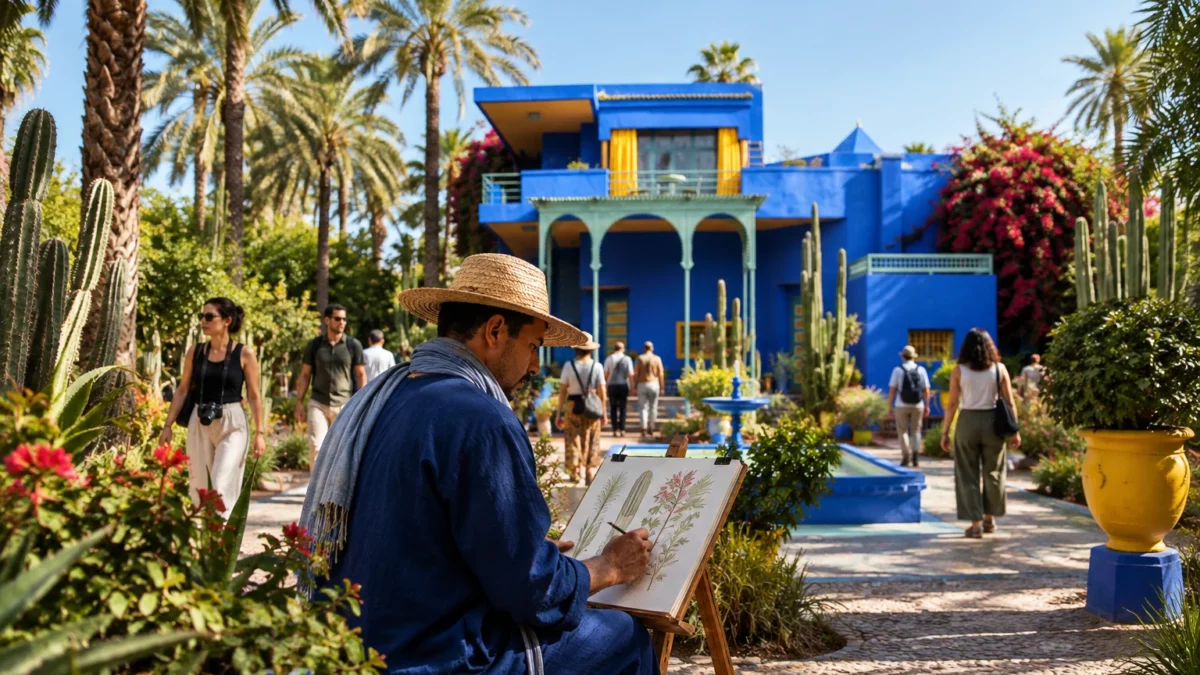
Painting a leaf without a camera means accepting its changes, its contours and sometimes its disappearance before the brush fixes them in place. In Marrakech, this attention to the living world becomes the thread running through an exhibition in which the garden is not a backdrop, but the subject itself.
Two stays, a different way of looking
Since 12 November 2026, the Yves Saint Laurent Museum Marrakech has been presenting works made by the American artist Dan McCleary during two residencies at the Jardin Majorelle. The exhibition is scheduled to run until 9 November 2027, according to the Yves Saint Laurent Museum Marrakech website. Moroccan media outlet Aujourd’hui le Maroc confirms these dates and says the works are displayed in the museum’s photography gallery.
The painter worked in the garden in spring and autumn 2026. Drawings, watercolours and oils make up a body of work devoted to its flora. The first period, in May, confronted him with a practical difficulty: in Marrakech’s heat, watercolour dried quickly. In autumn, he turned to oil painting, which demands a different pace.
His approach is based on direct observation. McCleary paints in front of the plants, without photographs, and follows their forms closely. The approach, initially precise and close to botanical illustration, gradually opens up to a more personal interpretation. This development is at the heart of the exhibition: the plant is no longer merely described, but becomes material for composition and memory.
Marrakech, between living heritage and contemporary art
The Jardin Majorelle has a distinctive artistic history. Created by the French painter Jacques Majorelle, it was acquired in 1980 by Yves Saint Laurent and Pierre Bergé. Today, the garden and museum form a cultural complex in Marrakech that brings together landscape, art and fashion history. McCleary’s exhibition extends this dialogue, but shifts the focus: here, plants take centre stage.
This shift also matters for the representation of Morocco. The garden is often photographed as an instantly recognisable image of Marrakech. Painting from life slows down this visual consumption: it invites viewers to distinguish species, textures and variations in light. It is not a general view of the city, but a situated encounter with a specific place, its plants and the practical conditions of observing them.
For McCleary, this work departs from his usual subjects. Based in Los Angeles, he is known in particular for scenes of everyday life and portraits of ordinary people. At the Jardin Majorelle, he retains his interest in observation, but changes scale and subject. This contrast gives the exhibition its distinctiveness without reducing the painter to this series alone.
A cultural significance beyond the garden
In Morocco, the exhibition is a reminder of the role Marrakech’s cultural institutions play in circulating international works and showcasing places associated with local history. It is taking place in a city that welcomes a public made up of residents, Moroccan visitors and foreign travellers. Access to art is therefore determined not only in the galleries, but also by ticket prices, opening hours, interpretation and the place given to local audiences. Practical information and visiting arrangements may change; the museum remains the point of reference for checking them.
The subject also resonates in a region where historic gardens, heritage collections and contemporary art scenes coexist, without forming a uniform cultural landscape. Morocco belongs to the Arab Maghreb Union, a regional organisation in North Africa. But the exhibition is not an intergovernmental project: its regional significance lies instead in the movement of artists, works and audiences between Maghreb cities and beyond.
The series also offers another way of talking about biodiversity. It is no substitute for scientific inventories or conservation policies. It can, however, bring into view details that escape a hurried visit and remind us that urban gardens are living spaces, maintained and transformed over time. This remains a possible interpretation, not an ecological claim attributed to the artist.
An exhibition running until November 2027
The exhibition continues until 9 November 2027, according to the museum’s schedule. Its duration gives visitors several seasons in which to discover the works and observe, in the neighbouring garden, the plants that inspired the painter. The two sites offer different experiences: one brings together interpretations on paper and canvas, while the other presents plants in their environment.
For the Moroccan cultural scene, the interest lies in this connection between a heritage site, a contemporary institution and the work of an artist from elsewhere. Marrakech does not appear here as a mere backdrop. The garden provides the conditions for creation, sets its own pace and transforms the painter’s gaze. It is this concrete encounter between place and practice that gives the exhibition its significance, far beyond simply celebrating the beauty of plants.