Algeria
 Egypt
 Libya
 Morocco
 Sudan
 Tunisia
 Benin
 Burkina Faso
 Cabo Verde
 Côte d'Ivoire
 Ghana
 Guinea
 Guinea-Bissau
 Liberia
 Mali
 Mauritania
 Niger
 Nigeria
 Senegal
 Sierra Leone
 The Gambia
 Togo
 Cameroon
 Central African Republic
 Chad
 DR Congo
 Equatorial Guinea
 Gabon
 Republic of the Congo
 São Tomé and Príncipe
 Burundi
 Comoros
 Djibouti
 Eritrea
 Ethiopia
 Kenya
 Madagascar
 Malawi
 Mauritius
 Mozambique
 Rwanda
 Seychelles
 Somalia
 South Sudan
 Tanzania
 Uganda
 Angola
 Botswana
 Eswatini
 Lesotho
 Namibia
 South Africa
 Zambia
 Zimbabwe
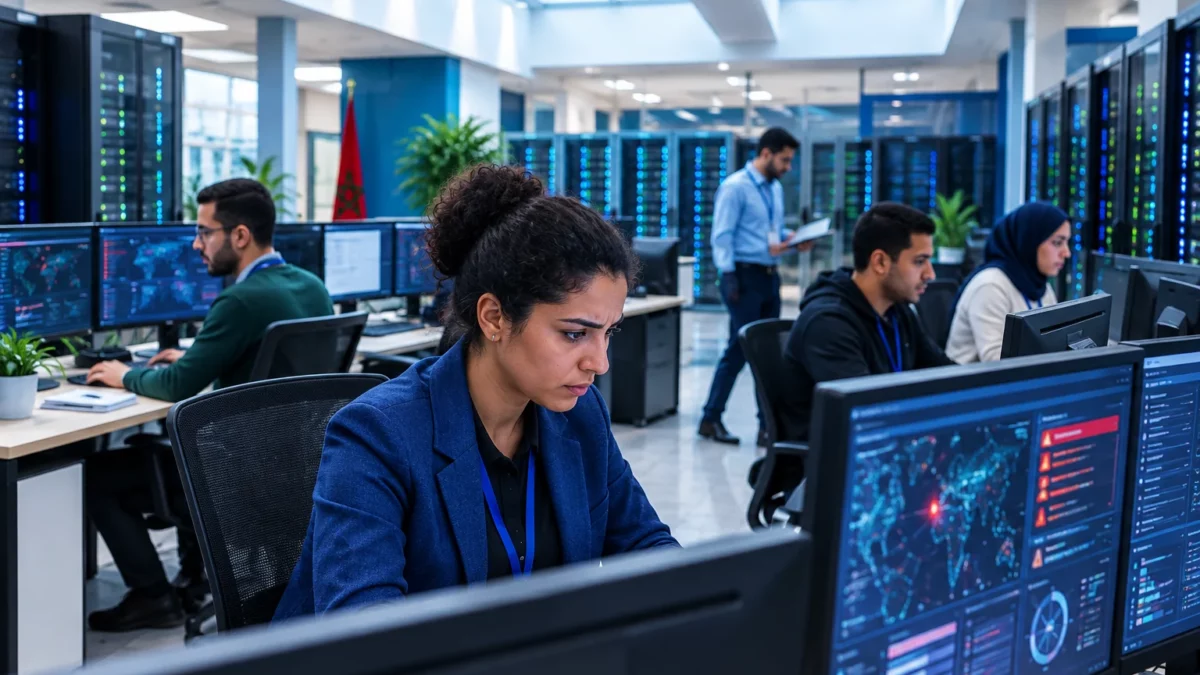
An IT outage in a government department, hospital or energy network can quickly become more than a technical problem. In Morocco, a partnership between Thales and Nucleon Security aims to combine automated detection and incident response, with data hosted locally. The question remains how the offer will meet organisations’ practical needs and fit with national ambitions for digital sovereignty.
A resilience challenge for Morocco
The kingdom has set its cybersecurity priorities through to 2030. Developed by the General Directorate for Information Systems Security (DGSSI), the national strategy notably provides for stronger governance, system resilience, skills and regional cooperation. It supports the country’s digital transformation, which is also expanding the area that needs protection: public services, businesses and connected infrastructure.
This priority comes amid a continental context in which digital threats cross borders. In its assessment published on 3 August 2026, INTERPOL says artificial intelligence is involved in 55% of reported cyber offences in Africa. This figure covers reports considered by the organisation, not all attacks on the continent. The report is based on responses from 36 African member countries.
Cooperation between states therefore remains important: an attack may target an organisation in one country while relying on infrastructure and criminal networks elsewhere. At regional level, police cooperation and information-sharing complement national capabilities. They do not, however, replace local teams or the investment needed to protect systems day to day.
What the announced offer includes
The partnership presented by the two companies combines Nucleon Security’s EDR solution with Thales’s expertise in integration, monitoring and incident response. EDR stands for “endpoint detection and response”: the system monitors computers and servers to identify suspicious behaviour and help contain a threat.
According to the description of the offer, the system can, in particular, isolate a compromised device or block a process deemed malicious. Nucleon highlights ATOM AI, which analyses usual behaviour, and Malprob, designed to detect previously unknown malicious files. These functions aim to speed up the identification of an intrusion, but their effectiveness also depends on configuration, the quality of alerts and teams’ ability to act.
Thales is to provide operational monitoring and support in the event of an incident. The target clients include government departments, businesses subject to specific security rules and critical infrastructure operators. The two partners also announce a managed cybersecurity offer, meaning a service in which monitoring and part of the response are provided by a contractor.
Hosting in a cloud located in Morocco is a central element of the proposal. The location of data can make it easier to control and meet certain sovereignty requirements. On its own, however, it is not enough to establish who controls access, encryption keys, technical operations and procedures in the event of an incident. These arrangements will need to be specified in contracts and the applicable governance rules.
Sovereignty is about more than where data is hosted
For the Moroccan authorities, the challenge is to protect essential services while continuing digitalisation. For businesses, the risk is also measured in business interruption, data loss or damage to customer trust. Smaller organisations may lack specialists able to analyse alerts around the clock. A managed service can give them access to expertise that is difficult to assemble in-house, without removing their security responsibilities.
The partnership brings together complementary profiles: a smaller technology company and a group with integration and operational capabilities. This combination could make deployment easier. It also raises practical questions: where is data processed, who can access it, which authorities may be called upon, and how do client organisations retain control of their systems? The answers vary according to the contracts and uses involved.
Another point to watch is that automation can shorten the time between detection and response, but it cannot replace human judgement. A false alert can disrupt a legitimate service; a threat that is not detected may, by contrast, persist. Organisations will therefore need to define which actions the tool can trigger on its own, which require human approval and what procedures will restore normal operations.
A reach extending beyond the Moroccan market
Nucleon Security says it has a presence in Paris and a subsidiary in Rabat, and operates in Europe and Africa. The partnership is presented as an offer initially aimed at the Moroccan market, with continental ambitions. On its own, it does not provide a uniform response to the needs of countries whose regulatory frameworks, infrastructure and specialist resources differ.
For Morocco, the test will be implementation: which organisations will adopt the service, what safeguards will govern the data, and how will detection and response times be measured? At regional level, cooperation between public and private sector players can strengthen capabilities, provided local expertise, training and governance accompany the tools. Its contribution to digital resilience will be judged against these criteria, rather than the announcement of an alliance.