Algeria
 Egypt
 Libya
 Sudan
 Tunisia
 Benin
 Burkina Faso
 Cabo Verde
 Côte d'Ivoire
 Ghana
 Guinea
 Guinea-Bissau
 Liberia
 Mali
 Mauritania
 Niger
 Nigeria
 Senegal
 Sierra Leone
 The Gambia
 Togo
 Cameroon
 Central African Republic
 Chad
 DR Congo
 Equatorial Guinea
 Gabon
 Republic of the Congo
 São Tomé and Príncipe
 Burundi
 Comoros
 Djibouti
 Eritrea
 Ethiopia
 Kenya
 Madagascar
 Malawi
 Mauritius
 Mozambique
 Rwanda
 Seychelles
 Somalia
 South Sudan
 Tanzania
 Uganda
 Angola
 Botswana
 Eswatini
 Lesotho
 Namibia
 South Africa
 Zambia
 Zimbabwe
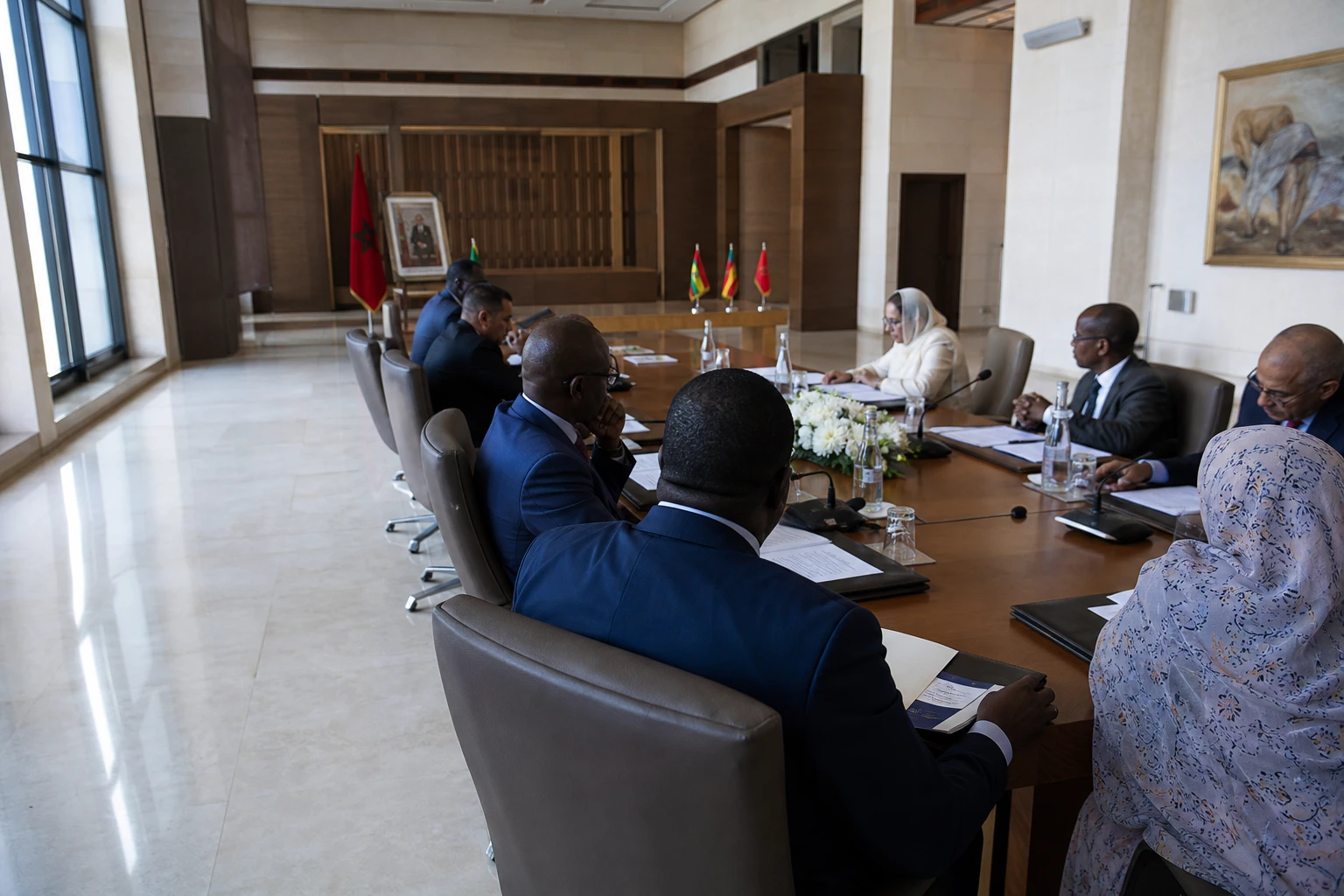
In Morocco, the 23 September 2026 general election shifted the centre of political power. The Authenticity and Modernity Party (PAM) came out on top, and its coordinator, Fatima Ezzahra El Mansouri, was then tasked with forming a government. The sequence raises a very practical question: how can an election victory be turned into a stable majority, and then into visible results in people’s daily lives?
Rebuilding a majority from Rabat
On 29 September 2026, King Mohammed VI appointed Fatima Ezzahra El Mansouri head of government and tasked her with forming a new team. The decision was announced by the official Moroccan portal. She becomes the first woman to hold the position in the kingdom.
The appointment follows the PAM’s victory in the general election. The party is said to have won 97 of the 395 seats in the House of Representatives. The National Rally of Independents (RNI) is said to have secured 66, Istiqlal 65 and the Justice and Development Party (PJD) 54. These results should be read against the electoral data published after the vote and cross-checked by several Moroccan sources.
No party therefore holds an absolute majority on its own. The threshold is 198 seats. Renewing the alliance formed in 2021 by the PAM, RNI and Istiqlal would give it 228 seats. This arithmetic secures a parliamentary majority, but does not resolve the question of political coherence.
Initial consultations have begun in Rabat. Fatima Ezzahra El Mansouri has received delegations from the RNI and Istiqlal. The PJD, back in the spotlight after its dramatic setback in 2021, remains another part of the new parliamentary landscape. Its participation in government appears uncertain. The party instead intends to establish itself as a visible opposition, with 54 MPs.
The 2021 precedent weighs on negotiations
The outgoing coalition was also based on the RNI, the PAM and Istiqlal. It enabled Aziz Akhannouch to govern with 270 seats at the start of the parliamentary term. The new balance of power is different. The PAM has gained ground and taken the lead. The RNI has lost ground. Istiqlal retains a central position, as its support can tip the balance of the majority.
The discussions are therefore not solely about the allocation of ministerial portfolios. They also concern the government programme. The incoming executive will have to set out its priorities on jobs, social protection, purchasing power, access to healthcare and water management. These issues go beyond rivalries between parties. Above all, they determine the new majority’s credibility with voters.
Low turnout is another signal. Turnout in the 23 September election is reported at 38%. This figure alone cannot explain the reasons for abstention. It does, however, show that the PAM’s victory cannot be equated with mass support for its programme. The government will therefore face an additional demand: to reconnect with citizens who no longer go to the polls.
Jobs and the cost of living as first tests
The new team will quickly be judged on the real economy. Morocco is pursuing major projects in infrastructure, industry, renewable energy, logistics and water desalination. But investment does not automatically create jobs accessible to young people, women and graduates.
Data available before the election pointed to a mixed picture. The country was creating jobs while maintaining high unemployment among 15- to 24-year-olds. Underemployment also affected a significant proportion of the workforce. The challenge is therefore less about announcing new projects than measuring their impact on incomes, skills and regions.
The disparities between Casablanca, Rabat, Tangier and Marrakech and rural areas are considerable. Major urban centres concentrate investment and services. More remote regions depend more heavily on agriculture, the informal economy and family transfers. A credible national employment policy will have to take these differences into account.
Prices will also come under pressure. Households are closely watching the cost of food, transport, housing and energy. Small businesses, meanwhile, are looking for better access to finance and simpler procedures. The coalition will have to balance continued public investment against immediate support for purchasing power.
Room for manoeuvre within a defined institutional framework
The 2011 Constitution strengthens the powers of the head of government. The office-holder directs the work of the executive and chairs the Government Council. However, the king chairs the Council of Ministers, where the state’s main strategic directions are considered. This framework makes it necessary to distinguish the day-to-day direction of government from sovereign decisions that fall to the monarchy.
Fatima Ezzahra El Mansouri already knows how the executive works. She has served as minister for territorial planning and urban development, as well as mayor of Marrakech. Her experience may help with the implementation of urban and housing policies. She will nevertheless have to demonstrate that she can arbitrate between the interests of political parties, the administration and economic operators.
Public procurement transparency will be closely watched. Strengthening the Competition Council, small and medium-sized enterprises’ access to contracts, taxation and the prevention of conflicts of interest are among the sensitive issues. The head of government will have to strike a balance between economic appeal, public oversight and equal access.
The new team’s first draft budget will offer an important indication of its approach. It will show whether election promises are translated into funding, timetables and oversight mechanisms. A coalition can be solid on paper and remain fragile in execution.
A change watched beyond Morocco’s borders
The political transition is unfolding in a particular regional context. Morocco is not part of an economic organisation in the Maghreb as integrated as ECOWAS in West Africa or SADC in Southern Africa. The Arab Maghreb Union remains largely inactive, while regional relations continue to be marked by diplomatic disagreements and competing economic interests.
In this environment, Rabat is seeking to strengthen its African partnerships. Moroccan investment in banking, telecommunications, insurance, agriculture and infrastructure gives domestic policy a continental reach. The next government’s stability will therefore also affect the continuity of these commitments and the kingdom’s ability to advance its priorities within the African Union.
Forming the coalition is now the immediate priority. The role given to the RNI, Istiqlal’s influence, the PJD’s stance and the content of the shared programme will all need to be watched. In Morocco, the success of this new phase will not be measured solely by the number of seats brought together. Above all, it will depend on the government’s ability to restore trust, create jobs and make major economic choices clearer to the public.