Algeria
 Egypt
 Libya
 Sudan
 Tunisia
 Benin
 Burkina Faso
 Cabo Verde
 Côte d'Ivoire
 Ghana
 Guinea
 Guinea-Bissau
 Liberia
 Mali
 Mauritania
 Niger
 Nigeria
 Senegal
 Sierra Leone
 The Gambia
 Togo
 Cameroon
 Central African Republic
 Chad
 DR Congo
 Equatorial Guinea
 Gabon
 Republic of the Congo
 São Tomé and Príncipe
 Burundi
 Comoros
 Djibouti
 Eritrea
 Ethiopia
 Kenya
 Madagascar
 Malawi
 Mauritius
 Mozambique
 Rwanda
 Seychelles
 Somalia
 South Sudan
 Tanzania
 Uganda
 Angola
 Botswana
 Eswatini
 Lesotho
 Namibia
 South Africa
 Zambia
 Zimbabwe
A vote that primarily tested Moroccans’ patience
In Morocco, elections do more than distribute seats. They also show whether voters still believe the ballot can speed up change, in a country where demand for jobs, public services and social justice remains strong. In 2021, this question weighed heavily in Rabat, as well as in medium-sized cities and rural areas, where access to opportunities remains unequal. The campaign unfolded amid reservations, with visible fatigue after the pandemic and high expectations surrounding the new development model presented a few months earlier.
This context was significant. The Kingdom of Morocco remains a constitutional monarchy in which the House of Representatives plays an important role in forming the government and debating reforms. The legislative elections of 8 September 2021 were held at the same time as the municipal and regional elections, a first in the country’s political history. The move was also intended to make the institutional calendar clearer, as the executive was expected to turn accumulated social and economic promises into concrete measures.
Electoral reforms designed to broaden representation
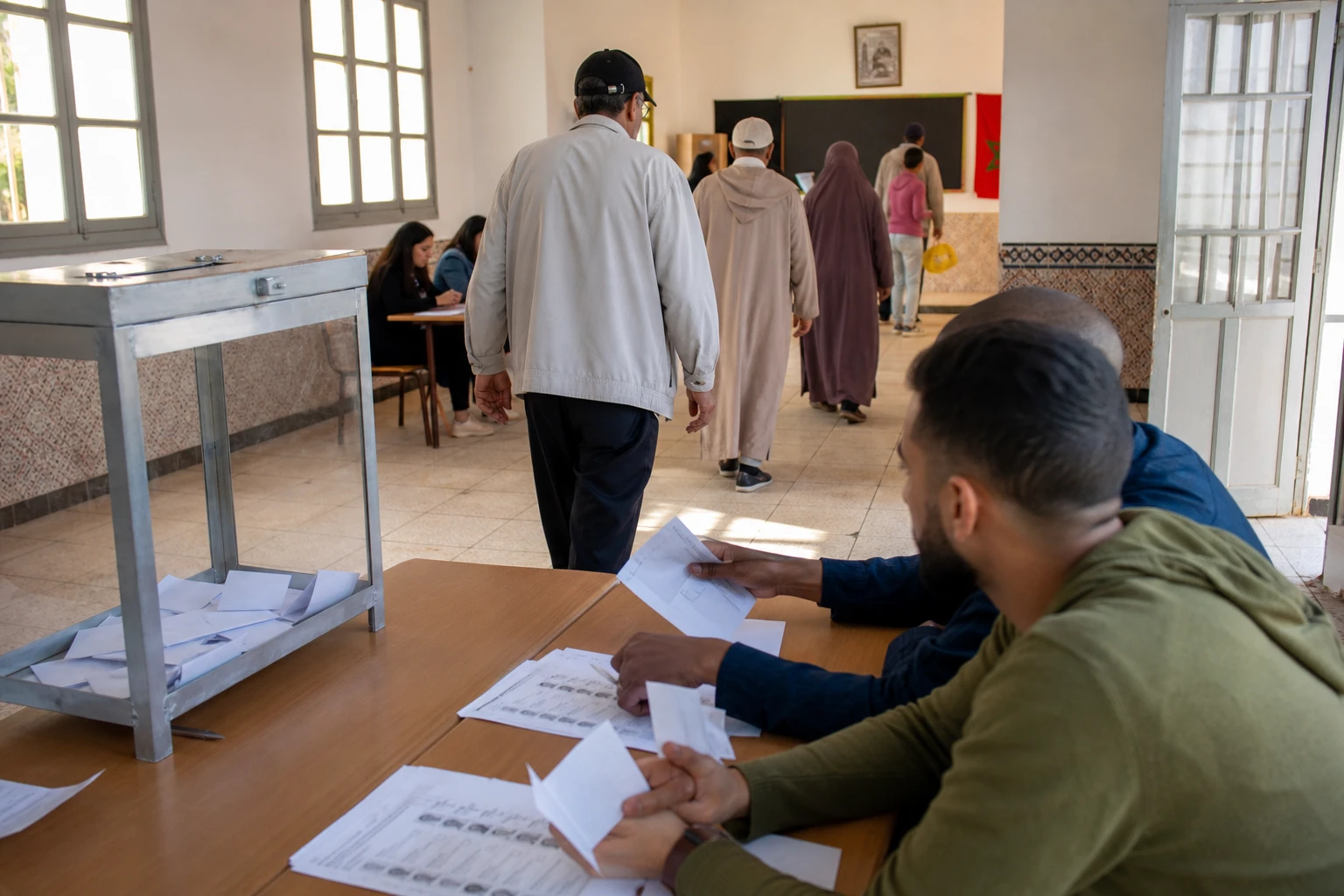
The 2021 vote differed from that of 2016. Electoral law had changed, notably with a new method for calculating the electoral quotient, and mechanisms intended to improve the representation of women and young people. The National Human Rights Council noted that the elections were held under a revised legal framework, with three polls organised on the same day and new provisions for women’s participation in elected bodies.
Before the vote, the High Commission for Planning estimated that nearly 25.226 million Moroccans were of voting age. Of these, 17.509 million were registered on the electoral rolls as of 31 July 2021, a registration rate of 69.4%. The same document showed a significant difference between rural and urban areas, as well as between men and women. These disparities say a great deal about the civic divide that still runs through the country. Voting does not everywhere reflect the same relationship with the state, or the same access to political networks.
Women were also at the heart of the institutional adjustments. The IPU says that 90 women were elected to the House of Representatives in 2021, or 22.8% of seats. This is real progress, but still limited given the place of Moroccan women in society and the economy. Figures from the HCP and the World Bank also show that women’s participation in the labour market remains low, at around 19% according to a recent HCP estimate, weighing on their presence in public life and their political influence.
The September vote confirmed the political shift
On 8 September 2021, final turnout reached 50.18%, according to the Interior Ministry, as reported by MAP and picked up by several media outlets. This was higher than in 2016, but did not signal mass enthusiasm. Rather, it showed that a significant part of the electorate wanted to have a say at a moment seen as decisive, without erasing the distance that had grown between some citizens and their parties.
The political verdict was clear. Based on official results, the IPU attributed 102 seats to the National Rally of Independents, 87 to the Authenticity and Modernity Party, 81 to the Istiqlal Party and just 13 to the Justice and Development Party, which had been in power since 2011. Reuters had already summed up the PJD’s spectacular collapse, leaving it far behind the leading parties. The shift was interpreted as a rebuke to a decade of unfulfilled promises, but also as proof that a change of government remained possible without an institutional rupture.
This shift did more than change the balance between parties. It also transferred expectations to the new majority, which was called on to turn the priorities of the new development model into visible public policies. In practice, this meant responding on education, health, employment and transport, the issues most frequently raised in opinion polls and public debate. In spring 2021, the World Bank noted that around 30% of 15- to 24-year-olds were not in employment, education or training, an indicator that helps explain young voters’ frustration.
What the frustrations say about Morocco in 2021
Electoral frustration does not come out of nowhere. It is rooted in an economy that rebounded after the shock of 2020, but where job creation remains too slow. The World Bank said that Morocco’s GDP grew by 7.4% in 2021 after contracting by 6.3% in 2020, while stressing that this recovery did not erase either the ground lost against the pre-crisis trajectory or structural vulnerabilities. The same institution also noted that inflation remained contained on average in 2021, before rising later under the impact of imported pressures.
For city dwellers, the central issues are often wages, housing and public services. For people in the provinces, they also include access to roads, healthcare and local administration. HCP data show that potential voters were mostly urban, but that registration on the electoral rolls was higher in rural areas. This contrast highlights a simple reality: in Morocco, political participation cannot be understood solely through the national turnout rate, but also through very different geographies of consent and expectation.
The CNDH, for its part, flagged several concerns during the campaign, including cases of verbal and physical violence, discrimination against women, allegations of the use of money and in-kind donations, and difficulties encountered by observers. The institution did not conclude that transparency had broken down across the board, but it described an imperfect electoral landscape, where democratic competition remains affected by contested practices.
A Moroccan election with significance beyond Rabat
The continental significance of this vote goes beyond the Moroccan case alone. The Kingdom of Morocco occupies a distinctive position in North Africa, at the intersection of debates on governance, women’s representation, welfare-state reform and the relationship between institutional stability and political renewal. The question is therefore not only which party governs, but whether the system can produce credible responses to the crisis of confidence.
For the region, this vote was also a test. It showed that a country can hold three elections on the same day, increase women’s representation and maintain strong turnout, while still being beset by deep social frustrations. This signal was observed well beyond North Africa, at a time when several African societies are seeking to reconcile electoral legitimacy, public-sector effectiveness and inclusion. In Morocco, what followed depended on the future government’s ability to turn electoral victory into tangible results, before civic patience wore away further.