Algeria
 Egypt
 Libya
 Morocco
 Sudan
 Tunisia
 Benin
 Burkina Faso
 Cabo Verde
 Côte d'Ivoire
 Ghana
 Guinea
 Guinea-Bissau
 Liberia
 Mali
 Niger
 Nigeria
 Senegal
 Sierra Leone
 The Gambia
 Togo
 Cameroon
 Central African Republic
 Chad
 DR Congo
 Equatorial Guinea
 Gabon
 Republic of the Congo
 São Tomé and Príncipe
 Burundi
 Comoros
 Djibouti
 Eritrea
 Ethiopia
 Kenya
 Madagascar
 Malawi
 Mauritius
 Mozambique
 Rwanda
 Seychelles
 Somalia
 South Sudan
 Tanzania
 Uganda
 Angola
 Botswana
 Eswatini
 Lesotho
 Namibia
 South Africa
 Zambia
 Zimbabwe
In Nouakchott, a dish says more than a menu
In the Mauritanian capital, a dish of semolina can tell a story of family, trade and transmission. Ngomu, the local name for couscous, is more than what arrives on the plate: it links home cooking, neighbourhood markets and a culinary identity that Mauritania is now asserting internationally.
This role is no minor matter. In a country where food practices bear the imprint of the Maghreb, the Sahel and regional exchanges, Mauritanian couscous moves between homes, ceremonies and commercial activities. The National Tourism Office presents it as a distinctive speciality alongside other local dishes, while UNESCO notes that couscous is part of a body of skills shared by Algeria, Morocco, Mauritania and Tunisia.
A recognised heritage, but one that still needs structure
The turning point came in 2020, when the knowledge, skills and practices associated with the production and consumption of couscous were inscribed on the Representative List of the Intangible Cultural Heritage of Humanity. UNESCO stresses one essential point: this heritage is not merely culinary; it involves techniques, tools, producers, craftspeople and, above all, women, who play a major role in passing on these practices.
In Mauritania, this recognition has particular resonance. The country already has a broader tourism and heritage framework, with listed historic sites and a policy of promoting living traditions. The link between cuisine and heritage is therefore not just decorative. It is part of an approach involving recognition, training and the telling of a national story.
The Mauritanian state opened a school of tourism and hospitality in Nouakchott in 2021. The Ministry of Trade, Industry and Tourism sees it as a way to train young people for careers in cooking, hospitality and services. The same official text says a partnership with Senegal had previously enabled 600 young Mauritanians to receive training over six months.
Ngomu, between home cooking and the neighbourhood economy
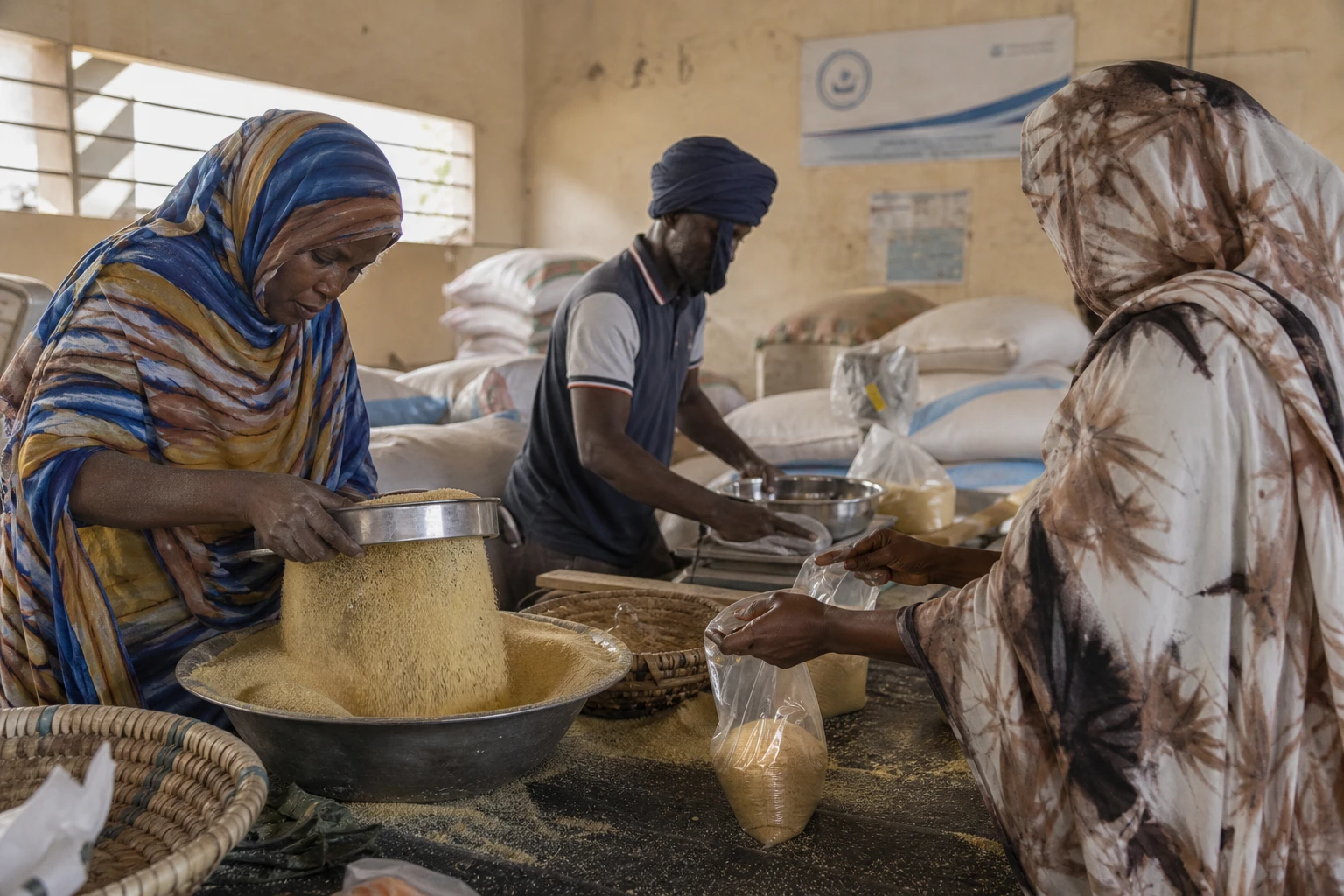
Ngomu remains, first and foremost, a precise craft. The semolina must be sifted, moistened, rolled by hand and then steamed. The meat is prepared separately with spices and vegetables before everything is brought together. This slowness is no minor detail. It gives the dish its social value: the time spent preparing it matters as much as the meal served.
This cuisine also rests on a modest but real economy. As far back as the 2000s, UNCTAD documented the existence of a Mauritanian couscous industry, including FAMO, which was already exporting to Senegal, Mali and Gambia because its capacity exceeded the needs of the local market. This precedent shows that Mauritanian couscous is not merely a domestic symbol: it can also become a commercial product for the subregion.
In the streets of Nouakchott, this commercial dimension takes a quieter form. Women prepare and sell portions or dried couscous, to be transported to other cities or to families living abroad. The Tourism Office also notes that several types of couscous are eaten in Mauritania, made from wheat, barley or millet, and served with meat, vegetables or milk. This says much about how the dish adapts to local resources and household preferences.
What this dish reveals about Mauritania and the region
Ngomu first shows that cultural sovereignty is not confined to archives or museums. It also takes shape in kitchens, markets, vocational schools and the networks through which knowledge is passed on. For Mauritanians, the question is not just how to protect a recipe. It is about documenting practices, supporting the women who teach them and making this knowledge visible in a tourism economy that is still taking shape.
For the women who often sustain this production chain, the stakes are tangible. They preserve the memory of the technique, ensure the quality of the product and, very often, deal directly with customers. For young people trained in hospitality and cooking, couscous can become a profession, not just an inheritance. And for families, it remains a dish served to guests, especially at weddings and major events.
At regional level, Mauritania is part of a broader movement to promote food heritage across North and West Africa. Couscous, shared with Algeria, Morocco and Tunisia, is a reminder that some traditions cross today’s borders without losing their local roots. In this region, cultural cooperation can also support tourism, small food businesses and grain supply chains.
The future will depend on three things: Mauritania’s ability to train more professionals, protect the product’s authenticity without freezing it in time, and turn a culinary symbol into a sustainable economic resource. In a country where Nouakchott concentrates movement, markets and institutions, ngomu ultimately makes a simple point: living heritage exists only if it is still cooked every day, and if there are hands to pass it on.