Algeria
 Egypt
 Libya
 Morocco
 Sudan
 Tunisia
 Benin
 Burkina Faso
 Cabo Verde
 Côte d'Ivoire
 Ghana
 Guinea
 Guinea-Bissau
 Liberia
 Mali
 Niger
 Nigeria
 Senegal
 Sierra Leone
 The Gambia
 Togo
 Cameroon
 Central African Republic
 Chad
 DR Congo
 Equatorial Guinea
 Gabon
 Republic of the Congo
 São Tomé and Príncipe
 Burundi
 Comoros
 Djibouti
 Eritrea
 Ethiopia
 Kenya
 Madagascar
 Malawi
 Mauritius
 Mozambique
 Rwanda
 Seychelles
 Somalia
 South Sudan
 Tanzania
 Uganda
 Angola
 Botswana
 Eswatini
 Lesotho
 Namibia
 South Africa
 Zambia
 Zimbabwe
A country on the margins of tourist maps, but at the heart of a living Saharan region
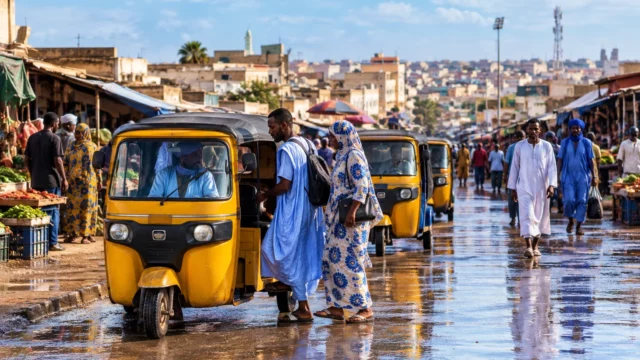
Mauritania is more than a desert to cross. It is a country where mobility, trade, faith, fishing and scholarly heritage have been intertwined for centuries. In Nouakchott, the capital, urbanisation is advancing across a territory still largely shaped by sand, tracks and long distances. The country now has more than 5.3 million inhabitants, according to the latest World Bank estimates, and remains one of the continent’s least densely populated countries.
In the outside world’s imagination, Mauritania is often reduced to its geography. Yet that geography says much about its economy and social dynamics. The Atlantic coast, the inner Sahara, the old caravan cities and pastoral areas still structure daily life. The country is a member of the African Union and is also part of the Arab Maghreb Union, a position that places it at the junction of West Africa, the Saharan world and the Maghreb.
From desert cities to Nouadhibou’s quays, a heritage that remains inhabited
Mauritania cannot be reduced to a postcard image. The ancient ksour of Ouadane, Chinguetti, Tichitt and Oualata have been UNESCO World Heritage sites since 1996. The organisation describes them as exceptional examples of towns built to serve the Sahara’s trade routes, rather than as frozen relics. In other words, these places arose from the movement of people, goods and ideas.
This reality still matters. In Oualata and Chinguetti, ancient manuscripts have often survived thanks to the families who kept them in their homes. UNESCO continues to monitor the state of conservation of these sites and support their protection. The risk is not just the wear and tear of time. It is also demographic: when young people leave for Nouakchott or the coastal cities, maintaining earthen houses becomes more difficult.
On the coast, Nouadhibou tells another side of the country. The Banc d’Arguin, a UNESCO-listed site, is described as an area of exceptional biodiversity, sustained by the permanent upwelling off Cape Blanc, where nutrient-rich deep waters rise to the surface. This process supports fishing and explains the area’s strategic importance for Mauritanians. Yet the resource is fragile, as UNESCO also highlights the pressures of fishing, marine pollution and climate change.
What Mauritania’s security situation really says
The security picture is more nuanced than the clichés about the Sahel. Mauritania has recorded no terrorist attacks in the recent data from the Global Terrorism Index, which gives it a score of 0 in 2025. This does not mean there is no vulnerability at all, but it shows that a Sahelian state can contain the threat over the long term when borders, intelligence and territorial surveillance are treated as national priorities.
This relative stability has a direct effect on daily life. It supports domestic travel, commercial exchanges and families’ journeys between cities and pastoral areas. It also protects the main routes to the east, such as the Road of Hope, which links Nouakchott to the most remote regions. But security does not remove the constraints: distances remain enormous, transport is slow, and reaching some historic towns still requires patience, connections and resources.
Tourism, meanwhile, remains a niche sector. The country attracts few international visitors compared with its neighbours, not for lack of attractions, but because infrastructure remains limited and travellers’ imaginations turn elsewhere. Yet the aim is not to chase mass tourism. It is to turn a scattered heritage into a local economy without disrupting the social balance of the old towns or the simplicity of the oases. This tension between promotion and preservation is at the heart of the Mauritanian story.
An African perspective on a country linking the Sahara, Sahel and Atlantic
Mauritania matters in the African conversation for a simple reason: it connects several worlds. It links the Atlantic and the desert. It connects scholarly cities and ports. Through its diplomatic positions, it also bridges the logic of the African Union and that of the Maghreb. On a continent where inherited borders have often divided long-established corridors of movement, a country of this kind reminds us that African integration is built not only at summits, but also along roads, through ports and at places of memory.
This is what sets Mauritania apart. It is neither a mere Saharan periphery nor a travel backdrop. It is a place where resilience can be read in earthen architecture, in Atlantic-Saharan fishing, in the continued use of caravans reinvented for the road, and in a country’s ability to remain legible despite its vastness. This blend of simplicity, historical continuity and adaptation gives Mauritania its distinctive place in Africa today.