Algeria
 Egypt
 Libya
 Morocco
 Sudan
 Tunisia
 Benin
 Burkina Faso
 Cabo Verde
 Côte d'Ivoire
 Ghana
 Guinea
 Guinea-Bissau
 Liberia
 Mali
 Niger
 Nigeria
 Senegal
 Sierra Leone
 The Gambia
 Togo
 Cameroon
 Central African Republic
 Chad
 DR Congo
 Equatorial Guinea
 Gabon
 Republic of the Congo
 São Tomé and Príncipe
 Burundi
 Comoros
 Djibouti
 Eritrea
 Ethiopia
 Kenya
 Madagascar
 Malawi
 Mauritius
 Mozambique
 Rwanda
 Seychelles
 Somalia
 South Sudan
 Tanzania
 Uganda
 Angola
 Botswana
 Eswatini
 Lesotho
 Namibia
 South Africa
 Zambia
 Zimbabwe
In Nouakchott, family digital life becomes a public issue
In many Mauritanian households, the smartphone has taken on a role few would have imagined five years ago. In Nouakchott, the discussion is no longer only about screen time. It now concerns the protection of minors, parental authority and freedom of expression. The debate is serious because it is unfolding in a country where digital technology is advancing rapidly, but safeguards remain uneven.
The issue also has a regional dimension. Mauritania is not part of ECOWAS, but it belongs to the West African region and the Arab Maghreb Union. In both spaces, states are seeking to reconcile connectivity, child protection and control of online abuse. The issue therefore extends beyond Mauritania alone. It says something about an Africa digitising its young people faster than it is developing protective rules.
What the Council of Ministers put on the table
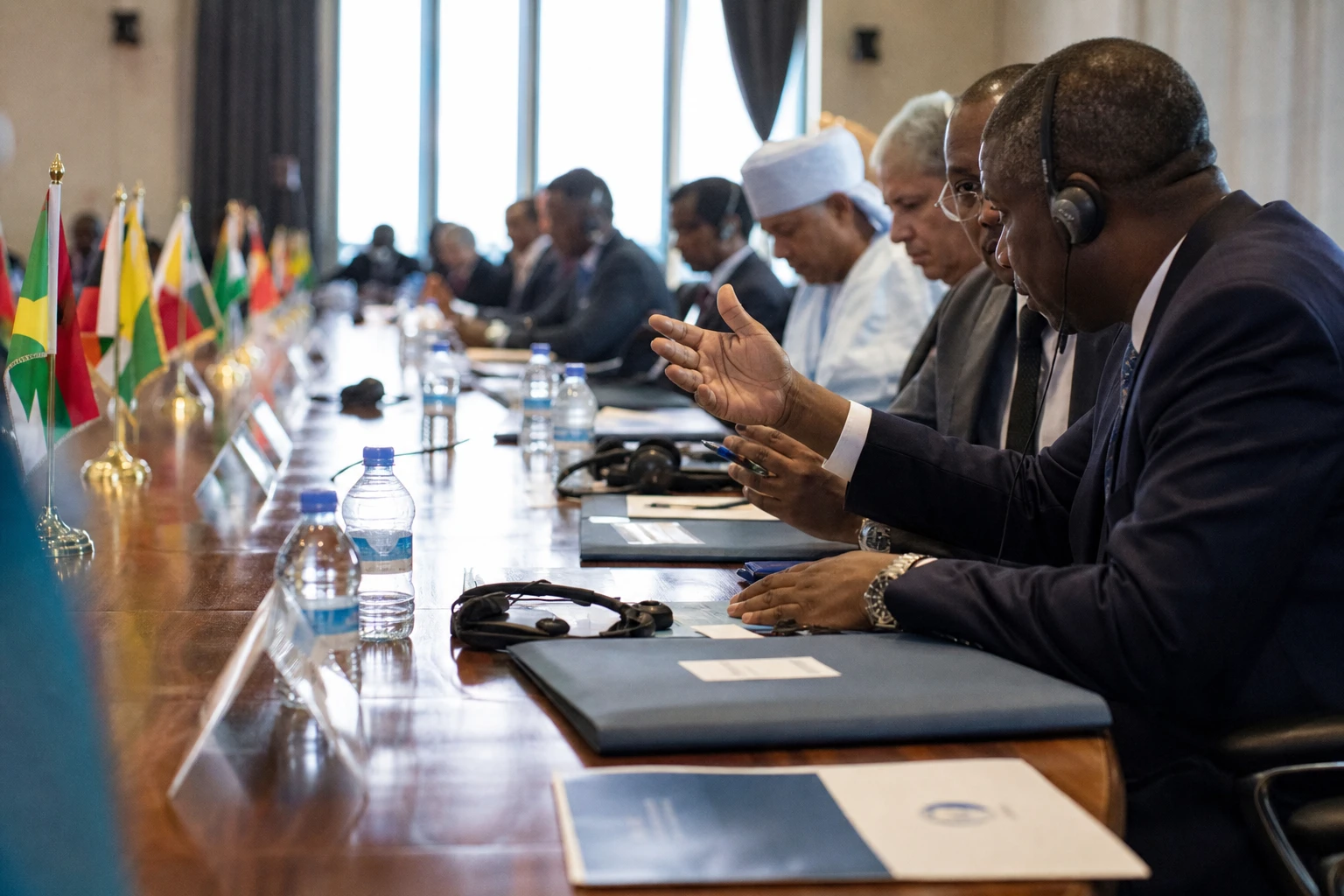
On Wednesday 16 September, the Council of Ministers meeting in Nouakchott considered a communication on protection from the harmful effects of the digital space. The government wants to establish a national framework to regulate minors’ access to social platforms. The stated aim is to better regulate access for under-16s, through technical and legal mechanisms. The proposal also refers to other safeguards: limiting content targeting minors, regulating targeted advertising, blocking messages from strangers, and disabling certain tools considered too intrusive for teenagers.
According to the authorities, the initiative was prepared by several departments, including the ministries responsible for youth, digital transformation and social action. An interministerial commission is to propose a framework bill. It includes, among others, the national population registry agency, the personal data protection authority and services involved in digital civil registration. In other words, the executive is not talking only about awareness-raising. It is also preparing an administrative and technical system.
The government links this initiative to another undertaking: an impending ban on gambling and online betting for minors, presented as a logical extension of its protection policy. Here too, the issue is not only moral. It is also financial, since betting platforms and some social networks rely on mechanisms for capturing attention that specifically target young people.
Between protection and freedom, a delicate balance
The proposal already has supporters. Several voices in favour say the risks are very real: cyberbullying, inappropriate content, sexual solicitation, screen addiction and the commercial exploitation of children’s data. These dangers are documented beyond Mauritania. UNICEF notes that digital environments expose children to various forms of violence, manipulation and abuse, while recent studies have highlighted the scale of online harm in several countries.
But some Mauritanian observers are just as clearly sceptical. They fear that an overly broad restriction could produce the opposite of the intended effect. In Mauritania, social networks serve as channels for information, expression and mobilisation. They carry local news, political debate, neighbourhood initiatives and the work of many content creators. Critics argue that severely restricting minors’ access could therefore also affect their civic learning and ability to stay informed.
The dilemma is a familiar one, but it is more sensitive in a country where digital regulation has already been used for coercive purposes. Amnesty International notes that in 2023 the Mauritanian authorities shut down mobile internet for several days, and that other restrictions have targeted the digital public sphere. This precedent has made defenders of freedoms cautious. They are calling for child protection not to become a pretext for restricting legitimate uses or expanding excessive surveillance.
Cybersecurity specialists take a more nuanced view. Protection does not necessarily mean prohibition. Regulation can take the form of digital education, training for parents, platform accountability and simple parental-control tools. This approach echoes UNICEF’s recommendations, which emphasise raising adults’ awareness and adopting safety policies suited to children’s actual online habits.
What this debate reveals about Mauritania today
This latest development sheds light on a broader reality. Mauritania is accelerating its digital transformation. Its strategic documents refer to expanding broadband, digital public services, cybersecurity and digital education. The country has also launched initiatives on IPv6, digital inclusion and administrative modernisation. In this context, the question is not only about social media. It is about a state seeking to manage a technological shift without leaving families alone to face the risks.
UN and World Bank data show that internet use in Mauritania remains below the global average, but is growing. This means that every new rule will have a tangible effect on a young population with unequal access to connectivity across regions and income groups. In Nouakchott, the issue affects urban families already heavily exposed to platforms. In the regions, it also points to unequal access to digital education tools.
The continental significance is clear. Across Africa, governments are seeking a balance between protecting minors, digital sovereignty and respect for civil liberties. Mauritania is thus joining a broader conversation, already visible in several African and European capitals: should access be blocked, limited or subject to age verification, or should the design of platforms themselves be regulated instead? Nouakchott’s response will say much about the approach it chooses in the coming months, but also about the role it intends to give families, schools and young people themselves in this regulation.