
 Algeria
 Egypt
 Libya
 Morocco
 Sudan
 Tunisia
 Benin
 Burkina Faso
 Cabo Verde
 Côte d'Ivoire
 Ghana
 Guinea
 Guinea-Bissau
 Liberia
 Mali
 Mauritania
 Niger
 Nigeria
 Senegal
 Sierra Leone
 The Gambia
 Togo
 Cameroon
 Central African Republic
 Chad
 Equatorial Guinea
 Gabon
 Republic of the Congo
 São Tomé and Príncipe
 Burundi
 Comoros
 Djibouti
 Eritrea
 Ethiopia
 Kenya
 Madagascar
 Malawi
 Mauritius
 Mozambique
 Rwanda
 Seychelles
 Somalia
 South Sudan
 Tanzania
 Uganda
 Angola
 Botswana
 Eswatini
 Lesotho
 Namibia
 South Africa
 Zambia
 Zimbabwe
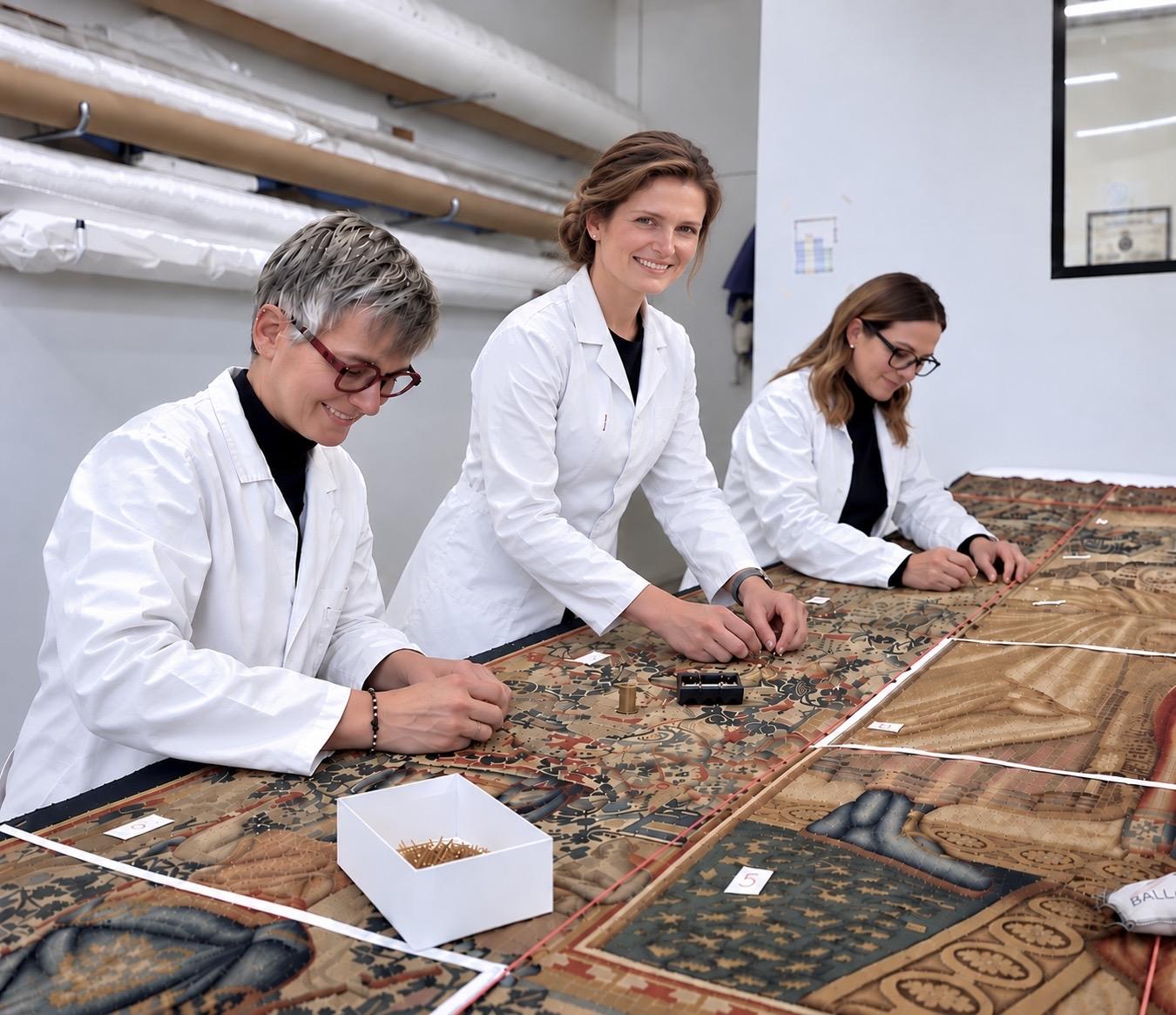
There is something profoundly European about Martina Galli. Born in Italy and a graduate in the conservation of cultural heritage from Urbino, she spent time in Belgium before choosing France after her studies, where she specialised in a field that is both discreet and demanding: the conservation and restoration of textiles. Tapestries, clothes, rugs, decorative pieces, ethnographic works: behind every fibre, she seeks not so much to erase the passage of time as to help the object withstand it.
Her name came to prominence with the Notre-Dame project. Between September and December 2024, her team restored the textiles in the cathedral’s treasury, including the spectacular coronation mantle of Napoleon I and the fragile tunic of Saint Louis. In 2025, this work earned her the title of Chevalier of the Order of Arts and Letters, a distinction awarded by Culture Minister Rachida Dati.
But her work also touches on a more contemporary memory. Galli Heritage was entrusted with restoring 27 items of clothing that belonged to Jean Moulin: coats, jackets, trousers, waistcoats and formal outfits. Part of this collection was later displayed by Lyon’s Centre for the History of the Resistance and Deportation, bringing the man behind the national hero to life again, in an almost literal sense.
Jean Moulin, Notre-Dame and Congo…
This could have remained the story of a leading conservator working for major European institutions. Yet it is now taking on another dimension. Martina Galli’s interest in Africa is reflected in particular in the Democratic Republic of the Congo, where Galli Heritage has drawn up a cooperation proposal with the National Museum of the DRC.
The scale of the challenge is considerable. The museum covers more than 6,000 sq m and houses a collection of more than 12,000 artefacts, a large proportion of which remains in storage.
The ambition Galli Heritage has presented to the highest Congolese authorities therefore goes far beyond restoring a handful of emblematic pieces: assessment and organisation of storage areas, scientific inventory, preventive conservation, restoration, museum development and training form the five pillars of the proposed approach.
The project includes cataloguing the 12,000 works, improving temperature, humidity and lighting conditions, restoring major pieces, and then carrying out museological and exhibition design work ahead of a gradual reopening.
Passing on expertise to Africa, rather than replacing it
But perhaps the most interesting point lies elsewhere. The proposed model explicitly rests on training local teams, transferring methodologies and helping the museum achieve lasting autonomy.
In other words, the aim is not for Europeans to come and “do it for them”, but to build capabilities that remain in place.
This is precisely where a new relationship between Africa and Europe could be forged. For too long, heritage exchanges have flowed in one direction: objects collected and taken to Europe, with expertise concentrated in the North. The 21st century demands a different approach.
Europe has laboratories, technologies, scientific methods and long experience in conservation. But Africa also possesses irreplaceable knowledge: of materials, uses, ritual and social meanings, climatic constraints, and above all the living bond between objects and the communities that created them. As the conservator explains: “cultural cooperation will only be truly modern when it creates this reciprocal exchange of knowledge. Restoring a Congolese work does not simply mean stabilising a material: we must understand what it tells us, whom it belongs to and how it should be passed on.”
From Notre-Dame to Kinshasa, Martina Galli is ultimately following the same thread: preserving the material so that memory endures. And making heritage not merely a legacy of the past, but a tool for transmission, cultural sovereignty and dialogue between continents.



