Algeria
 Egypt
 Libya
 Morocco
 Sudan
 Tunisia
 Benin
 Burkina Faso
 Cabo Verde
 Côte d'Ivoire
 Ghana
 Guinea
 Guinea-Bissau
 Liberia
 Mali
 Mauritania
 Niger
 Nigeria
 Senegal
 Sierra Leone
 The Gambia
 Togo
 Cameroon
 Central African Republic
 Chad
 DR Congo
 Equatorial Guinea
 Gabon
 Republic of the Congo
 São Tomé and Príncipe
 Burundi
 Comoros
 Djibouti
 Eritrea
 Ethiopia
 Kenya
 Madagascar
 Malawi
 Mauritius
 Rwanda
 Seychelles
 Somalia
 South Sudan
 Tanzania
 Uganda
 Angola
 Botswana
 Eswatini
 Lesotho
 Namibia
 South Africa
 Zambia
 Zimbabwe
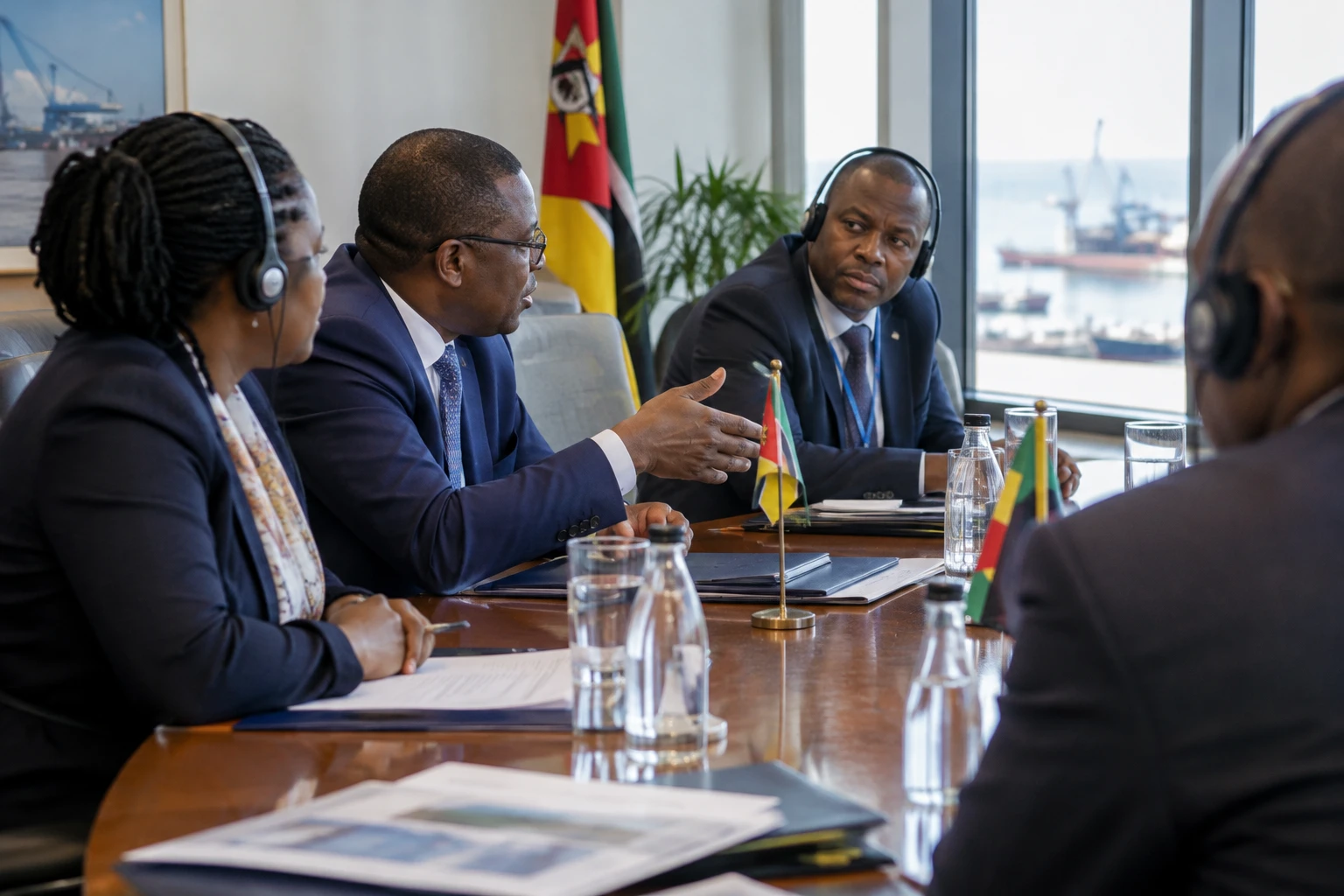
For a port, accommodating larger ships is not enough to win business. Their cargoes must also be moved inland without extending delivery times or pushing up transport costs. This is the challenge facing the work launched in Maputo, in a Mozambique where port performance depends directly on regional corridors.
A port serving trade across southern Africa
Located on the Indian Ocean, the port of Maputo serves Mozambique as well as neighbouring countries connected to the sea by road and rail. Its links with South Africa, Eswatini and Zimbabwe make it a regional gateway. This position matters to landlocked countries, which depend on several networks and border crossings to export or import goods.
The port operates in a region where infrastructure is both in competition and complementary. The Southern African Development Community (SADC), a regional organisation that includes Mozambique and South Africa, seeks to facilitate trade and cross-border links. Maputo’s competitiveness is therefore not decided solely at the quayside: it also depends on co-ordination between ports, railways, roads and border posts.
These issues are all the more apparent as Maputo’s traffic has grown over the years. According to figures released by the operator, the port handled 32 million tonnes of cargo in 2025, up 3.4% on 2024. This record level has also been reported by Grindrod, an indirect shareholder in the concessionaire. This growth puts the capacity of maritime and land access routes at the heart of investment decisions. The operational results published by the port of Maputo are consistent with Grindrod’s financial disclosures.
A deeper, wider channel
Work to dredge the port’s access channel began on 12 October 2026. The operation, estimated at $150 million, is set to increase its maximum depth from 14.4 to 15.3 metres and widen the passage. Dredging involves removing sediment from the seabed to enable ships to navigate in better conditions. Information published in Mozambique indicates that the project is intended to make it easier to accommodate larger ships. Mozambican outlet Evidências and O País both report the cost and the targeted new depth.
The project is part of a broader cycle of port modernisation, presented as an investment programme worth several billion dollars. But the overall sums and timetable cover different projects and parties. They should not be confused with the dredging cost alone, which has been put at $150 million.
On land, the expansion of the container terminal operated by DP World complements this development. Announced in May 2025 with an investment of $165 million, the project aims to increase its annual capacity from 255,000 to 530,000 TEU. A TEU, or twenty-foot equivalent unit, is the standard unit used to measure container capacity. The stated capacity is that of the terminal once the project is complete: it does not mean that this volume is already being handled today. DP World sets out the aims of the expansion.
Performance will also depend on links beyond the quayside
Deeper maritime access and an expanded terminal can make it possible to receive larger ships and handle more cargo. However, these facilities alone do not guarantee lower costs or shorter delays for businesses and households. For Mozambican exporters, the benefits will depend in particular on the regularity of shipping services, cargo handling and the ability to transport goods to the port.
The effects may also vary between different groups. Large mining or agricultural companies shipping substantial volumes may benefit directly from more efficient port access. Small businesses, transport operators and traders depend more on tariffs, formalities and transit times. Cities close to the infrastructure will not experience the same effects as remote regions, where poor road conditions or insufficient rail links can erase some of the gains made at sea.
The issue, then, is the continuity of logistics. If routes linking Maputo to its hinterland do not keep pace, higher-capacity ships risk increasing pressure on roads and storage areas. Rising volumes will need to be accompanied by co-ordination between the port operator, transport operators and the authorities responsible for roads, railways and customs. The port already says rail traffic has grown alongside volumes, but this trend will need to continue to absorb further growth.
A test for regional corridors
The Maputo project is part of a regional competition in which southern African ports are seeking to capture trade flows and better serve landlocked economies. For Mozambique, the challenge is to turn its geographical position into sustained activity, revenue and opportunities for local businesses. This requires the benefits of improved logistics to extend beyond terminals and major operators.
The next steps to watch are the actual completion of the dredging, adherence to its timetable, and then the expansion of land-based facilities. Traffic figures in the coming years will show whether investment eases constraints or simply shifts bottlenecks to roads, railways and borders. In Maputo, port ambitions will depend as much on these links as on the depth of the channel.