Egypt
 Libya
 Morocco
 Sudan
 Tunisia
 Benin
 Burkina Faso
 Cabo Verde
 Côte d'Ivoire
 Ghana
 Guinea
 Guinea-Bissau
 Liberia
 Mali
 Mauritania
 Niger
 Nigeria
 Senegal
 Sierra Leone
 The Gambia
 Togo
 Cameroon
 Central African Republic
 Chad
 DR Congo
 Equatorial Guinea
 Gabon
 Republic of the Congo
 São Tomé and Príncipe
 Burundi
 Comoros
 Djibouti
 Eritrea
 Ethiopia
 Kenya
 Madagascar
 Malawi
 Mauritius
 Mozambique
 Rwanda
 Seychelles
 Somalia
 South Sudan
 Tanzania
 Uganda
 Angola
 Botswana
 Eswatini
 Lesotho
 Namibia
 South Africa
 Zambia
 Zimbabwe
A neighbourhood that matters more than messaging
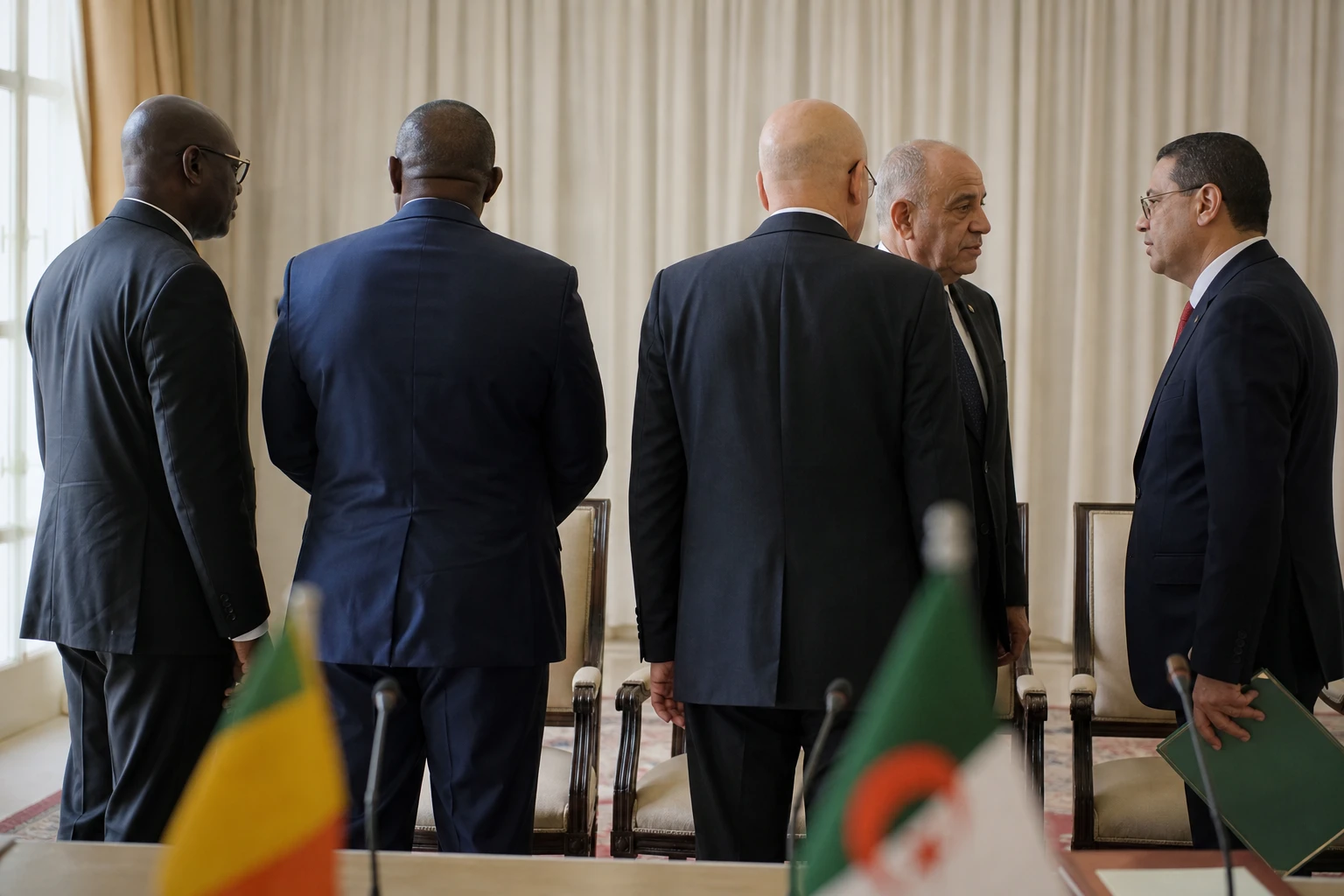
Between Bamako and Algiers, the diplomatic thaw is more than a protocol gesture. It concerns a border nearly 1,400 kilometres long, Saharan trade routes and, above all, a security issue in which every incident quickly affects northern Mali, southern Algeria and the Sahel as a whole. After more than a year of strained relations, the two capitals have chosen to reopen their airspace and reinstate their ambassadors, signalling a return to negotiations after the breakdown triggered in 2025.
The rapprochement comes amid an already fragile regional context. Mali, Niger and Burkina Faso have left ECOWAS, the West African economic community, and are now moving forward through the Alliance of Sahel States, a political framework born of successive breaks with traditional West African partners. In this landscape, Algiers is seeking to preserve its influence to the south, while Bamako wants to avoid isolation along a border that also serves as a corridor for surveillance, trafficking and informal trade.
From the downed drone to the return of ambassadors
The crisis came to a head in spring 2025, after a Malian drone was destroyed near Tin Zaouatine in northern Mali. Algiers said the aircraft had violated its airspace, citing an incursion of about 1.6 kilometres, and decided on 7 April 2025 to close its airspace to flights from or to Mali. Bamako disputed this account and described the incident as a hostile act on its own territory. The two countries subsequently recalled their ambassadors.
The date 2025-04-07 also marked the start of an open diplomatic confrontation. Mali and the Confederation of Sahel States denounced an act of aggression, while Algiers rejected the accusations and recalled its representatives in Bamako and Niamey. The shock did not affect only diplomatic missions. It slowed a long-standing relationship, built up since the 1960s, and underscored how sensitive the Algerian-Malian border remains in an area where the Malian army, armed groups in the north and various criminal networks operate in the same space.
On 24 August 2026, the working visit to Algiers by Mali’s prime minister, General Abdoulaye Maïga, marked the most visible step in the thaw. Mali’s Prime Minister’s Office said the invitation followed a telephone conversation on 9 August 2026, initiated by the Algerian side. Bamako presents the sequence as a resumption of direct dialogue, based on mutual respect, non-interference and the reopening of airspace. Algiers, for its part, has confirmed the normalisation process through its official channels.
Border security, political mistrust
In substance, the proposed cooperation is not starting from scratch. Algeria long played a central role in resolving Tuareg rebellions in northern Mali, including through the Algiers Accord signed in 2015 under President Ibrahim Boubacar Keïta. The accord provided for decentralisation, the integration of former rebels into the army and development projects in the north. But Mali’s transitional government announced in January 2024 that the accord was over, saying it had become inapplicable. The withdrawal weakened the political framework that had still provided a basis for Algerian mediation.
The problem for both Bamako and Algiers is straightforward: insecurity in northern Mali spills over into Algerian territory, and vice versa. Algerian authorities fear that a prolonged conflict across the border could fuel trafficking, armed movements and instability in the Sahara. The Malian authorities, meanwhile, want to retain political control of an issue on which sovereignty has become a watchword since the 2020 coup and the break with several external partners. Cooperation therefore appears necessary, but trust remains low.
This is where the real stakes lie. Simply reinstating ambassadors makes it possible to reopen diplomatic channels. Intelligence-sharing, operational coordination or mediation over northern Mali, however, require a higher level of trust, which neither the drone incident nor the denunciation of the 2015 accord has yet restored. In practice, the first gains are likely to concern border management, air traffic, administrative exchanges and, in the medium term, the security of trans-Saharan routes.
Implications for the Sahel and the continent
The resumption of dialogue between Bamako and Algiers therefore goes beyond bilateral relations. It says something about the new balance in the Sahel: states in transition seeking partners outside traditional frameworks, northern neighbours keen to prevent the spread of insecurity, and regional organisations trying to retain a role in a region where ECOWAS no longer plays the same part as before. The African Union, for its part, continues to call for stronger cooperation on intelligence, border security and the fight against armed networks.
For Mali, the question is practical: how can it stabilise the north without reigniting a war of attrition with separatist groups and without isolating itself from its neighbours? For Algeria, the stakes are equally clear: how can it protect its southern border, preserve its role as a mediating power and prevent the Sahara from becoming a permanent zone of tension? The answer will not come from a diplomatic formula, but from a series of verifiable steps: a lasting reopening of channels, technical mechanisms and perhaps, if political conditions allow, a new discussion on a peace framework for Mali.