Algeria
 Egypt
 Libya
 Morocco
 Sudan
 Tunisia
 Benin
 Burkina Faso
 Cabo Verde
 Côte d'Ivoire
 Ghana
 Guinea
 Guinea-Bissau
 Liberia
 Mali
 Mauritania
 Niger
 Nigeria
 Senegal
 Sierra Leone
 The Gambia
 Togo
 Cameroon
 Central African Republic
 Chad
 DR Congo
 Equatorial Guinea
 Gabon
 Republic of the Congo
 São Tomé and Príncipe
 Burundi
 Comoros
 Djibouti
 Eritrea
 Ethiopia
 Kenya
 Malawi
 Mauritius
 Mozambique
 Rwanda
 Seychelles
 Somalia
 South Sudan
 Tanzania
 Uganda
 Angola
 Botswana
 Eswatini
 Lesotho
 Namibia
 South Africa
 Zambia
 Zimbabwe

A land issue rooted in memory, but also in the present
In Madagascar, land remains as much a political issue as an economic one. On an island where access to land shapes agriculture, housing and investment projects, the debate extends well beyond former colonial titles. It touches on how the Malagasy state intends to regain control of a legal legacy that remains sensitive.
On 1 July 2026, the National Assembly adopted a text providing for the transfer to the Malagasy state of land registered in the names of foreigners during the colonial period, provided it was still registered under that status on 26 June 1960, the date of independence. The same text excludes diplomatic or consular titles, property already transferred to Malagasy nationals, and land belonging to foreign nationals who subsequently became Malagasy.
A reform built on a long history of land ownership
The heart of the issue becomes clear when viewed through Madagascar’s trajectory. The land tenure system of the Great Island was shaped by laws inherited from colonial rule, followed by several reforms, notably those of 2005 and 2006, which clarified land statuses and strengthened public management of land. The new law therefore continues a line of legal developments, but with a more explicitly political objective: to complete an unfinished “decolonisation of land”.
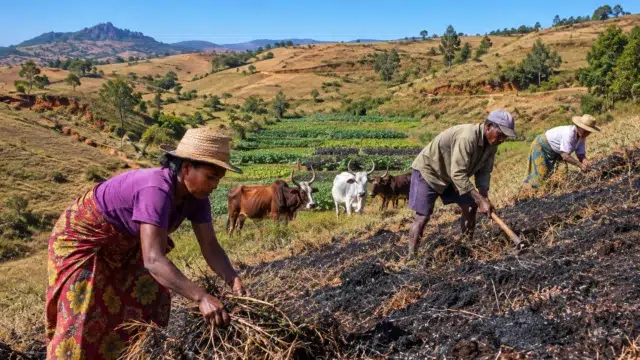
This is not an abstract issue. Land in Madagascar remains at the centre of tensions between formal titles, customary use, long-standing occupation and the state’s administrative capacity. Past reforms sought to make rights more secure while decentralising some land management to municipalities. The new framework, by contrast, reasserts the central government’s control over property deemed to be a historical legacy of colonial relations.
What the Constitutional High Court upheld
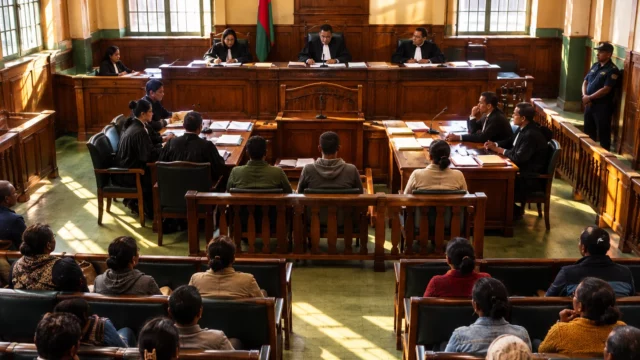
The President of the Refoundation of the Republic, Michaël Randrianirina, referred the text to the Constitutional High Court before promulgation. The Court issued its decision on 3 August 2026, ruling the entire text constitutional and clearing the way for its publication in the Official Gazette. This is a decisive step: in Madagascar, the Constitutional High Court plays a central role in reviewing laws before promulgation.
The decision also follows a long-standing practice. In 2015, the same court had already reviewed a law transferring land formerly owned by colonists to Malagasy citizens. In other words, the current dispute has not emerged in a vacuum. It extends a debate that has run through the Malagasy state for years: how far should the colonial legacy be corrected without undermining the legal certainty of land titles?
Practical effects for the state, families and investors
For the Malagasy state, the law could expand public assets and reinforce a sovereign approach to land. For some families, local authorities or de facto occupants, however, it raises strong expectations about the fate of the plots concerned, particularly where inheritances, past transfers or local uses have blurred the chain of ownership. The text excludes some cases, but it does not in itself resolve land disputes that arise when an old title meets present-day occupation.
Economically, the signal is twofold. On the one hand, the government is seeking to show that it can reclaim assets considered frozen or under-valued. On the other, investor confidence will depend on how the administration implements the law, without conflating historical redress with general land insecurity. In Madagascar, where the formal sector coexists extensively with informal practices, the clarity of titles matters as much as the political gesture itself.
The text does not, however, remove the state’s practical constraints. In reality, automatic transfer requires up-to-date registers, a land administration capable of identifying the titles concerned and manageable litigation. Without these, the law may raise expectations faster than it delivers results. This is where the difference lies between a powerful symbol and a reform that is genuinely implemented.
Regional significance amid a period of transition
The issue takes on added significance because it comes during a period of political transition in Madagascar. SADC, the southern African regional organisation of which the country is a member, is closely following the Malagasy process and reaffirmed its support for the transition and institutional stability in 2026. In this context, a land reform carrying strong symbolic weight can be read as a marker of state refoundation.
For the region, the stakes go beyond Madagascar. Several African states have reopened debates in recent years on property, colonial legacies and the security of titles. The Great Island thus serves as a reminder that land reform can be an act of sovereignty, a tool for redistribution and a test of administrative credibility. The key issue now will be publication of the law, followed by its implementation on the ground, where the law meets archives, municipal authorities and local realities.