Algeria
 Egypt
 Libya
 Morocco
 Sudan
 Tunisia
 Benin
 Burkina Faso
 Cabo Verde
 Côte d'Ivoire
 Ghana
 Guinea
 Guinea-Bissau
 Liberia
 Mali
 Mauritania
 Niger
 Nigeria
 Senegal
 Sierra Leone
 The Gambia
 Togo
 Cameroon
 Central African Republic
 Chad
 DR Congo
 Equatorial Guinea
 Gabon
 Republic of the Congo
 São Tomé and Príncipe
 Burundi
 Comoros
 Djibouti
 Eritrea
 Ethiopia
 Kenya
 Malawi
 Mauritius
 Mozambique
 Rwanda
 Seychelles
 Somalia
 South Sudan
 Tanzania
 Uganda
 Angola
 Botswana
 Eswatini
 Lesotho
 Namibia
 South Africa
 Zambia
 Zimbabwe
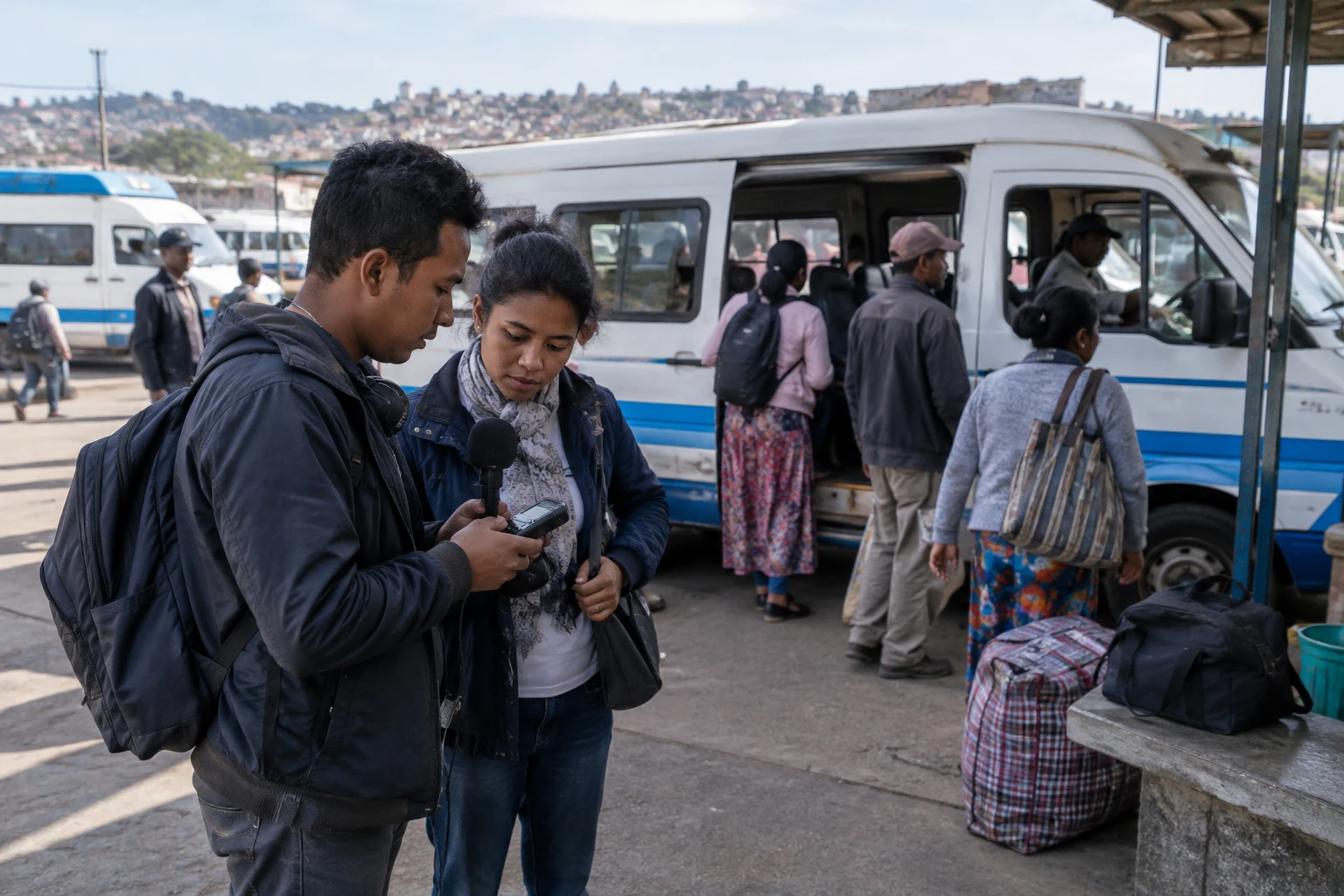
In Madagascar, reporting on violence against women and bringing the work of a craftsperson to life are not the same kind of assignment. But the two reports have one thing in common: they make realities lived far from grand speeches visible. The selection of two Malagasy professionals for a radio training grant thus shines a light on stories rooted in everyday life.
Stories rooted in Malagasy life
On 2 November 2026, in Antananarivo, Nadia Razafimahatratry and Yves Ramarosandratana were named winners of the 13th edition of the Ghislaine Dupont and Claude Verlon Grant, according to the announcement linked to the ceremony. The journalist is 34 and works at the Regional Directorate of Communication and Culture in Itasy. The 32-year-old sound technician works at Radio FAFI.
The selection process brought together five Malagasy journalists and five sound technicians for two weeks of workshops at Madagascar’s public radio and television broadcaster. Journalist candidates had to produce a report on “Dialogue and Tolerance”. The sound technicians, meanwhile, made a sound piece about the island’s crafts and trades.
Nadia Razafimahatratry’s report is about domestic violence. The jury recognised the strength of the testimonies and the decision to address a reality that is often little covered by the media. Yves Ramarosandratana’s report follows the work of a blacksmith in Mangatany, a village about 35 kilometres west of Antananarivo. His piece captures the making of a plough, a tool used by Malagasy farmers.
The two winners are due to receive four weeks of training in Paris in the first quarter of 2027. The programme, funded by RFI, is intended to build on the skills gained during the workshops in Madagascar. The grant honours journalists Ghislaine Dupont and Claude Verlon, who were killed in Kidal, in northern Mali, on 2 November 2013.
A figure that needs to be read carefully
Nadia Razafimahatratry’s report sits within a documented context, but figures vary according to the surveys and definitions used. The 2021 Demographic and Health Survey in Madagascar reports that 44% of women aged 15 to 49 who are not single have experienced physical, emotional or sexual violence by a spouse or partner during their lifetime. For the 12 months before the survey, the figure was 27%.
A document from the French Development Agency (AFD), drawing on data from the National Institute of Statistics, gives a figure of 41% of women aged 15 to 49 who have experienced some form of domestic violence. These figures are not directly interchangeable: the populations studied, reference periods and categories of violence may differ. Giving the source and scope helps avoid reducing diverse experiences to a single indicator.
The 2021 survey data also show differences between areas. The proportion of women reporting domestic violence during their lifetime is estimated at 58% in Antananarivo, compared with 40% in rural areas. These figures describe survey responses; they do not mean that violence is absent from rural areas. Access to services, the ability to speak without risk and recognition of acts can all influence responses.
Beyond the statistics, the report addresses concrete obstacles: fear of reprisals, economic dependence, stigma and pressure to resolve conflicts within the household. The AFD document notes that the social normalisation of some forms of violence makes it harder to speak out and seek support. Naming these mechanisms helps explain why reporting on the issue requires caution, consent and protection for interviewees.
Radio, a tool for connecting with communities
The two selected works are linked by their attention to voices and sounds. In the first, gathering testimony on an intimate subject requires protecting people’s safety and dignity. In the second, recording and editing bring a trade, its techniques and its tools to life. These are distinct editorial choices, but both rely on attentive work in the field.
This approach matters in a country where media practices are not confined to the capital. Nadia Razafimahatratry works in the Itasy region; Yves Ramarosandratana’s report locates the craft activity in Mangatany. These local roots shift the focus towards local experiences, without claiming to sum up Madagascar as a single territory or reality.
The regional context also matters. Madagascar is a member of the Southern African Development Community (SADC), an economic and political co-operation organisation comprising 16 states. Strengthening local media and training journalists are also relevant to regional exchange: the flow of information, coverage of social issues and representation of communities in public debate.
Training, then the day-to-day work
The grant is named after two reporters killed while covering the conflict in northern Mali. It thus combines professional training with remembrance of journalism practised in the field. For the Malagasy winners, the planned 2027 programme in Paris offers an opportunity to develop their skills further; its lasting impact will also depend on working conditions, technical resources and the space given to their work when they return.
The next step is to follow the release of the two reports and how they might contribute to public conversations in Madagascar. On domestic violence, the challenge is to make the facts visible without exposing those who testify. On craftsmanship, it is to document a skill and its relevance today. In both cases, journalism has greater impact when it connects an individual story with the social realities around it.