Algeria
 Egypt
 Libya
 Morocco
 Sudan
 Tunisia
 Benin
 Burkina Faso
 Cabo Verde
 Côte d'Ivoire
 Ghana
 Guinea
 Guinea-Bissau
 Liberia
 Mali
 Mauritania
 Niger
 Nigeria
 Senegal
 Sierra Leone
 The Gambia
 Togo
 Cameroon
 Central African Republic
 Chad
 DR Congo
 Equatorial Guinea
 Gabon
 Republic of the Congo
 São Tomé and Príncipe
 Burundi
 Comoros
 Djibouti
 Eritrea
 Ethiopia
 Kenya
 Malawi
 Mauritius
 Mozambique
 Rwanda
 Seychelles
 Somalia
 South Sudan
 Tanzania
 Uganda
 Angola
 Botswana
 Eswatini
 Lesotho
 Namibia
 South Africa
 Zambia
 Zimbabwe
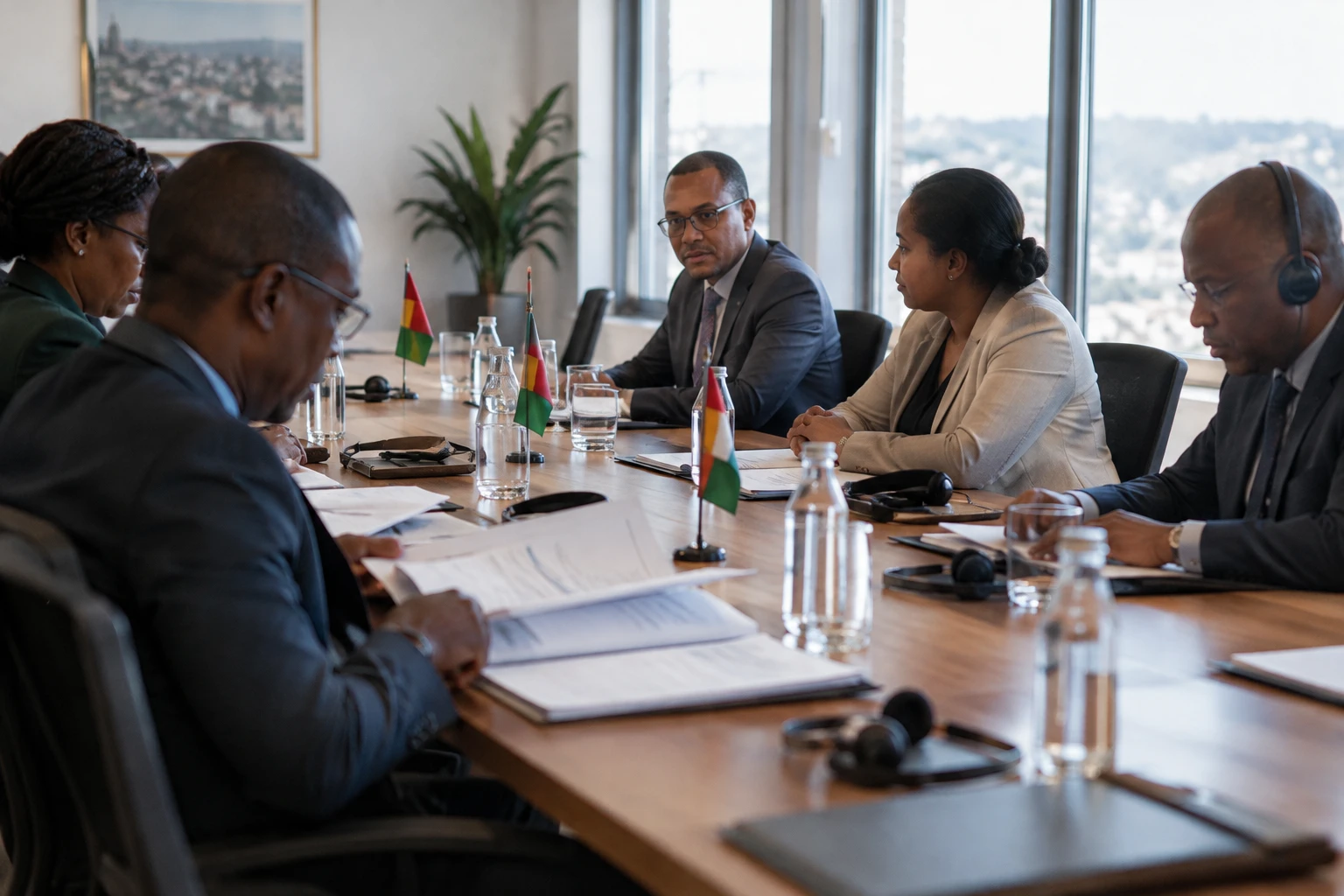
In Antananarivo, the cable car was intended to offer a new answer to traffic congestion. But its cabins are idle, while the project’s financing continues to weigh on public finances. The Malagasy government is now seeking both a financial solution and an operator capable of putting the system back into service.
An urban project at the centre of a financial debate
The discussion goes beyond the fate of a transport line. It raises a practical question for residents of the capital: who will pay for the repairs, who will operate the network and who will bear the financial commitments made before it opened?
The Franco-Malagasy financing agreement, signed on 20 September 2021, provided for a total cost of about €150 million. The arrangement combined a loan from the French Treasury, commercial financing guaranteed by Bpifrance and Malagasy funds. In February 2026, President Michaël Randrianirina said he had asked France to cancel the sums owed. He estimated at the time that about €116 million came from the French Treasury and €88 million from Société Générale. These figures describe components of the financing and should not be added together without clarification of the arrangement.
The government now says it wants the debt linked to the project cancelled. However, this request does not mean that the lenders have accepted it. In June 2026, the French ambassador to Madagascar described the arrangement as a commercial relationship involving economic actors, rather than a conventional bilateral debt between two states. This legal distinction could complicate a write-off decided through diplomatic channels.
The French and Malagasy authorities therefore have different views of the nature of the financing. This disagreement is central: cancellation depends not only on a political declaration, but also on the contracts and guarantees governing the loans. At this stage, the public information consulted does not report any agreement to write off the debt.
Restarting without new public investment
In November 2026, Transport Minister Herizo Ramanambola Andrianavalona put forward another option: entrusting the network to a private operator under a concession. The operator would finance the rehabilitation and then take responsibility for technical and commercial operations. In return, the state would receive a fee, according to information provided by the ministry and reported by the Malagasy media outlet 2424.mg on the concession project.
The minister said the state did not want to mobilise new investment to restore the infrastructure. An international call for expressions of interest was due to be finalised, and potential bidders had reportedly already contacted the authorities. But preliminary interest guarantees neither the signing of a contract nor the actual resumption of services.
A concession could limit immediate spending by the Malagasy Treasury. It would not, however, eliminate existing obligations linked to the initial financing. It would also transfer sensitive decisions to a private operator: priority works, service levels, fares and maintenance. The contract will therefore need to specify who bears cost overruns and how users will be protected from unaffordable prices.
Power supply also remains crucial. The Malagasy Court of Accounts found that the system was not operating normally, notably because of an unstable electricity supply and the absence of a permanent operator. Its audit concluded that there were performance and compliance problems, as well as outstanding additional costs. It notes that loan repayments run until 2034 and will weigh on public finances.
An infrastructure that must prove its value
The cable car was part of a broader plan to modernise transport in Antananarivo, the Malagasy capital, which faces heavy traffic and a fragmented range of transport options. The Court of Accounts notes that cable transport was intended to complement other urban modes of travel. But infrastructure on its own cannot ease a city’s congestion: it must connect with buses, shared taxis and the daily journeys of residents in the neighbourhoods it serves.
Access is also at issue. A fare that is too high could reserve the service for only some households, even though the costs and financial risks are borne by the country as a whole. Workers who cross the capital every day, businesses near the stations and users of informal transport would not be affected in the same way. Residents of regions far from Antananarivo, meanwhile, could indirectly contribute to repayments without benefiting from the network.
The experience of 2023 highlights the difficulties of the model. Two consortia reportedly responded to an initial tender to operate the system, but the government of the time ultimately set up a state-owned management company. The network was only partially opened before it was shut down following the protests of September 2025. Stations were damaged. The change of regime brought the project under review again, without erasing the financial commitments already made.
The restart will therefore depend on several conditions at once: the state of the stations, the safety of the facilities, the availability of electricity, staff training and the viability of fares. Without a credible plan on these issues, choosing an operator will not be enough to turn the cables into a regular service.
A governance test beyond the capital
For Madagascar, the issue is transparency in the management of major public projects. The Court of Accounts’ audit provides a national framework for the debate: it documents the project’s shortcomings and recommends corrective measures. It does not, by itself, settle the question of loan cancellation or the best operating model.
Regionally, Madagascar is a member of the Southern African Development Community (SADC), a cooperation organisation for countries in southern Africa. The case is also of interest to financial partners supporting urban infrastructure across the continent: it is a reminder that a transport project must be assessed as much for its financing as for its use, maintenance costs and integration into the existing network.
The next step will be to see whether the call for expressions of interest produces serious bids and whether the authorities publish the terms of the concession. At the same time, the request for cancellation will need a clear response from the creditors concerned. Until both issues are resolved, Malagasy people do not know who will finance the repairs or on what terms the cable car might resume service.