Algeria
 Egypt
 Libya
 Morocco
 Sudan
 Tunisia
 Benin
 Burkina Faso
 Cabo Verde
 Côte d'Ivoire
 Ghana
 Guinea
 Guinea-Bissau
 Liberia
 Mali
 Mauritania
 Niger
 Nigeria
 Senegal
 Sierra Leone
 The Gambia
 Togo
 Cameroon
 Central African Republic
 Chad
 DR Congo
 Equatorial Guinea
 Gabon
 Republic of the Congo
 São Tomé and Príncipe
 Burundi
 Comoros
 Djibouti
 Eritrea
 Ethiopia
 Kenya
 Malawi
 Mauritius
 Mozambique
 Rwanda
 Seychelles
 Somalia
 South Sudan
 Tanzania
 Uganda
 Angola
 Botswana
 Eswatini
 Lesotho
 Namibia
 South Africa
 Zambia
 Zimbabwe

In Antananarivo, a longstanding land question returns to the fore
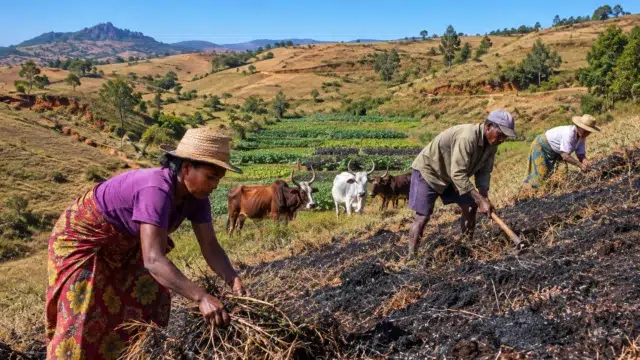
In Madagascar, land is never just a line in a register. It speaks to colonial history, social balances and the state’s ability to secure everyone’s rights. In the capital, Antananarivo, debate has resumed over a law targeting titles still registered in foreigners’ names since the colonial period.
The issue touches on a sensitive aspect of public life in Madagascar: land ownership, long shaped by old administrative legacies and by a reform launched in 2005 to better recognise land statuses and local rights. This framework remains incomplete, with a land market in which a large share of plots has yet to be formally registered.
What the law upheld by the Constitutional High Court provides
The core of the measure is clear. Law No. 2026-007 sets 26 June 1960, the date of independence, as the reference point. All property titles still registered on that date in a foreigner’s name, and never since transferred to a Malagasy owner, must automatically become part of the state’s assets. The law was adopted by the National Assembly on 1 July 2026, then submitted for constitutional review before promulgation.
The Constitutional High Court is playing its usual role as a legal filter before promulgation. In Madagascar, this prior review is provided for by the Constitution, and the court has already carried it out on other land or property reforms. In 2015, for example, it upheld a law on transferring land formerly owned by settlers to Malagasy citizens.
Three categories of property are exempt from automatic transfer: diplomatic or consular land, plots already transferred into Malagasy ownership, and property whose foreign owner subsequently acquired Malagasy nationality. After promulgation and publication in the Official Gazette, the state must still launch a census of the plots concerned.
Land decolonisation in practice, but with limited reach
The government presents the reform as an act of land decolonisation. It is a powerful term. It evokes a longstanding dispute rooted in ownership inherited from the colonial administration and a system of titles that was centralised for many years. But the law’s practical reach appears narrower than its political symbolism. The titles concerned are those that have never left a foreigner’s name since independence. In other words, the law does not resolve all the country’s land disputes.
That is precisely how several specialists in Malagasy land issues interpret it: they say the real task remains securing agricultural use and reconciling titles, land certificates and customary rights. The 2005 law launched an important reform, but formal registration is progressing slowly. According to estimates cited in research and reference documents on Madagascar, only a minority of land still has a formal title.
In practice, this means that the major disputes clogging the courts, tensions between heirs, conflicts between families and municipalities, and decisions over agricultural land will not disappear with this new law. The reform addresses a specific historical stock of land. It cannot, by itself, repair the land system as a whole. That is where the distinction lies between an assertion of sovereignty and structural overhaul.
What this means for the state, landowners and agriculture
For the Malagasy state, the gain is primarily political and administrative. It is taking back control of plots that remained trapped in a status inherited from the past. In a country where land is a central economic asset, this move could also pave the way for greater clarity over public assets. But that will require a thorough census, documentary checks and an administration able to handle complex cases without creating new disputes.
For families, farmers and local authorities, the stakes are different. Any land reform can provide reassurance if it clarifies rights. It can also cause concern if the process is not transparent. In Madagascar, where land often carries family memories, the boundary between private property, state land and land used under customary arrangements remains a matter requiring vigilance. A measure presented as corrective can create uncertainty if its implementation is not clearly explained.
The agricultural sector is also watching the issue closely. The question is not merely symbolic. It affects investment security, access to credit, the transfer of farms and decisions between residential, commercial and productive uses. Yet the fundamental reform expected by those working on the ground is not confined to the colonial legacy. It concerns the country’s ability to protect cultivated land, reduce disputes and reconcile written law with local practices.
A national signal with implications beyond Madagascar
The issue extends beyond Madagascar’s borders because it speaks to land sovereignty, postcolonial memory and legal certainty. Madagascar is a member of SADC, the Southern African Development Community, which comprises 16 member states and officially prioritises regional integration, stability and development. Across the region, land remains both a driver of growth and a source of tension.
The regional context also lends the issue a more political dimension. Madagascar hosted the 45th SADC summit in Antananarivo in August 2025, before subsequently giving up its rotating presidency following domestic political developments. The episode served as a reminder that the country’s institutional balance is being watched at regional level. A land reform upheld by the High Court does more than change a register: it sends a signal about how the Malagasy state intends to reshape its relationship with the colonial legacy, property rights and administrative continuity.
What happens next will depend above all on two concrete steps: promulgation of the law and the census of the plots concerned. That is when the symbolism will have to meet the realities of administration, archives, possible challenges and the expectations of both rural communities and urban landowners. In Madagascar, major land reforms are rarely judged by their announcement. They are assessed by how they are implemented, plot by plot, case by case.