Algeria
 Egypt
 Libya
 Morocco
 Sudan
 Tunisia
 Benin
 Burkina Faso
 Cabo Verde
 Côte d'Ivoire
 Ghana
 Guinea
 Guinea-Bissau
 Liberia
 Mali
 Mauritania
 Niger
 Nigeria
 Senegal
 Sierra Leone
 The Gambia
 Togo
 Cameroon
 Central African Republic
 Chad
 DR Congo
 Equatorial Guinea
 Gabon
 Republic of the Congo
 São Tomé and Príncipe
 Burundi
 Comoros
 Djibouti
 Eritrea
 Ethiopia
 Kenya
 Malawi
 Mauritius
 Mozambique
 Rwanda
 Seychelles
 Somalia
 South Sudan
 Tanzania
 Uganda
 Angola
 Botswana
 Eswatini
 Lesotho
 Namibia
 South Africa
 Zambia
 Zimbabwe
When carbon promises income, but communities are still waiting
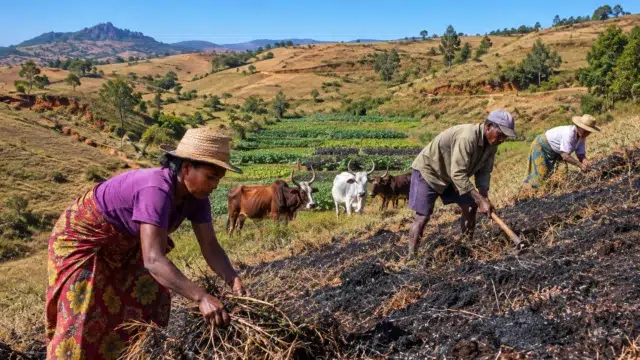
In Madagascar, forest protection has become a very concrete test of the credibility of climate mechanisms. On paper, carbon credits are meant to reward those who keep trees standing, limit slash-and-burn farming and protect watersheds. In reality, Malagasy communities involved in these efforts say they are still waiting for a share of the proceeds, long after the first payments were made.
The issue goes beyond environmental accounting. It touches on trust in the state, the role of rural communes, and how the benefits of climate finance do — or do not — reach villages. In a country where eastern forests remain under pressure, the challenge is not just to sell carbon credits. It is also to prove that the promise benefits the first guardians of forest cover.
A national programme backed by the World Bank and SADC
Madagascar has embraced REDD+, or “Reducing Emissions from Deforestation and Forest Degradation”, through a results-based payment agreement signed with the World Bank in February 2021. The agreement, worth up to $50 million, aims to reduce emissions by 10 million tonnes of CO2e on the island’s eastern side. The World Bank says it is a mechanism based on verified results, with a benefit-sharing plan built in from the outset.
The country has already received an initial payment of $8.8 million in December 2023, following the verified reduction of 1.76 million tonnes of carbon in 2020. Madagascar’s environment ministry, for its part, has established a dedicated regulatory framework, including a Madagascar REDD+ Strategy 2030 and a carbon revenue-sharing plan.
The issue also falls within a regional framework. Madagascar is a member of SADC, the Southern African Development Community, which has 16 member states, including Mozambique, Tanzania and South Africa. Across the region, the energy transition, forest management and climate resilience have become economic as well as environmental concerns.
Communities promised 5%, but still far from the payment desks
Under the allocation framework described by programme stakeholders, 5% of carbon-credit revenues goes to local communities. Communes are to receive 13%, while a substantial share is supposed to go to protected-area managers for reforestation, income-generating activities and basic services. On the ground, the problem is the delay. Communities say they have not seen the money arrive. Some say they did not even know they were entitled to it.
The reasons are well known. First, the programme’s scale makes implementation more complicated. The area concerned covers nearly 7 million hectares, or about 10% of the country, along the eastern forest belt. Access to some protected areas is also difficult. Teams sometimes have to travel by motorbike and then on foot to meet communities scattered across remote areas.
Finally, the administrative chain slows everything down. The ministry acknowledges a cumbersome system in which an error in an application can send a project back to square one. Yet the implementation report published in 2025 says that an interministerial decree did establish the framework for the first allocation of funds, with information meetings held for the promoters of beneficiary initiatives. But this formal framework has not yet been enough to get the money flowing to villages at the expected pace.
What the delays say about forest governance in Madagascar
The heart of the problem is as political as it is administrative. In Madagascar, forests are not just reservoirs of biodiversity. They protect soils, feed watersheds and support a rural economy that remains heavily dependent on wood, subsistence farming and natural resources. The World Bank also points out that eastern forests provide essential biodiversity and hydrological protection services, while helping mitigate droughts and floods.
In this context, a carbon mechanism can work only if local people see a direct and clear benefit. Otherwise, it risks being seen as a funding channel detached from conditions on the ground. This is especially true in a country where protected areas are managed jointly with communities, a principle championed by Madagascar National Parks and adopted by several conservation programmes.
The fundamental questions are simple: who decides, who receives the money, and when? If communes and villages cannot clearly understand the rules, the promise of sharing will erode. Conversely, if revenues fund visible projects — tracks, water points, small-scale productive activities, useful reforestation — the mechanism can strengthen conservation. Natural capital then becomes a local asset, not merely a budget line.
A signal to watch for Africa’s carbon markets
The case of Madagascar matters beyond Antananarivo. In several African countries, carbon markets are presented as a source of income for forest areas, mangroves and agricultural landscapes. But the same question arises everywhere: how can a fair, transparent and timely sharing of benefits be guaranteed? Madagascar is thus becoming a test of credibility for results-based climate mechanisms.
Monitoring will be decisive in the coming months, as the agreement with the World Bank provides for two further payment tranches, subject to actual emissions reductions and implementation of the revenue-sharing plan. Madagascar faces a dual challenge: preserving its forests, while ensuring that climate finance reaches the rural communities that bear the practical burden of conservation.