Algeria
 Egypt
 Libya
 Morocco
 Sudan
 Tunisia
 Benin
 Burkina Faso
 Cabo Verde
 Côte d'Ivoire
 Ghana
 Guinea
 Guinea-Bissau
 Liberia
 Mali
 Mauritania
 Niger
 Nigeria
 Senegal
 Sierra Leone
 The Gambia
 Togo
 Cameroon
 Central African Republic
 Chad
 DR Congo
 Equatorial Guinea
 Gabon
 Republic of the Congo
 São Tomé and Príncipe
 Burundi
 Comoros
 Djibouti
 Eritrea
 Ethiopia
 Kenya
 Malawi
 Mauritius
 Mozambique
 Rwanda
 Seychelles
 Somalia
 South Sudan
 Tanzania
 Uganda
 Angola
 Botswana
 Eswatini
 Lesotho
 Namibia
 South Africa
 Zambia
 Zimbabwe
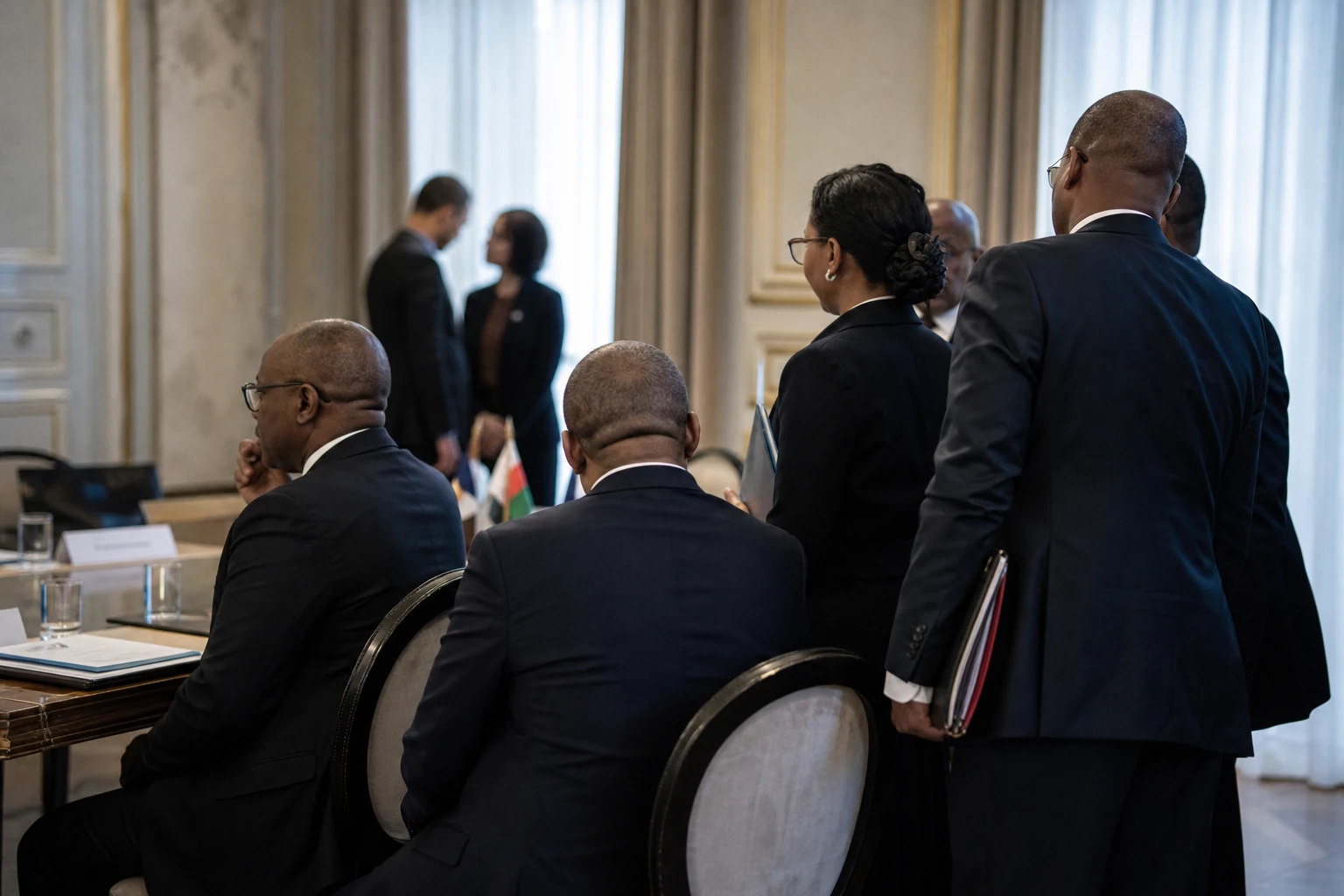
In Paris, Madagascar seeks to widen its room for manoeuvre
For Antananarivo, this trip is not merely a protocol stop. It says something broader: Madagascar, an Indian Ocean island and a member of SADC, is trying to keep several doors open at once without being locked into a single diplomatic alignment. In a regional context shaped by political transitions and shifting alliances, every presidential meeting is also a signal to economic partners, donors and southern African neighbours.
On 10 September 2026, the Élysée’s schedule confirmed a bilateral meeting with Michaël Randrianirina, described as president of the Refoundation of the Republic of Madagascar. The one-to-one meeting took place on the sidelines of the International Space Summit, held in Paris on 9 and 10 September and billed as the first edition of this global gathering.
The meeting took place amid an already busy diplomatic schedule for the Malagasy head of state. In February 2026, Randrianirina had already been received in Paris by Emmanuel Macron, during a visit to France from 23 to 25 February. The latest exchange therefore confirms a sustained series of contacts, at a time when Madagascar is seeking to consolidate its institutional refoundation and reassure partners about the continuity of the state.
The substance: cooperation, credibility and geopolitical balance
The issue goes beyond a conventional bilateral relationship. Since Michaël Randrianirina came to power in October 2025, Madagascar has been under the close scrutiny of regional and international organisations. The UN in Madagascar said a joint high-level mission from the African Union and the United Nations had visited the country in July 2026 to meet the authorities, political parties, civil society and economic and social actors. Meanwhile, SADC called on its members and the Malagasy parties to prioritise dialogue and calm.
This backdrop matters. Madagascar is an island state, but it is not isolated. It belongs to SADC, which brings together 16 southern African countries and has economic integration, peace and good governance as its central objectives. Antananarivo therefore has an interest in showing that the transition under way remains clear to the region, especially as announced elections approach that are seen as a test of credibility.
The rapprochement with Paris also follows a determined opening towards Moscow. In February 2026, Randrianirina travelled to Russia and met Vladimir Putin at the Kremlin. Russian and Malagasy official sources spoke at the time of cooperation in energy, agriculture and international platforms, and of strengthening strategic ties more broadly. This balancing act between several partners gives the September visit to Paris its full significance.
In other words, Madagascar is not simply asking for support. The transitional authorities are seeking to make themselves indispensable. They want to convince France, the European Union and other partners that the island remains a credible, useful and stable actor, despite the political rupture of 2025. In Paris, Malagasy diplomacy therefore put forward a position of balance: maintaining dialogue with the West without giving up its new contacts with Russia.
What the meeting means for the Malagasy people
For the population, the stakes are less symbolic than practical. Madagascar is emerging from a crisis rooted in severe social tensions, particularly over water and electricity cuts, followed by a military takeover that toppled the previous government. The current authorities must therefore prove they can revive public services, organise credible elections and keep the economy moving. Meetings in Paris serve that purpose too: securing financial, technological and political support.
Malagasy authorities have also indicated that bilateral cooperation with France could resume on concrete issues, beyond diplomatic language. Local media have reported possible discussions on energy, European partnerships and major projects, while the February joint communiqué recalled priorities including political dialogue, economic development and security. In a country where investment needs remain high, the ability to turn a presidential meeting into tangible results will be closely watched.
The space summit also has very practical implications. Madagascar was among the signatories to the international declaration on space data. For a country such as Madagascar, this opens up scope for cooperation on remote sensing, crop monitoring, climate surveillance and civilian uses of satellites. This is not a technological luxury. It is a potential tool for agriculture, disaster management and land-use planning.
This dimension matters for Africa too. The continent is no longer merely a stage for competition between major powers. It is seeking to enter technology value chains, including in space. Madagascar’s presence in Paris alongside other African signatories shows that a country in transition can also position itself on forward-looking issues, rather than being defined by its political fragilities.
The next steps remain. For Madagascar, the real test will come in the months ahead: setting the election timetable, maintaining domestic dialogue, clarifying external partnerships and easing tensions surrounding the transition. In southern Africa, the situation will continue to be monitored by SADC, the African Union and bilateral partners, because Madagascar’s trajectory will say much about whether, and how, a military transition can seek to regain regional and international legitimacy.