Algeria
 Egypt
 Libya
 Morocco
 Sudan
 Tunisia
 Benin
 Burkina Faso
 Cabo Verde
 Côte d'Ivoire
 Ghana
 Guinea
 Guinea-Bissau
 Liberia
 Mali
 Mauritania
 Niger
 Nigeria
 Sierra Leone
 The Gambia
 Togo
 Cameroon
 Central African Republic
 Chad
 DR Congo
 Equatorial Guinea
 Gabon
 Republic of the Congo
 São Tomé and Príncipe
 Burundi
 Comoros
 Djibouti
 Eritrea
 Ethiopia
 Kenya
 Madagascar
 Malawi
 Mauritius
 Mozambique
 Rwanda
 Seychelles
 Somalia
 South Sudan
 Tanzania
 Uganda
 Angola
 Botswana
 Eswatini
 Lesotho
 Namibia
 South Africa
 Zambia
 Zimbabwe
A brief return, but one laden with meaning
In Dakar, a few hours were enough to revive several fault lines at once. Macky Sall’s return to the Senegalese capital on 17 July 2026 was not merely a courtesy visit: it brought face to face a former head of state, now a candidate for the post of UN secretary-general, and his successor, Bassirou Diomaye Faye, in a Senegal still grappling with debt, political violence and party loyalties.
The contrast is stark. On one side, a former president seeking to reposition himself on the multilateral stage. On the other, a government born of the change of power in March 2024, elected on a promise of a break with the past, transparency and economic sovereignty. The meeting therefore went beyond mere republican courtesy. It was a reminder that Senegalese political life remains shaped by the legacy of the past decade.
The Senegalese and West African context
Senegal remains a major political player in West Africa and within ECOWAS, where each period of institutional stability matters to the region. Since Bassirou Diomaye Faye came to power, Dakar has adopted a more sovereigntist line while keeping channels open to African and international partners. The Senegalese presidency itself recently championed a “sovereign, innovative Africa” at a summit in Nairobi.
This regional context matters. Senegal does not operate in isolation. Its economy remains under strain following a revision of the public accounts and the discovery of under-reported debt between 2019 and 2023, confirmed by the IMF. The affair weighs on the scope for budgetary action, the state’s financial credibility and the timetable for reforms.
At the same time, West African diplomacy is being reshaped. The region’s capitals are watching closely to see whether Dakar can balance domestic stability, budgetary discipline and external influence. It is in this context that a former Senegalese president seeking a UN post also becomes a subject of regional politics.
What happened in Dakar
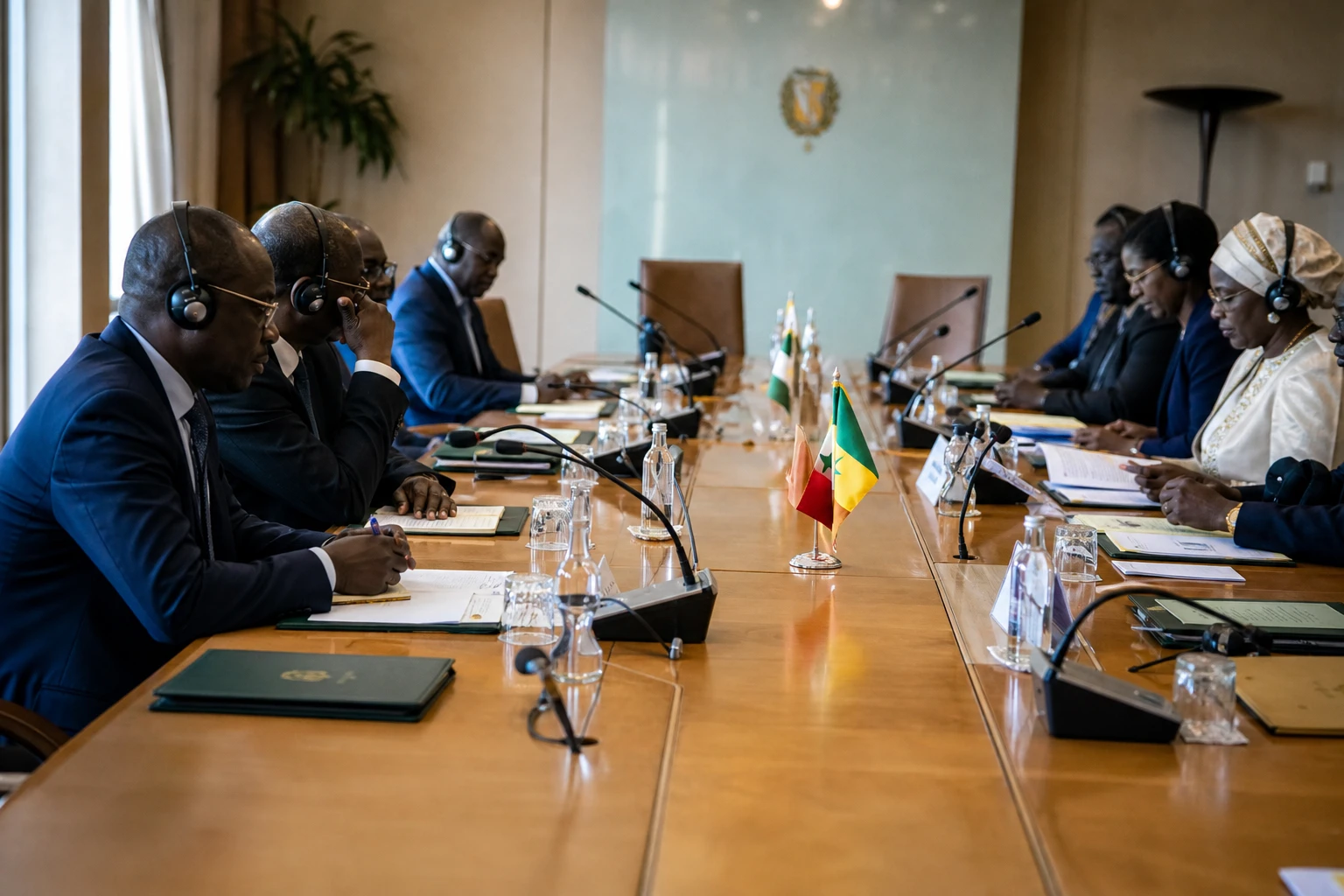
Macky Sall landed in Dakar shortly after 3pm, where he was welcomed by supporters, before being received at the presidential palace by Bassirou Diomaye Faye. The Senegalese presidency released an image of the meeting without giving details of its content. The former president left the country the same day, after a very brief visit.
The visit had a clear purpose: to promote his candidacy for the post of UN secretary-general. His nomination was formally submitted to the United Nations by Burundi, which put his name forward on 2 March 2026. The selection process is overseen by the General Assembly and the Security Council, and António Guterres’s term ends on 31 December 2026.
Politically, the audience immediately divided opinion. Macky Sall’s supporters saw it as a gesture of institutional respect. In the presidential camp, however, the meeting was poorly received by some senior figures, at a time when tensions between Bassirou Diomaye Faye and Ousmane Sonko have already weakened the majority. One presidential adviser even announced his resignation, saying that victims of the repression had yet to obtain justice.
Justice, debt and the battle over the narrative
Criticism of Macky Sall is not rooted solely in political rivalry. It centres on two serious grievances. First, the deaths and injuries linked to the protests from 2021 to 2024, amid intense tensions between the government and the opposition. Second, the hidden-debt issue, which revealed the scale of the budgetary imbalances inherited from the previous government. In 2025, the IMF confirmed that deficits and debt had been under-recorded, with central government debt revised up to 99.7% of GDP at the end of 2023, from 74.4% previously.
These two issues are more than mere talking points. They affect household confidence, the cost of public borrowing and the state’s ability to invest. For Senegalese people, the consequences are tangible: greater pressure on public finances, more difficult trade-offs and strong demand for the truth from institutions. For the authorities, the challenge is twofold: to rebuild economic credibility and retain the political initiative.
In this battle over the narrative, Macky Sall is seeking to present himself as an experienced figure capable of carrying an African voice to the top of the UN. His critics, by contrast, argue that a return to the international spotlight cannot erase the political record he left behind at home. Bassirou Diomaye Faye, for his part, must balance institutional restraint, demands for justice and the competing interests of a government still consolidating its position.
A moment with continental implications
The implications reach beyond Senegal. Macky Sall’s candidacy touches on a sensitive question for Africa: who represents the continent’s voice in a major multilateral organisation, and with what political legitimacy? The fact that a former president has been put forward by Burundi, the African Union’s chair in 2026, illustrates the weight of continental alliances, regional balances and diplomatic calculations in such contests.
For West Africa, the episode also sends a simple message. Political transitions do not erase past liabilities. They manage them, make choices about them or reopen them. Senegal, often seen as a bastion of institutional stability in the sub-region, is showing today that a change of power can coexist with sharp tensions over justice, political memory and economic governance.
The next step will take place in New York, under the formal timetable for selecting the next UN secretary-general. But Africa’s reading of the issue will also be shaped in Dakar, by whether or not the Senegalese state reopens the cases concerning past violence and public debt. That is where the strength of a political transition will be measured, far beyond an audience at the palace.