Algeria
 Egypt
 Morocco
 Sudan
 Tunisia
 Benin
 Burkina Faso
 Cabo Verde
 Côte d'Ivoire
 Ghana
 Guinea
 Guinea-Bissau
 Liberia
 Mali
 Mauritania
 Niger
 Nigeria
 Senegal
 Sierra Leone
 The Gambia
 Togo
 Cameroon
 Central African Republic
 Chad
 DR Congo
 Equatorial Guinea
 Gabon
 Republic of the Congo
 São Tomé and Príncipe
 Burundi
 Comoros
 Djibouti
 Eritrea
 Ethiopia
 Kenya
 Madagascar
 Malawi
 Mauritius
 Mozambique
 Rwanda
 Seychelles
 Somalia
 South Sudan
 Tanzania
 Uganda
 Angola
 Botswana
 Eswatini
 Lesotho
 Namibia
 South Africa
 Zambia
 Zimbabwe
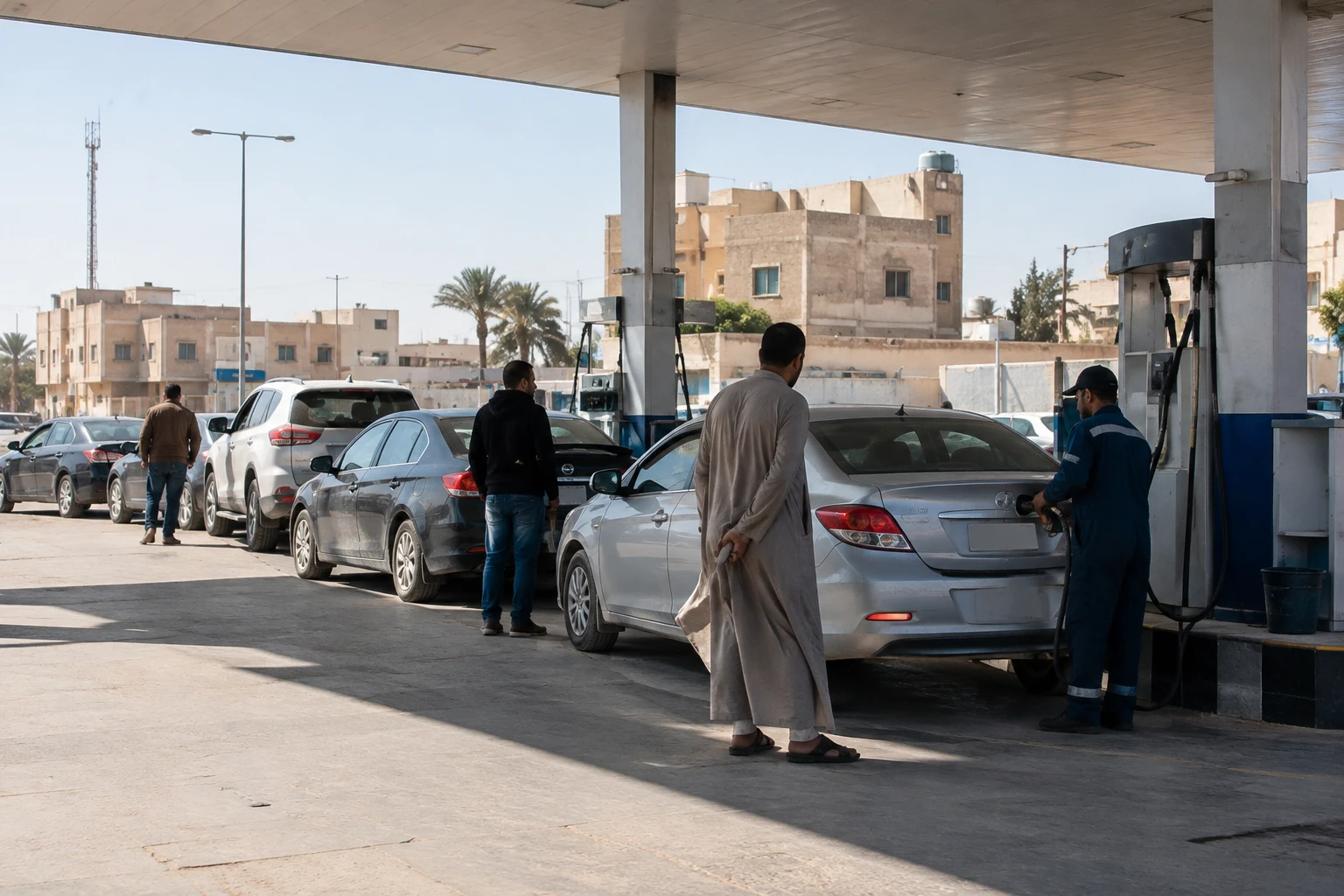
In an oil-producing country, motorists can still wait for hours outside a petrol station. In Libya, the contrast stems from a sector capable of extracting crude, but still too limited to process and distribute fuel regularly to meet the country’s needs.
The announced commissioning of a petrol unit in Sirte could strengthen local production. But its impact will depend on its actual capacity, the regularity of deliveries and the control of fuel once it leaves the plant.
A new unit, with capacity still unannounced
On 11 and 12 October 2026, the National Oil Corporation (NOC), Libya’s state-owned oil company, reviewed operations at Sirte Oil Company and the Ras Lanuf processing company. It said final preparations were under way to start a petrol production unit in Sirte this week. Its statement did not specify the actual start date.
The NOC has also not published the facility’s capacity, its technical specifications or the volume of petrol it could supply. It is therefore too early to assess its contribution to national supply. The statement also mentions plans to restart a gas processing unit and build a fourth 30-megawatt power plant in the Sirte petrochemical complex.
The company presents these projects as ways to increase domestic production and improve the efficiency of its facilities. The announcement was reported by the NOC in its 12 October statement. Italian news agency Agenzia Nova also reported it on 13 October, citing the same communication. This coverage confirms the date and the announcement, but is not an independent source on the unit’s expected performance.
Shortages vary by region
Need is immediate, but it is not felt in the same way everywhere. In Tripoli, Misrata and other western cities, motorists have reported queues. In the south, the municipality of Sebha announced on 9 October that a barcode system would soon return to organise access to petrol stations, following delivery difficulties.
The system can regulate the available distribution. It cannot, however, replace the delivery of tanker trucks to stations. Local reports say deliveries in the region were interrupted for several days. Brega Oil Marketing, which is responsible for distribution, disputed some claims of supply shortages and said shipments were continuing. Claims about shortages should therefore be attributed to the parties concerned rather than presented as a uniform national picture.
This difference between the coast and the interior directly affects residents. When supplies become scarce, travel, commercial activity and services that depend on transport become more difficult. Stations near major depots do not necessarily face the same pressures as those in the south, where long distances make logistics particularly important.
More refining is not enough
The problem goes beyond the number of facilities. In January 2026, NOC chairman Masoud Suleiman cited an increase in the country’s nominal refining capacity, from 380,000 to 660,000 barrels per day. Actual output, then estimated at about 180,000 barrels per day, remains far below that theoretical capacity. These figures, published by the NOC and reported by The Libya Observer, illustrate the gap between installed equipment and its actual operation.
In May, the NOC resumed full control of the Ras Lanuf complex after an agreement ended its partnership with Trasta. The refinery, shut down since 2013, can process up to 220,000 barrels of crude a day on paper. But it still needs to be rehabilitated before a possible restart. Masoud Suleiman then cited a timeframe of six to 12 months. The restoration of public ownership creates an industrial opportunity; it does not mean production has already resumed.
The NOC has also set long-term self-sufficiency targets: 2037 for petrol and 2034 for diesel. Demand projections give an idea of the scale of the challenge. Analysis firm Kpler estimates that Libyan demand for road fuels could reach 250,000 barrels per day in 2026, including 90,000 to 100,000 barrels of petrol. These estimates, cited in the available reports, are not accompanied here by a second independent publication; they should therefore remain attributed to Kpler.
Domestic production is only one part of the picture. In its investigation published in November 2025, the organisation The Sentry estimates that fuel diversion cost Libya nearly $20bn between 2022 and 2024. This is the organisation’s estimate, not a figure established by a court ruling. It has nevertheless been reported by Italian news agency ANSA and Libyan media. The report thus highlights that producing or importing additional volumes does not, by itself, guarantee that they will reach consumers.
A national issue that extends beyond the oil sector
The NOC plays a central role in an economy where hydrocarbons provide a large share of public revenue. Libya remains marked, however, by divided institutions and power struggles between the west, where Tripoli is located, and the east of the country. In this context, the management of facilities, imports and distribution networks is also an issue of governance and trust between regions.
For the authorities, increasing refining could reduce dependence on imported products and make better use of Libyan crude. For households and businesses, the result will be judged at the pump: fuel availability, regular deliveries and access for remote regions. A new unit will not resolve these issues if transport and distribution networks remain fragile or diversion persists.
Across North Africa, the issue is a reminder that energy security depends not only on underground resources. It also relies on processing capacity, maintained infrastructure and monitored distribution. Libya is a member of the Arab Maghreb Union, a regional organisation bringing together the countries of the Maghreb, although regional co-operation remains limited. The actual start-up of the Sirte unit, the rehabilitation of Ras Lanuf and the state of deliveries in the south will be the next concrete indicators to watch.