Algeria
 Egypt
 Morocco
 Sudan
 Tunisia
 Benin
 Burkina Faso
 Cabo Verde
 Côte d'Ivoire
 Ghana
 Guinea
 Guinea-Bissau
 Liberia
 Mali
 Mauritania
 Niger
 Nigeria
 Senegal
 Sierra Leone
 The Gambia
 Togo
 Cameroon
 Central African Republic
 Chad
 DR Congo
 Equatorial Guinea
 Gabon
 Republic of the Congo
 São Tomé and Príncipe
 Burundi
 Comoros
 Djibouti
 Eritrea
 Ethiopia
 Kenya
 Madagascar
 Malawi
 Mauritius
 Mozambique
 Rwanda
 Seychelles
 Somalia
 South Sudan
 Tanzania
 Uganda
 Angola
 Botswana
 Eswatini
 Lesotho
 Namibia
 South Africa
 Zambia
 Zimbabwe
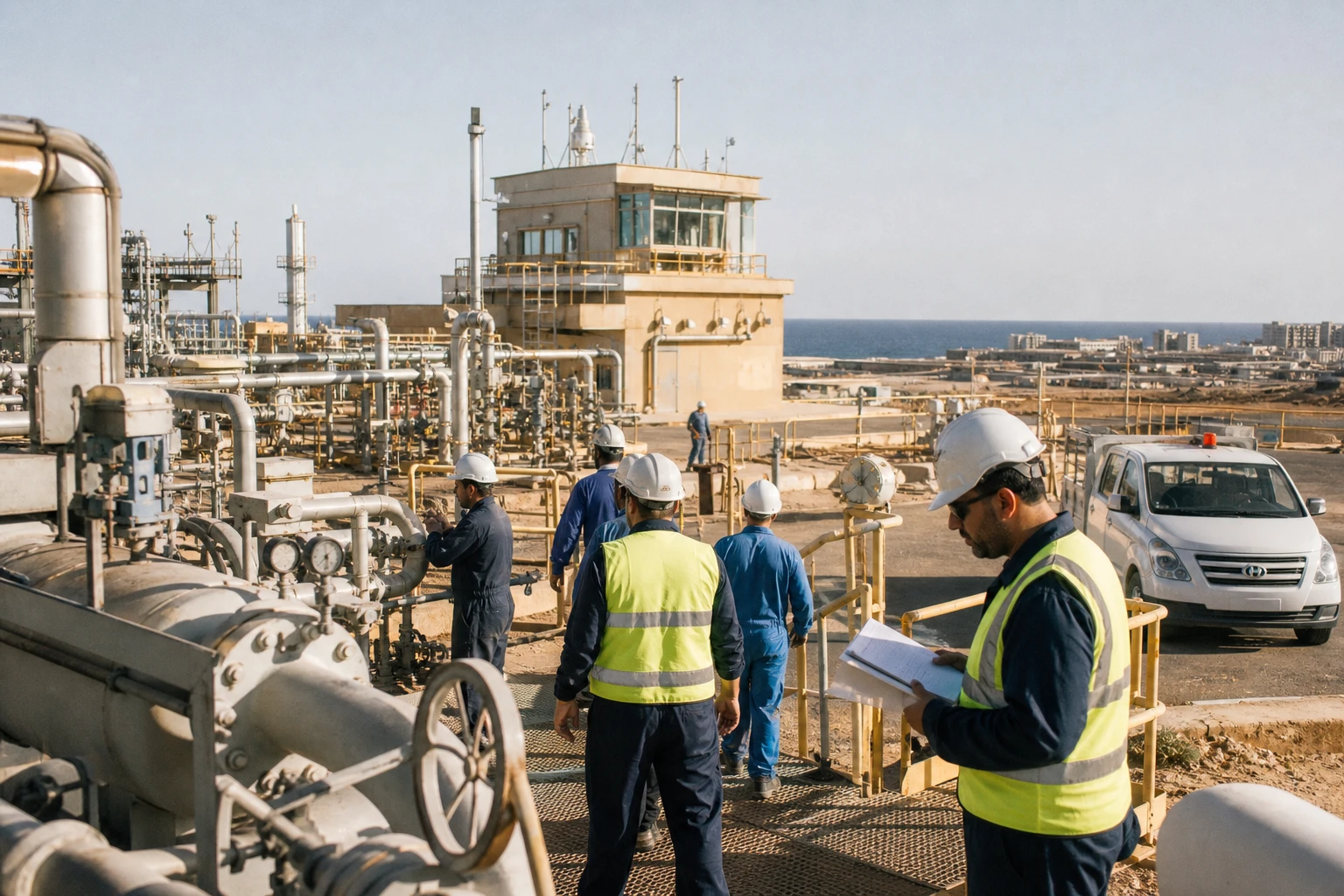
At Mellitah, anger is about the missing electricity, not gas being sent abroad
In Libya, the cost of power cuts often ends up being paid at energy facilities. When homes are left in the dark, suspicion quickly shifts to pipelines, terminals and contracts signed with foreign countries. At Mellitah, west of Tripoli, this tension took concrete form: protesters interrupted gas lines, convinced that the country was exporting its energy instead of supplying its own power stations. The facts tell a different story. But the anger stems from a very real problem: an electricity grid under pressure and recurring outages.
The Mellitah complex occupies a particular place in Libya’s economy. It connects gas production from the Wafa fields in the desert and Bahr Essalam offshore to the Greenstream pipeline, which crosses the Mediterranean to Sicily. Libya’s National Oil Corporation, the NOC, and Eni operate it through their joint venture, Mellitah Oil and Gas. In such a system, the line between domestic supply and exports is politically sensitive, especially when electricity is scarce in cities and several regions in the west of the country.
What the NOC clarified, and why the misunderstanding took hold
On Tuesday 28 July 2026, after the intrusion into the complex, the Government of National Unity ordered the site to be secured and the lines supplying power stations to be restarted. The NOC subsequently confirmed the resumption of gas production and pumping at Mellitah. On Wednesday 29 July, the corporation sought above all to dispel a widely held belief: it said exports to Italy do not exceed 10% of Eni’s contracted share. In practice, the rest is directed to the domestic market when Libyan demand rises in summer.
This point needs clarification. The contract signed by the NOC and Eni in January 2023 provides for the “Structures A&E” project to first increase gas production for the Libyan market, while maintaining exports to Europe. Eni said at the time that production was due to start in 2026 and reach a plateau of 750 million standard cubic feet per day, with total investment estimated at $8 billion. The project uses Mellitah’s facilities. In other words, the infrastructure is designed for both uses, not one at the expense of the other.
The confusion also stems from the political geography of energy. Exported gas is visible because it crosses the sea to Italy. Domestic supply, by contrast, passes through power stations, substations and networks that are harder for the public to track. When domestic demand surges in the heat, the NOC says it buys back up to 90% of Eni’s share for the local market. In this context, blocking Mellitah does not deprive Europe of a major flow; it mainly cuts some of the fuel that powers Libyan electricity plants. The crisis being denounced thus turns against the users it claims to defend.
A signal for Libya’s economy, and for relations with Italy
The figures help put the decline in exports into perspective. Eni noted in 2023 that the Greenstream pipeline has a capacity of about 8 billion cubic metres a year. Yet the volumes actually sent to Italy have been far more modest in recent years. A 2025 business article cited by the regional press referred to less than 100 million cubic feet per day, while other estimates put deliveries to Italy at about 1 billion cubic metres in 2025, against 1.4 billion in 2024. The common message is clear: Libya currently exports little gas relative to its potential and the pipeline’s theoretical capacity.
This decline is not the result of a simple technical accident. It reflects rising domestic consumption, repeated production stoppages and energy governance weakened by the country’s political divisions since 2011. In Tripoli, the government is seeking to preserve export revenues and avoid service disruptions. Across the country, residents focus above all on what they see: load-shedding, power cuts and power stations operating below capacity. Both perspectives coexist, but they do not carry the same social weight.
For Italy, Mellitah remains an important but not decisive source of supply. For Libya, the issue affects state finances, infrastructure security and the credibility of contracts signed with foreign partners. Relations with Rome, already central to migration and energy discussions, therefore remain closely tied to the stability of the Libyan coastline and its offshore facilities. This connection also explains why any disruption at Mellitah is immediately watched in both Tripoli and Rome.
What to watch in the coming months
The real test is not limited to the resumption of flows after the protests. It concerns the ability of the NOC and its partners to secure sites over the long term, increase supply for Libyan households and meet industrial schedules. If the Structures A&E project does enter production, it could ease pressure on part of the domestic market while reviving some scope for exports to Europe. If it is delayed, Libya will remain trapped in the same equation: a gas-rich country still unable to turn that wealth into a stable electricity supply for its citizens.