Algeria
 Egypt
 Morocco
 Sudan
 Tunisia
 Benin
 Burkina Faso
 Cabo Verde
 Côte d'Ivoire
 Ghana
 Guinea
 Guinea-Bissau
 Liberia
 Mali
 Mauritania
 Niger
 Nigeria
 Senegal
 Sierra Leone
 The Gambia
 Togo
 Cameroon
 Central African Republic
 Chad
 DR Congo
 Equatorial Guinea
 Gabon
 Republic of the Congo
 São Tomé and Príncipe
 Burundi
 Comoros
 Djibouti
 Eritrea
 Ethiopia
 Kenya
 Madagascar
 Malawi
 Mauritius
 Mozambique
 Rwanda
 Seychelles
 Somalia
 South Sudan
 Tanzania
 Uganda
 Angola
 Botswana
 Eswatini
 Lesotho
 Namibia
 South Africa
 Zambia
 Zimbabwe

Libya’s oil revival depends on technical expertise, but also on trust
In Libya, every oil deal signed says more than just an industrial transaction. It also tests Tripoli’s ability to attract capital in a country whose economy remains heavily dependent on hydrocarbons and whose institutions are still fragmented. In this context, a contract with a major international group is never purely commercial: it becomes a test of credibility for the Libyan state and the National Oil Corporation, the country’s state-owned company.
The new Chevron deal fits this pattern. The US group first secured an onshore exploration block on 11 February 2026, as part of Libya’s first licensing round since 2007. The area, designated Zone 106 or S4, is in the Sirte Basin, the country’s most productive region. The NOC then moved on to technical steps: a memorandum of understanding in January, work on an offshore block in March, and a study of shale resources in April.
What the agreement signed in Tripoli covers
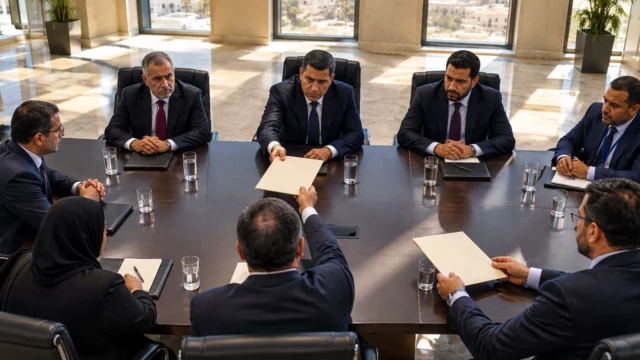
On 24 August 2026, the NOC formalised a production-sharing agreement with Chevron for Zone 106. This type of contract, often referred to by the acronym PSC, sets out the terms between the host state and the operator: the company advances exploration costs, then recovers them under mechanisms set out in the contract before profits are shared. Libya has adopted the fifth generation of its contractual model, EPSA-V, which the NOC says offers more flexibility in cost recovery than the previous model.
The area covers 7,437 sq km onshore. It lies in a basin already of strategic importance to Libyan production. The NOC also describes the block as still underexplored, with promising geological potential. On the Libyan side, NOC chairman Masoud Suleiman calls it an important step towards exploring and developing national resources. Chevron, meanwhile, has already described its return to the country as consistent with its strategy in North Africa and the eastern Mediterranean.
The timing matters as much as the signing. In February, the NOC announced the results of its first licensing round in 17 years. Of the 20 blocks offered, only five found buyers. The successful bidders included Chevron, Eni, QatarEnergy, the Repsol-TPAO-MOL consortium and Nigerian group Aiteo. The result shows that companies have a genuine interest, but also remain cautious about Libyan risk.
A sector in recovery, but still exposed to political divisions
Libya’s oil sector is advancing even as the country remains divided between rival authorities. In Tripoli, the Government of National Unity retains control of the NOC and the main oil revenues. In the east, Benghazi maintains its own political levers and regularly challenges certain economic decisions. This duality complicates every long-term commitment, particularly when contracts require stability, arbitration and legal predictability.
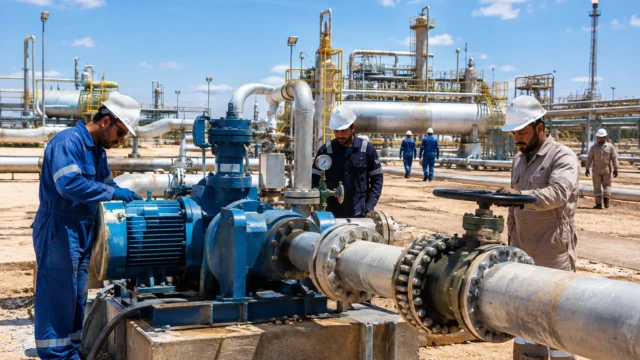
This fragility does not erase operational progress. In June 2026, the NOC’s daily crude output reached 1,438,560 barrels, with a further 49,163 barrels of condensate, bringing the total to 1,487,723 barrels. The company described this as its highest level since 2013. A few months earlier, its management said it aimed to reach 1.6 million barrels per day initially, then 2 million in the medium term. These targets will nevertheless require billions of dollars in investment in production, maintenance, drilling and infrastructure.
The contrast is clear. For the Libyan state, every additional barrel strengthens its fiscal position and supports imports, public-sector salaries and subsidies. For producing regions, however, the questions remain how revenues are distributed, the state of facilities and security around sites. The NOC itself stresses the need to transfer expertise and train Libyan teams alongside international partners. This matters in a country where rebuilding the sector depends as much on machinery as on engineers, technicians and procedures.
A significance that extends beyond Libya
The deal’s significance extends beyond Libya’s borders. For energy groups, Libya remains a strategic part of the Mediterranean Basin, close to European markets and rich in resources that are still underdeveloped. For North Africa, the stakes are broader: a revival in Libyan production could support export flows, but also affect the balance of energy cooperation between neighbours, particularly in a region where the Arab Maghreb Union remains politically paralysed.
At continental level, the episode is a reminder of a familiar reality in Africa’s hydrocarbons market: the majors return when the state demonstrates a minimum capacity for organisation, security and contracting. Libya is trying to prove precisely that. The next test, then, will not be merely signing a document, but turning the agreement into tangible work and then measurable results. That is where the next chapter will be decided in the coming months: in the field in the Sirte Basin and in offices in Tripoli.