Algeria
 Egypt
 Morocco
 Sudan
 Tunisia
 Benin
 Burkina Faso
 Cabo Verde
 Côte d'Ivoire
 Ghana
 Guinea
 Guinea-Bissau
 Liberia
 Mali
 Mauritania
 Niger
 Nigeria
 Senegal
 Sierra Leone
 The Gambia
 Togo
 Cameroon
 Central African Republic
 Chad
 DR Congo
 Equatorial Guinea
 Gabon
 Republic of the Congo
 São Tomé and Príncipe
 Burundi
 Comoros
 Djibouti
 Eritrea
 Ethiopia
 Kenya
 Madagascar
 Malawi
 Mauritius
 Mozambique
 Rwanda
 Seychelles
 Somalia
 South Sudan
 Tanzania
 Uganda
 Angola
 Botswana
 Eswatini
 Lesotho
 Namibia
 South Africa
 Zambia
 Zimbabwe
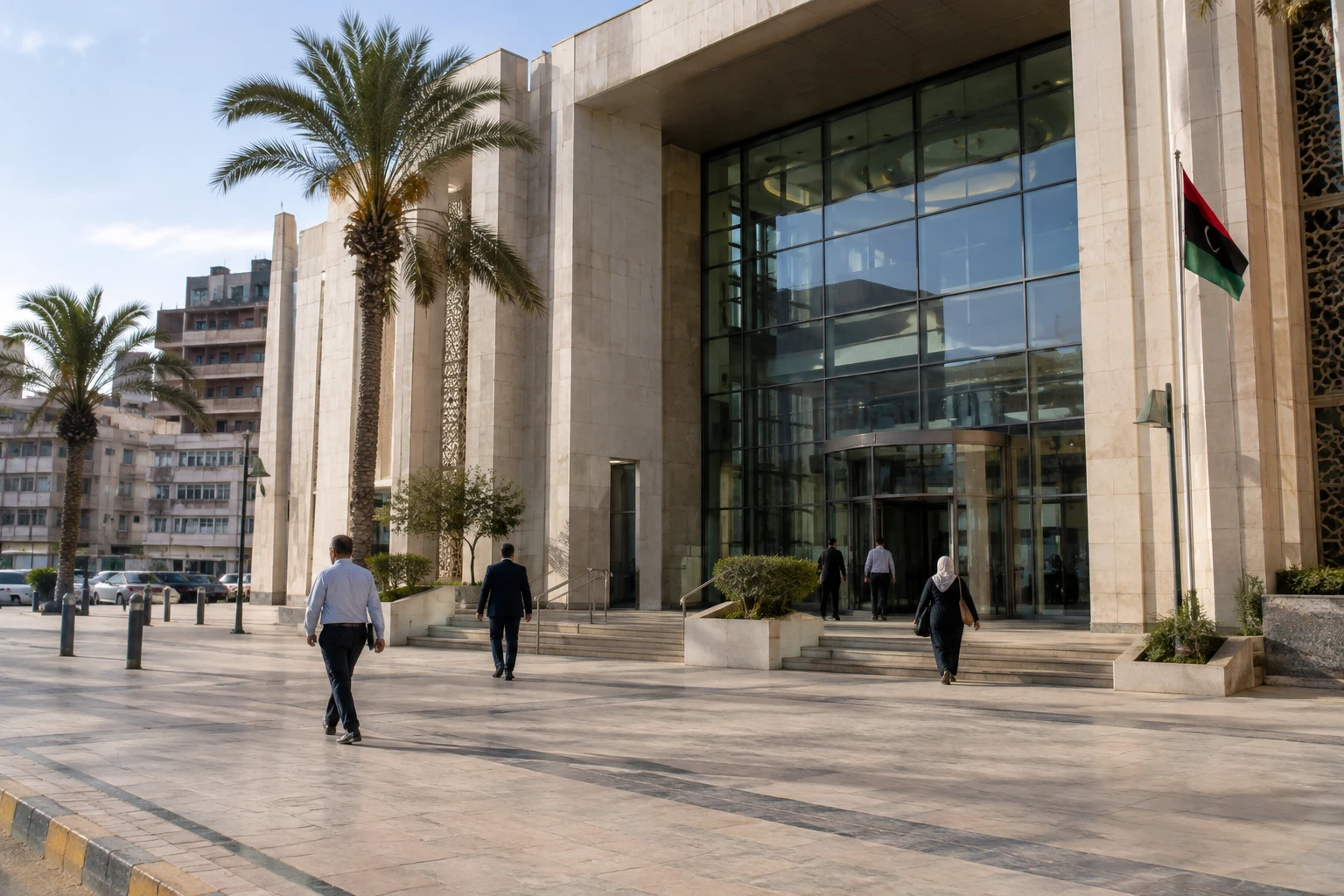
In Libya, a decision on the leadership of the Central Bank was followed on 22 October by the entry of unidentified people into its headquarters in Tripoli. The institution denounced an intrusion into its premises. The episode has brought a key question back to the fore: who can decide the leadership of an institution responsible for managing the country’s oil revenues ?
A transition announced, but not yet settled
The presidency of the House of Representatives, based in the east of the country, announced on 22 October that it had accepted « in principle » Naji Issa’s resignation, submitted in August. It appointed Fawzi Musbah Abukhzam, a member of the Central Bank’s board, to serve temporarily as governor. The resignation must still be considered by the House in a plenary session. The Libyan News Agency reported the decision and its provisional terms.
The significance of the announcement remains disputed. Officials from the High Council of State, an institution based in Tripoli and involved in Libya’s political arrangements, have expressed differing positions on the resignation and the interim appointment. The governor himself is reported to have contested the measure, according to Libyan media. These disagreements leave the effective status of the handover uncertain, beyond the decision published by the parliamentary presidency.
A few hours after the announcement, the Central Bank said that a force and other people had entered its headquarters and then the governor’s office in his absence. It did not identify the individuals or give details of the circumstances. In its statement, the institution blamed the parties involved and recalled that the defence ministry is responsible for protecting the building. The Tripoli-based government had not commented by the time reports were published on 22 October.
The Libyan News Agency report on the Central Bank’s response confirms the date and wording of the accusation. The agency also reported on the provisional decision concerning the governor. At this stage, the intrusion remains an account attributed to the institution: no independent identification of the people present has been published.
The Central Bank at the heart of a fragile balance
Libya remains divided between rival authorities in the west and east, despite efforts to bring its institutions closer together. The Central Bank has a strategic place in this balance. It manages public finances and hydrocarbon revenues, the state’s main source of income. A governance crisis at the institution could therefore go beyond the question of who leads it.
The 2024 precedent is a reminder of the possible consequences. A confrontation over the Bank’s leadership then disrupted oil production and financial transactions. The World Bank estimated that hydrocarbon production fell during the crisis. This precedent does not mean a repeat is inevitable, but it shows why decisions concerning the institution are being closely watched by economic and political actors.
Naji Issa’s appointment in 2024 followed an agreement between Libya’s main institutions, facilitated by the United Nations. This search for compromise responded to a crisis that had pitted officials in the west and east against each other over control of the Bank. The October 2026 announcement, however, comes as agreement on a long-standing resignation and its temporary replacement raises fresh questions about procedure and consent between institutions.
The dispute is therefore not limited to individuals. It also concerns how officials are appointed to a sovereign institution and whether rival bodies can act together. The Central Bank, for its part, says it cannot be held responsible for any measures taken following the intrusion and reserves the right to seek legal remedies to protect its offices and documents.
Effects that reach beyond Tripoli’s offices
For residents, institutional tensions can have tangible consequences if they affect public payments, imports or access to foreign currency. State employees and businesses reliant on banking transactions are particularly exposed to delays or uncertainty. The effects may vary between regions according to access to financial services and dependence on public spending. However, no direct impact on these services had been established in the information available about the incident.
Economic partners are also watching the stability of financial governance. A contested leadership at an institution can complicate budget planning and undermine confidence in payment procedures. But it would be premature to conclude that the reported intrusion alone caused financial disruption: the sources consulted do not report any suspension of the Bank’s operations following the episode.
The case also unfolds against an uncertain political timetable. On 30 August, Libyan actors signed an agreement under the auspices of the United Nations Support Mission in Libya, setting out steps towards elections and the reunification of institutions. In her briefing to the Security Council on 14 October, however, the UN special representative said the High Council of State rejected some decisions taken by the House of Representatives. The dispute over the Central Bank thus highlights the continuing gap between commitments to bring institutions closer together and their implementation.
Across North Africa, the stability of Libyan institutions also matters for regional trade and the management of energy resources. For the African Union and Libya’s neighbours, the issue goes beyond this appointment: it is a question of whether national institutions can function without becoming arenas for political confrontation. The next steps to watch are the House’s final decision on the resignation, clarification of Abukhzam’s role and any official response to the Bank’s accusations.