Algeria
 Egypt
 Libya
 Morocco
 Sudan
 Tunisia
 Benin
 Burkina Faso
 Cabo Verde
 Côte d'Ivoire
 Ghana
 Guinea
 Guinea-Bissau
 Liberia
 Mali
 Mauritania
 Niger
 Nigeria
 Senegal
 Sierra Leone
 The Gambia
 Togo
 Cameroon
 Central African Republic
 Chad
 Equatorial Guinea
 Gabon
 Republic of the Congo
 São Tomé and Príncipe
 Burundi
 Comoros
 Djibouti
 Eritrea
 Ethiopia
 Kenya
 Madagascar
 Malawi
 Mauritius
 Mozambique
 Rwanda
 Seychelles
 Somalia
 South Sudan
 Tanzania
 Uganda
 Angola
 Botswana
 Eswatini
 Lesotho
 Namibia
 South Africa
 Zambia
 Zimbabwe
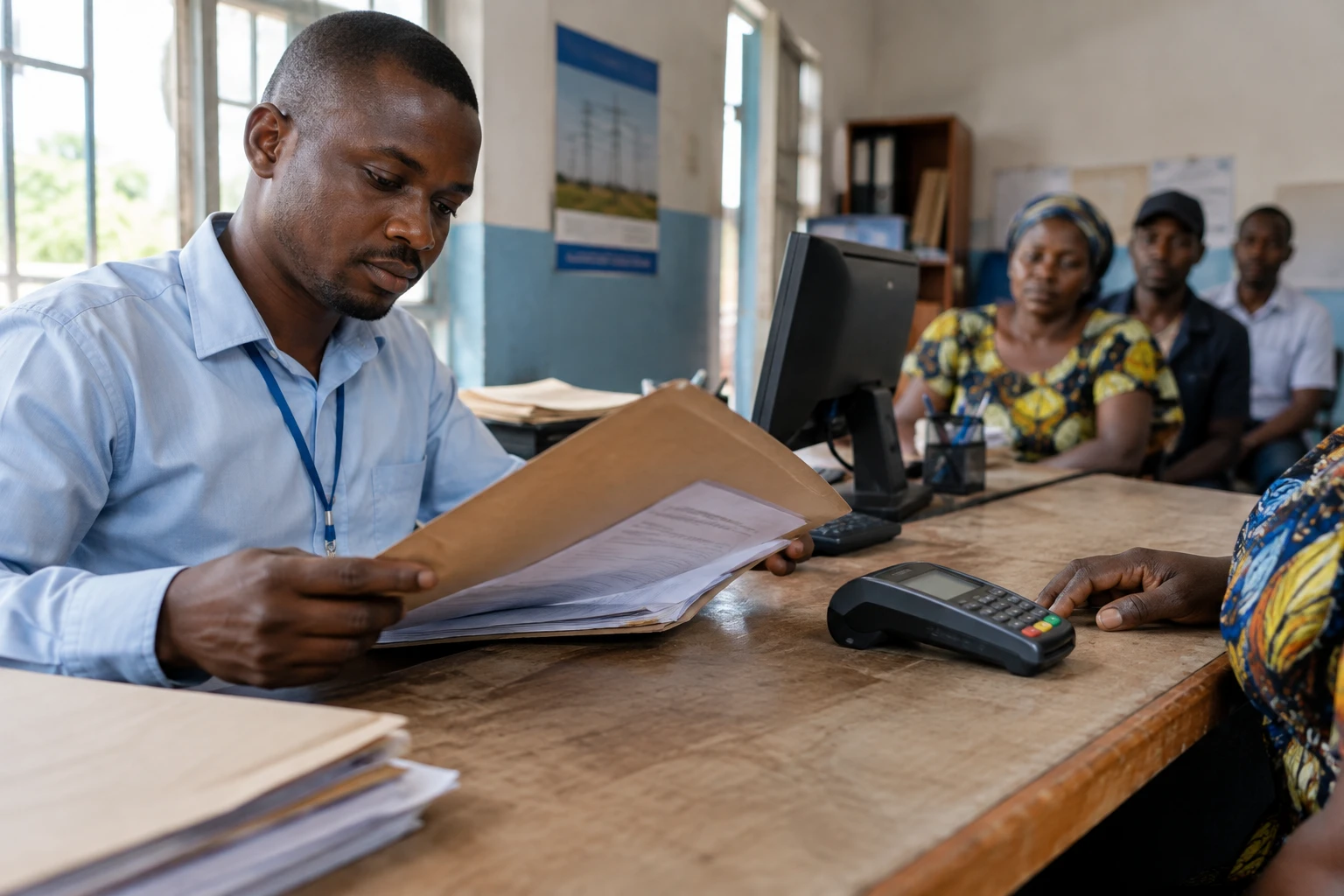
For residents of Kenge and the outskirts of Kinshasa, a new power plant will only change lives if electricity reaches homes and businesses. That is the challenge posed by the 100-megawatt (MW) solar project announced in Kwango: turning a cooperation agreement into electricity that is actually available.
A grid-connected project that still needs structuring
The Democratic Republic of the Congo has significant energy potential, but access to electricity remains limited and uneven. Estimates vary according to definitions and calculation methods. The 2024 report of the Electricity Sector Regulatory Authority distinguishes, in particular, between the access rate and the service coverage rate. This difference is a reminder that nearby infrastructure alone does not guarantee a regular service for households.
In this context, the National Agency for Electrification and Energy Services in Rural and Peri-urban Areas (ANSER) is seeking to develop both power plants connected to the national grid and local solutions. The National Electricity Company (SNEL), the state-owned company responsible for generation and distribution, would be the buyer and operator of the grid concerned.
The project is also part of a broader energy landscape. The DRC is a member of the Southern African Power Pool, which facilitates exchanges between the electricity grids of several countries in the region. However, the plant announced at Bukangalonzo is primarily intended to meet Congolese needs: its connection to the national grid and the grid’s capacity to carry the electricity will be decisive.
From 26 to 28 October 2026, an ANSER delegation led by its deputy director-general, Damien Twambilangana, travelled to Jinan, China. At the end of the visit, the agency signed a cooperation agreement with SEPCO, the operating subsidiary of Chinese state-owned group PowerChina. The DRC’s ambassador to China and Carousel Finance Africa, described as a facilitator of financial structuring, also took part in the discussions.
From announcement to commissioning: the decisive steps
The first phase provides for a 100 MW photovoltaic solar plant connected to the SNEL grid from the Bukangalonzo substation in Kwango province. The stated aim is to improve electricity supply to Kenge and the outskirts of Kinshasa. ANSER announced a June 2027 target, which was reported by several Congolese media outlets.
The agreement refers to broader cooperation encompassing energy infrastructure and industrial activities. The indicative allocation put forward is 70% for energy and 30% for industry. But these proportions describe a general direction: they specify neither which industrial projects have been selected nor how they will be financed.
The financing structure has not yet been detailed publicly. A supplier’s credit is being considered: in this arrangement, the company supplying equipment or carrying out the work provides financing that is repaid by the buyer or the state. Discussions with Sinosure, the Chinese state insurer specialising in commercial and investment risks, are expected to examine possible guarantees.
Several points therefore remain to be clarified before the announcement’s practical impact can be assessed: the total cost, the respective contributions of the partners, repayment terms and the electricity sales contract. The price per kilowatt-hour, the duration of guaranteed purchases by SNEL and the investments needed for the connection have not been specified in the information available. Without these details, it is difficult to assess how risks will be shared between the state, the state-owned company and private partners.
For users, the issue is not limited to installed capacity. The regularity of service, the price charged and the extension of power lines will determine who actually benefits from the output. Businesses in Kenge could have an additional energy source if the local grid can distribute it. In the outskirts of Kinshasa, the impact will also depend on transmission and distribution capacity further downstream.
A portfolio of partnerships at different stages
The agreement with SEPCO joins a series of deals developed by ANSER with foreign partners. However, they are not all at the same stage of progress. With German company GAUFF Engineering, the agency signed a commercial contract in March 2025 for an electrification programme covering 36 territories, valued at €150 million. The procurement contract was subsequently signed in Kinshasa on 2 April 2026. The programme provides for photovoltaic installations with storage and small hydropower plants.
In April 2026, ANSER also concluded a €25 million commercial contract with Off-Grid Europe for solar mini-grids. The announced first phase targets 8.5 MWp and about 27,700 households in six urban areas. A mini-grid generates and distributes electricity locally, without relying entirely on the national grid.
Other announcements should be distinguished from contracts being implemented. The memorandum concluded with French group ITRA on 1 September 2026 aims to prepare projects and mobilise a stated amount of about $900 million to develop 650 MW. Similarly, the agreement with SEPCO is a step towards cooperation, but published information does not indicate that an electricity purchase agreement has been signed with SNEL or that financing has been finalised.
Implementation will be the real measure
The growing number of projects could diversify the solutions available: large grid-connected plants, decentralised installations and mini-grids. It could also support economic activity beyond major urban centres. But comparing announcements is not enough. The next steps to watch are the publication of the financing structure, the signing of implementation and power purchase contracts, and then connection works at the Bukangalonzo substation.
For the DRC, the challenge therefore goes beyond the announcement of 100 MW. It is about turning international partnerships into functioning equipment, a grid capable of transmitting electricity and affordable tariffs. At regional level, the reliability of Congolese infrastructure will also affect the electricity exchanges in which the country can participate. The June 2027 date, presented as a target, will have to be assessed in light of these outstanding steps.