Algeria
 Egypt
 Libya
 Morocco
 Sudan
 Tunisia
 Benin
 Burkina Faso
 Cabo Verde
 Côte d'Ivoire
 Ghana
 Guinea
 Guinea-Bissau
 Liberia
 Mali
 Mauritania
 Niger
 Nigeria
 Senegal
 Sierra Leone
 The Gambia
 Togo
 Cameroon
 Central African Republic
 Chad
 Equatorial Guinea
 Gabon
 Republic of the Congo
 São Tomé and Príncipe
 Burundi
 Comoros
 Djibouti
 Eritrea
 Ethiopia
 Kenya
 Madagascar
 Malawi
 Mauritius
 Mozambique
 Rwanda
 Seychelles
 Somalia
 South Sudan
 Tanzania
 Uganda
 Angola
 Botswana
 Eswatini
 Lesotho
 Namibia
 South Africa
 Zambia
 Zimbabwe
Lunch as an urban lifeline
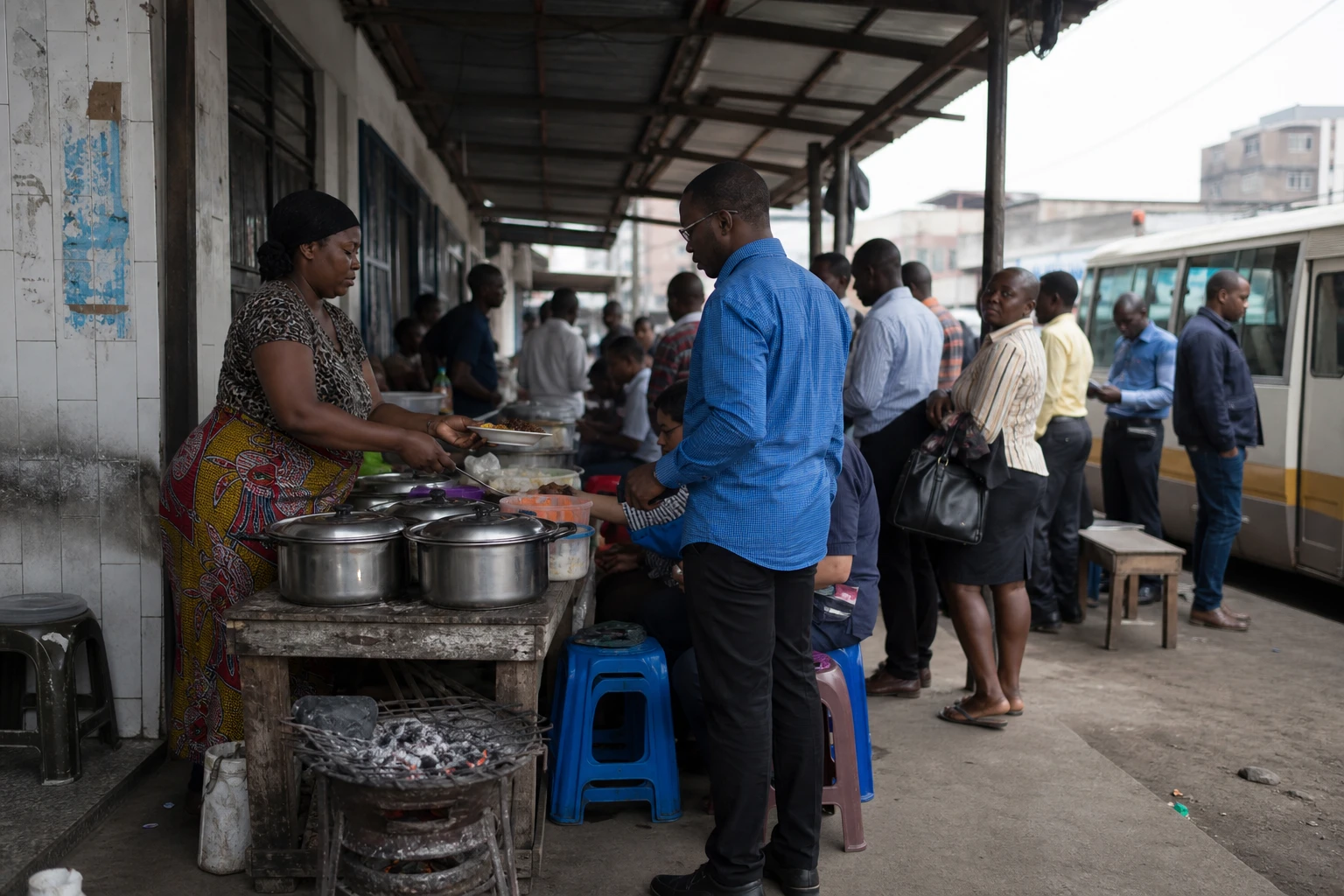
In Kinshasa, lunch is about more than habit. It meets a very practical need: living and working in a vast, densely populated city, often held up by traffic, where people cannot always go home to eat. In this setting, small street restaurants play a useful, understated and enduring role. They feed employees, drivers, vendors and local residents looking for an affordable hot meal.
These pavement canteens, locally known as malewa, have been part of the Congolese capital’s landscape for years. They have become a mainstay of everyday urban life, alongside markets, transport hubs and makeshift workshops. Their strength lies in their flexibility: they set up quickly, serve quickly and adapt to the means of people in the neighbourhood.
Kinshasa, a capital of organised informality
The Democratic Republic of the Congo remains a country where a large share of economic activity takes place in the informal sector – meaning income and jobs that largely fall outside traditional administrative channels. International institutions regularly point this out, while the African Development Bank also highlights persistent underemployment in Central Africa, where the urban economy relies heavily on activities with little capital investment.
In this context, malewa are not a folkloric curiosity. They are an economic response. In Kinshasa, the National Agency for Investment Promotion has recently supported women who run these restaurants in efforts to formalise their businesses, with the aim of giving them legal status and better access to support programmes. The issue is therefore no longer just culinary; it concerns employment, taxation, hygiene and recognition of women’s work.
The issue also extends beyond the capital. Across Africa, street food is not an add-on to modern city life; it often serves as neighbourhood social infrastructure. It provides low-cost meals, absorbs some of the demand for food and generates income for thousands of women and men without access to stable employment. The World Bank stresses the central role of the urban informal sector in securing incomes and meals.
Pots, charcoal and an everyday economy
The system is simple at its core. In the morning, the women who run the restaurants go to market to buy vegetables, meat, fish or beans, then cook on site, often over charcoal. Menus follow what is available and what customers can afford. They include foufou, okra, cassava leaves, chicken, fish, pork and beans. The dishes are popular and familiar, served without unnecessary ceremony.
This artisanal approach makes it possible to sell food at prices suited to tight budgets. For a bus driver, an office worker or someone living far from the centre, a malewa saves time while providing a full meal. In Kinshasa, where distances and traffic jams weigh on the working day, lunch on the pavement is as practical as it is economical.
The model also rests on a chain of women’s knowledge. Many of the women who run the restaurants learned to cook within their families, from a mother, an aunt or an older woman already established in the trade. Word of mouth does the rest, building a stall’s reputation more reliably than a signboard. Customers in this business are looking not only for a price, but also for consistent flavour, proximity and a degree of trust.
What these street tables say about the Congolese city
Malewa illustrate an important reality of Kinshasa: the Congolese urban economy also runs on a small scale, with limited means but a great deal of social interaction. Behind every pot is a woman who buys, prepares, serves and starts again the next day. Behind every queue of customers are irregular schedules, modest wages and long commutes. This economy absorbs some of the labour market’s vulnerabilities without resolving them.
It also raises a public health question. The authorities and public radio stations have already warned about sometimes precarious hygiene conditions in some makeshift restaurants: water, dishes, storage, dust and exposure to insects all require vigilance. In other words, the popularity of malewa does not remove the need for appropriate health regulation. The right response is not a sweeping ban, but a gradual improvement in practices and selling spaces.
This is where the issue becomes political. Formalising these activities does not mean changing their nature. It means giving them simple rules, a manageable tax framework, access to water and sanitation and, if possible, start-up credit. The ANAPI has recognised this by launching a regularisation process for dozens of women restaurant owners in Kinshasa. This movement says something broader about the DRC: urban growth cannot be considered solely through large companies or mines; it also takes place in the street, where Congolese people eat, work and organise their daily lives.
The continental significance is clear. From Dakar to Kinshasa, Yaoundé to Nairobi, African cities are moving forward with an economy built on quick meals, street trading and neighbourhood entrepreneurship. The case of Kinshasa shows that serious urban policy cannot ignore these actors. It must recognise, regulate and protect them without destroying what makes them socially useful. In Kinshasa, an affordable lunch is not a minor detail of pavement life. It is part of the city’s equilibrium.