
 Algeria
 Egypt
 Libya
 Morocco
 Sudan
 Tunisia
 Benin
 Burkina Faso
 Cabo Verde
 Côte d'Ivoire
 Ghana
 Guinea
 Guinea-Bissau
 Liberia
 Mali
 Mauritania
 Niger
 Nigeria
 Senegal
 Sierra Leone
 The Gambia
 Togo
 Cameroon
 Central African Republic
 Chad
 Equatorial Guinea
 Gabon
 Republic of the Congo
 São Tomé and Príncipe
 Burundi
 Comoros
 Djibouti
 Eritrea
 Ethiopia
 Kenya
 Madagascar
 Malawi
 Mauritius
 Mozambique
 Rwanda
 Seychelles
 Somalia
 South Sudan
 Tanzania
 Uganda
 Angola
 Botswana
 Eswatini
 Lesotho
 Namibia
 South Africa
 Zambia
 Zimbabwe
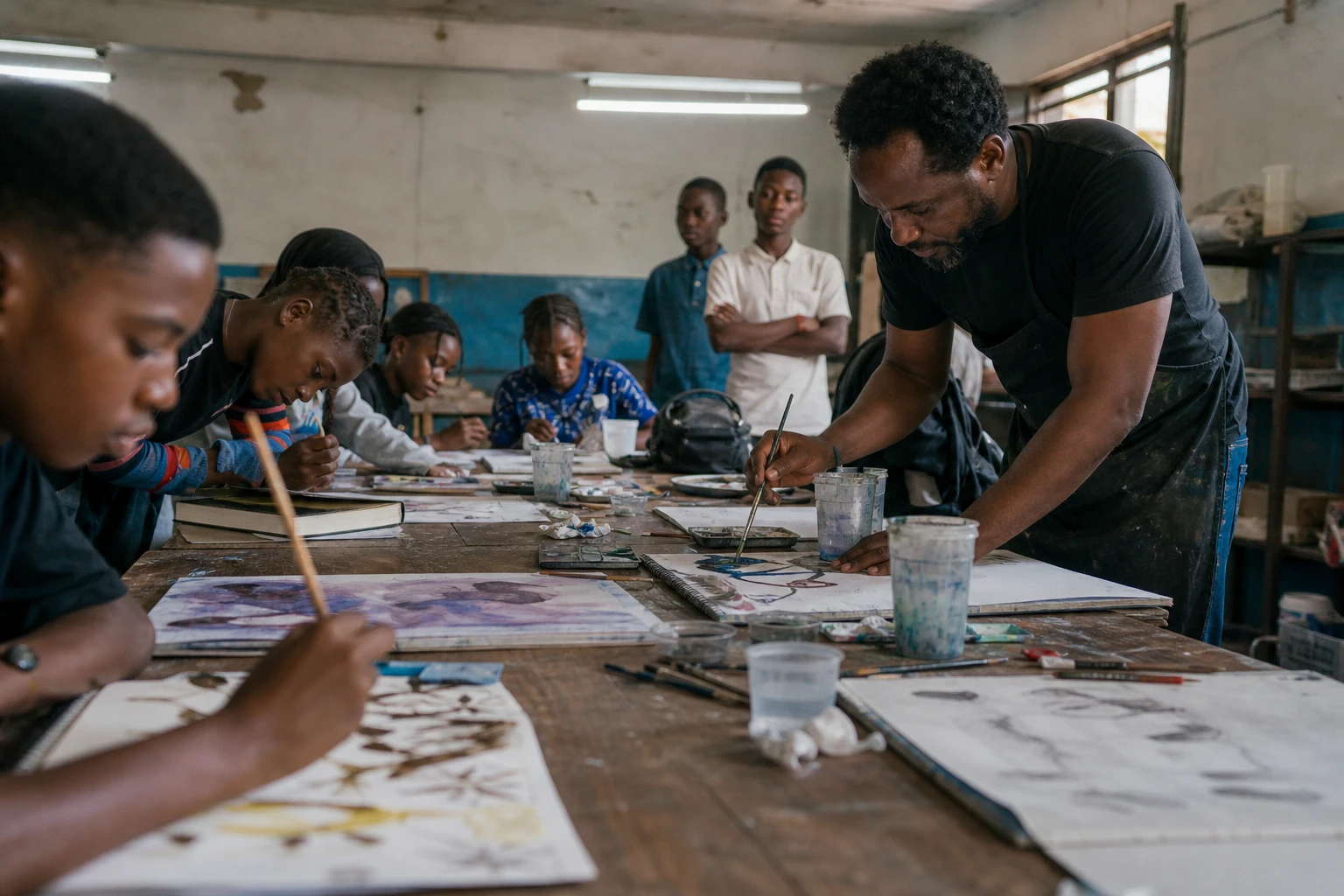
When night becomes a neighbourhood workshop
In Kinshasa, night is not only a time for alertness and vigilance. Sometimes it is also a space for meeting, listening and rebuilding confidence for young people whom the city too often leaves behind. In several working-class districts of the Congolese capital, artists have chosen to turn this fragile time into an opportunity for shared creativity.
The starting point remains stark. In the Democratic Republic of the Congo, public and voluntary-sector child-protection services are trying to address a longstanding problem that is even more visible in large cities such as Kinshasa. A study cited by UNICEF notes that Kinshasa province had 13,877 out-of-school children, while support organisations estimated in 2024 that around 50,000 children were living on the streets of the capital. This figure should be understood as an estimate given by people working on the ground, not as a single official census.
It is in this context that grassroots initiatives such as Butu nde Makambu are emerging. The Lingala expression is a reminder that the night has its own realities. For three years, the collective has run painting, dance, music and drawing workshops in working-class neighbourhoods of Kinshasa. The idea is simple: bring together children living on the streets and other young people who go home in the evening, so they can share the same creative space. The project does not promise a miracle solution. It offers a framework, a presence and a routine.
Paintbrushes against street life, without romanticising it
In accounts from the field, children do not first ask for a grand speech. They ask for a place. In Kinshasa, emergency shelters and UNICEF partner organisations regularly describe this need for immediate protection, followed by family reunification or referral to foster families when possible. The Congolese institutional approach is based on this same logic: providing shelter, follow-up and then reintegration.
The arts project follows this same model, but uses its own tools. Here, the paintbrush takes the place of an instruction. The rhythm of dance replaces a reprimand. Music serves as a way in for teenagers who are often wary of conventional settings. It is a way of saying that child protection is not just about providing material care, but also recognising young people’s talents and giving them a voice. This view is in line with the work of Congolese institutions and organisations, which are stepping up training in identifying, supporting and reintegrating children living on the streets of Kinshasa.
The case of Chris, 12, illustrates what these workshops seek to foster before it is too late. An orphan living on the streets in Lemba, he says he wants to learn to draw better. This desire may seem modest, but it says everything: a child can still imagine a future when a safe environment allows them to do so. In street settings, this simple return to a personal goal is already a means of protection. At least for a time, it takes children away from survival strategies that expose them to violence, harmful substance use and deeper ruptures.
Plamedy Masinga, who leads the painting workshop, stresses this point: passing on an artistic skill also opens up a career prospect. The issue is not just cultural. It is social and economic. In a city where many families depend on informal work, a creative activity can provide an initial step towards self-esteem, then income, training or a support network. This is precisely where local initiatives such as Butu nde Makambu prove their worth: they work on a small scale, but in an area that public policies still struggle to reach everywhere.
What Kinshasa tells the DRC and the continent
The Congolese experience goes beyond the capital. Across Central Africa, the issue of children living on the streets reflects similar urban trajectories: rapid city growth, household hardship, incomplete schooling, internal migration and weak social safety nets. The response cannot therefore be purely punitive. It must combine prevention, schooling, social protection, mental health care and community support. This is also the aim of initiatives led by the Ministry of Social Affairs, the National Fund for the Promotion of Women and the Protection of Children, and UNICEF partners in the DRC.
The continent-wide significance is clear. In several African capitals, the street remains the last refuge for minors who have lost a parent, fled violence or left school too early. In Kinshasa, responses that combine art, support and reintegration offer an approach for other cities facing the same challenge. They are a reminder that child policy should be measured not only by the number of facilities opened, but by their ability to reach young people where they are, without reducing them to their vulnerability alone.
One central question remains: how can isolated initiatives be made continuous? In Kinshasa, efforts to identify and count vulnerable children are multiplying, while grassroots organisations continue their support work. What comes next will depend on how voluntary-sector energy, public support and local engagement are brought together. For many children in the capital, the first victory is not immediate reintegration. It is first to be seen, heard and protected early enough for the future to become imaginable again.



