Algeria
 Egypt
 Libya
 Morocco
 Sudan
 Tunisia
 Benin
 Burkina Faso
 Cabo Verde
 Côte d'Ivoire
 Ghana
 Guinea
 Guinea-Bissau
 Liberia
 Mali
 Mauritania
 Niger
 Nigeria
 Senegal
 Sierra Leone
 The Gambia
 Togo
 Cameroon
 Central African Republic
 Chad
 DR Congo
 Equatorial Guinea
 Gabon
 Republic of the Congo
 São Tomé and Príncipe
 Burundi
 Comoros
 Djibouti
 Eritrea
 Ethiopia
 Madagascar
 Malawi
 Mauritius
 Mozambique
 Rwanda
 Seychelles
 Somalia
 South Sudan
 Tanzania
 Uganda
 Angola
 Botswana
 Eswatini
 Lesotho
 Namibia
 South Africa
 Zambia
 Zimbabwe
When lawyers leave the courtroom
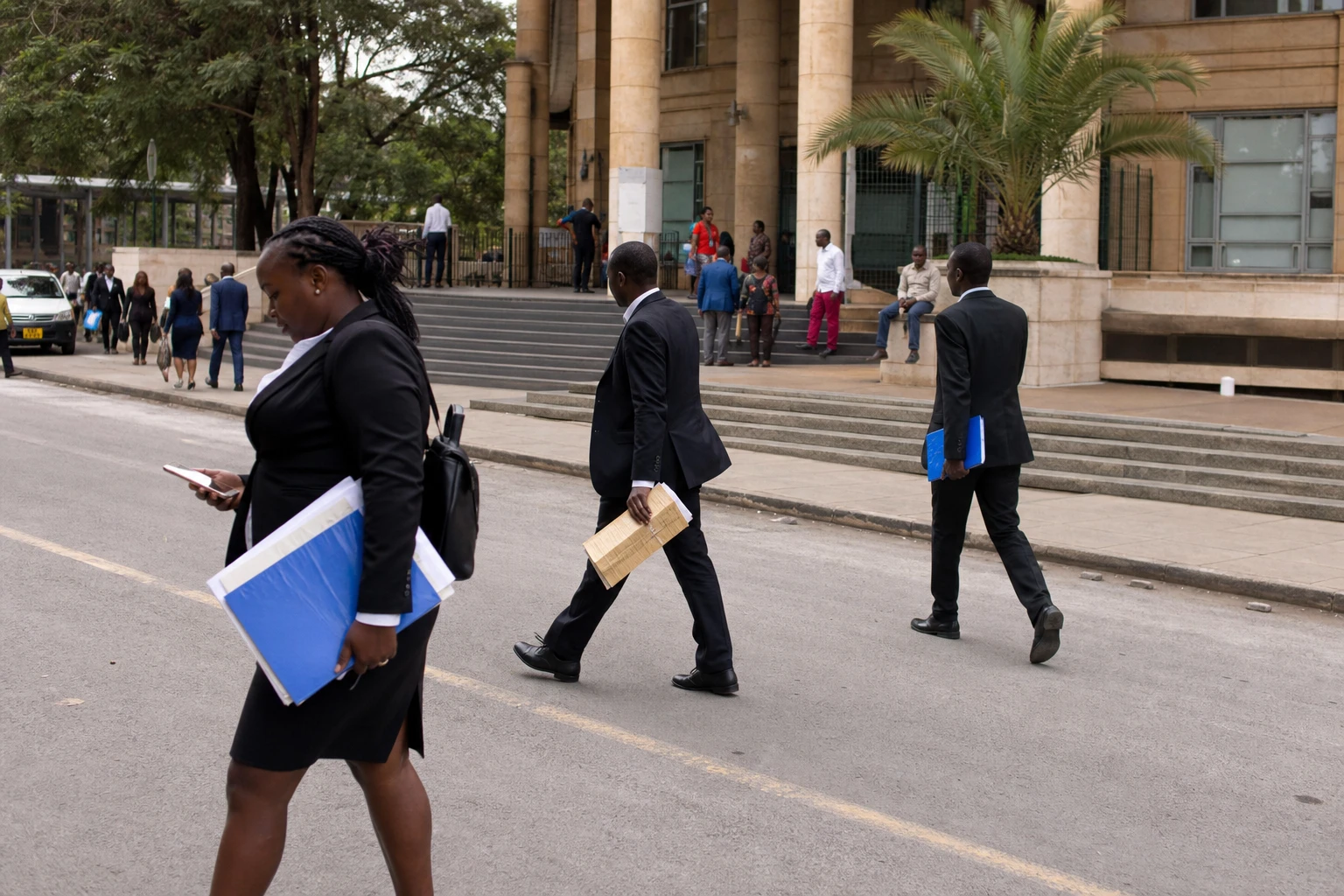
In Kenya, the signal is powerful when lawyers stop entering the courts. The move does more than stall cases. It also highlights a broader question: how can justice be made credible when users complain of delays, repeated adjournments and persistent suspicions of corruption?
The country is a central player in East Africa and the East African Community, where judicial institutions are often seen as a test of the rule of law. In Nairobi, home to the Supreme Court and the judiciary, pressure on the courts is also reflected in official reports: the Judiciary’s 2023-2024 report noted 635,262 pending cases at the end of the financial year, even though the case clearance rate reached 99% during the period.
What the Law Society decided
On 22 July 2026, the Law Society of Kenya launched a national court boycott. The action, announced a few days earlier in Machakos by its president, Charles Kanjama, took an initial form: a day without submissions or applications before the country’s courts. A second, more targeted phase is expected to focus on certain judges and magistrates suspected of obtaining orders that hindered investigations by the Judicial Service Commission or the EACC, Kenya’s Ethics and Anti-Corruption Commission.
The protest centres on a list of grievances familiar to court users: corruption, professional misconduct, abuse of power, delayed judgments, mounting case backlogs and too many adjournments. In its statement, the Law Society said it had held repeated discussions with Chief Justice Martha Koome without receiving a response it considered adequate. The action is therefore intended both to raise public alarm and to exert institutional pressure.
On the same day, anti-corruption authorities announced the arrest of a magistrate suspected of soliciting 170,000 Kenyan shillings to influence the outcome of a criminal case, according to the Kenyan press. The episode matters not because it sums up the entire system, but because it feeds a sense of déjà vu: citizens hear about reforms, then learn of new bribery cases or procedural obstruction.
A long-standing malaise, now documented
The problem is not only a moral one. It is also administrative and structural. The judiciary’s 2023-2024 annual report recorded 1,115 complaints against members of the judiciary, including 141 concerning judges. The same document says the complaints relate to ethical breaches, professional misconduct and procedural abuses. In other words, the debate is not just about a few individuals. It concerns how the system is overseen, sanctioned and made understandable to the public.
The judiciary, however, says it has improved its performance. In November 2024, the Supreme Court presented an annual report showing an improvement in the clearance rate, with 516,121 cases filed against 509,664 resolved, and a fall in the overall backlog. But these broad gains are not enough to dispel users’ day-to-day experience, especially in overloaded courts where adjournments, queues and missing documents prolong disputes.
The tension is therefore visible on two levels. For ordinary court users, every delay comes at an immediate cost: lost wages, a stalled business case, a prolonged family dispute, or sometimes months with their freedom suspended. For lawyers, the issue also concerns professional ethics. Continuing to appear in court as if nothing were wrong may, in their eyes, look like tacit acceptance of dysfunction. The boycott is specifically intended to break this appearance of normality.
The political fallout of a judicial dispute
The mobilisation extends beyond the legal profession. In Kenya, the courts often become a decisive battleground when a political or electoral crisis looms. Post-election disputes, challenges to appointments and corruption cases regularly end up before the courts. When the Law Society talks of “boycotting” certain judges, it is therefore touching on more than professional discipline. It is also affecting public confidence in the adjudication of major national disputes.
Anti-corruption institutions, meanwhile, are working on several fronts. The EACC has recently shown that it is pursuing cases involving both front-line staff and more serious allegations, including the arrest of a court assistant in Mombasa for allegedly asking for 10,000 shillings to conceal a court file. This chain of events points to a widespread problem: from the registry counter to the courtroom, corruption can creep into the most routine procedures and delay access to justice.
In this context, the question is not whether Kenya’s justice system works or not in absolute terms. It is about measuring the gap between declared reforms and practitioners’ perceptions. In Nairobi and in county courts, the credibility of justice depends on how long cases take, how files are managed, the transparency of disciplinary processes and the ability to deal swiftly with allegations of internal corruption. Without that, every new performance statistic will be viewed through a lens of suspicion.
The implications are regional, too. Across the East African Community, where investors, commercial disputes and cross-border families move between countries, a judicial system seen as slow or vulnerable to corruption undermines legal certainty. The Kenyan case is a reminder that an effective justice system is not merely a matter of institutions. It is a factor in economic stability, civic trust and regional standing.