Algeria
 Egypt
 Libya
 Morocco
 Sudan
 Tunisia
 Benin
 Burkina Faso
 Cabo Verde
 Côte d'Ivoire
 Ghana
 Guinea
 Guinea-Bissau
 Liberia
 Mali
 Mauritania
 Niger
 Nigeria
 Senegal
 Sierra Leone
 The Gambia
 Togo
 Cameroon
 Central African Republic
 Chad
 DR Congo
 Equatorial Guinea
 Gabon
 Republic of the Congo
 São Tomé and Príncipe
 Burundi
 Comoros
 Djibouti
 Eritrea
 Ethiopia
 Madagascar
 Malawi
 Mauritius
 Mozambique
 Rwanda
 Seychelles
 Somalia
 South Sudan
 Tanzania
 Uganda
 Angola
 Botswana
 Eswatini
 Lesotho
 Namibia
 South Africa
 Zambia
 Zimbabwe
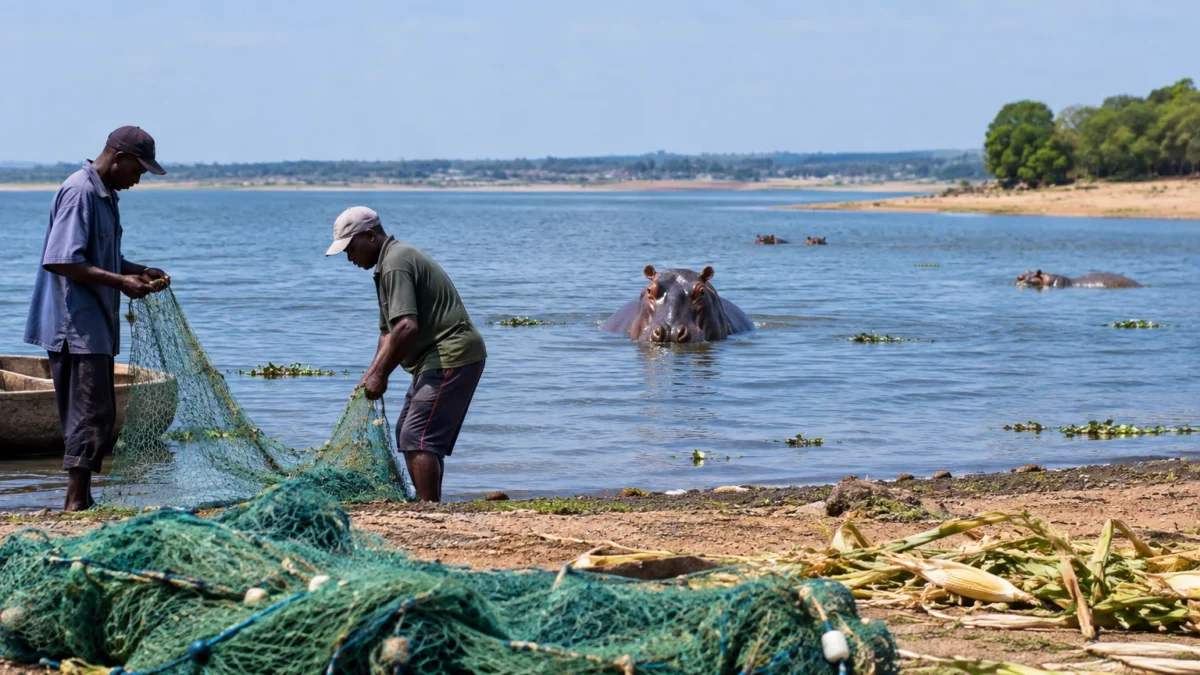
At Lake Naivasha, an abandoned fishing net and agricultural residues have been linked to the deaths of hippos. The findings are a reminder that everyday activities around a lake can affect wildlife, as well as the fishing, farming and tourism on which local people depend.
The Kenya Wildlife Service (KWS), the Kenyan agency responsible for wildlife protection, confirmed two probable causes after post-mortem examinations. The investigation into the other reported carcasses remains separate: findings concerning two animals are not enough to explain all the reported deaths.
A lake shared by wildlife and human activities
Located in Nakuru County in the Rift Valley, Lake Naivasha is a freshwater site recognised under the Ramsar Convention, an international agreement dedicated to protecting wetlands. It supports fishing, floriculture, tourism and geothermal power generation, among other activities. These uses take place in an area also home to hippos and numerous bird species.
A census conducted by the Kenyan Wildlife Research and Training Institute in December 2022 counted 686 hippos at Naivasha and in nearby wetlands. Researchers had already identified illegal fishing, shoreline degradation and the occupation of lakeside areas as pressures on their habitat. This figure is a 2022 benchmark, not a current estimate of the population.
Pressure on the lake’s shores has coincided with recent changes in its water level. In April 2026, the Kenyan daily The Standard reported that rising water had covered grazing land and pushed animals towards roads, farms and inhabited areas. The consequences affect displaced animals, farm workers, fishers and residents of lakeside areas alike.
Two post-mortems establish causes, not a complete toll
In a statement reported on 19 November 2026 by the Kenyan outlet Citizen Digital, the KWS detailed the results of two post-mortem examinations. The first hippo, a subadult female, had swallowed an abandoned synthetic net. According to the veterinarians, it had caused a complete obstruction between the stomach and small intestine, leading to cardiorespiratory failure.
In the second case, specialists found a large build-up of gas in the stomach of an adult female. Maize stalks were among its contents and may have contributed to excessive fermentation. The swelling is thought to have compressed the lungs and impaired breathing. The KWS presents these findings as the probable mechanism of death, not as a conclusion that applies to the other animals.
Figures released about the series of deaths vary according to the information available. On 19 November, Citizen Digital referred to at least six hippos recently reported dead. The following day, Pulse Kenya reported an investigation into at least seven animals between 28 October and 19 November. The Daily Nation, meanwhile, reported nine deaths reported by local residents, while the KWS had located five carcasses and said another report remained to be verified. These counts are therefore not equivalent: some tally reports, while others count bodies confirmed or examined.
Risks converge on the lake’s shores
For fishers, the lake is a source of livelihood, but their work brings them into contact with hippos. Lost or discarded nets pose an additional danger to animals grazing near the shore. Agricultural waste can also affect their diet. Reducing these risks requires appropriate management practices, without placing all the responsibility on communities that depend on the lake.
Tensions involve more than wildlife. When grazing areas shrink or become less accessible, hippos venture closer to farms and roads. Residents, fishers who sometimes work in the water and farm workers may then face dangerous encounters. In 2026, Grace Nyambura, a representative of local fishing organisations, told The Standard that conflicts around the lake had increased, linking them in part to the loss of grazing land as water levels rose.
This situation calls for a co-ordinated response involving the KWS, fisheries services, the Nakuru County authorities, farmers and local beach management organisations. Monitoring used nets, protecting shorelines and regularly tracking hippos can help prevent further incidents. The Kenyan Lake Naivasha Basin Ecosystem Management Project already highlights water governance, wetland restoration and sustainable land management — issues that concern livelihoods as much as biodiversity.
A local issue tied to regional commitments
Naivasha is a Kenyan lake, but the pressures on wetlands extend beyond national borders. Kenya is a member of the East African Community (EAC), which brings together several countries in the region and has a framework for co-operation on wildlife conservation. The organisation highlights threats linked to the expansion of human activities, pollution and the degradation of shared ecosystems.
The situation at Naivasha is a reminder that protecting wildlife is not just a matter of counting carcasses after the fact. It also requires monitoring the condition of habitats and the causes of conflict, with the involvement of communities that depend on the lake. The immediate next step is to clarify the number of confirmed deaths and determine whether further post-mortems will identify similar causes. For now, the available examinations document two specific cases, while the full scale of the series remains to be established.