Algeria
 Egypt
 Libya
 Morocco
 Sudan
 Tunisia
 Benin
 Burkina Faso
 Cabo Verde
 Côte d'Ivoire
 Ghana
 Guinea
 Guinea-Bissau
 Liberia
 Mali
 Mauritania
 Niger
 Nigeria
 Senegal
 Sierra Leone
 The Gambia
 Togo
 Cameroon
 Central African Republic
 Chad
 DR Congo
 Equatorial Guinea
 Gabon
 Republic of the Congo
 São Tomé and Príncipe
 Burundi
 Comoros
 Djibouti
 Eritrea
 Ethiopia
 Madagascar
 Malawi
 Mauritius
 Mozambique
 Rwanda
 Seychelles
 Somalia
 South Sudan
 Tanzania
 Uganda
 Angola
 Botswana
 Eswatini
 Lesotho
 Namibia
 South Africa
 Zambia
 Zimbabwe
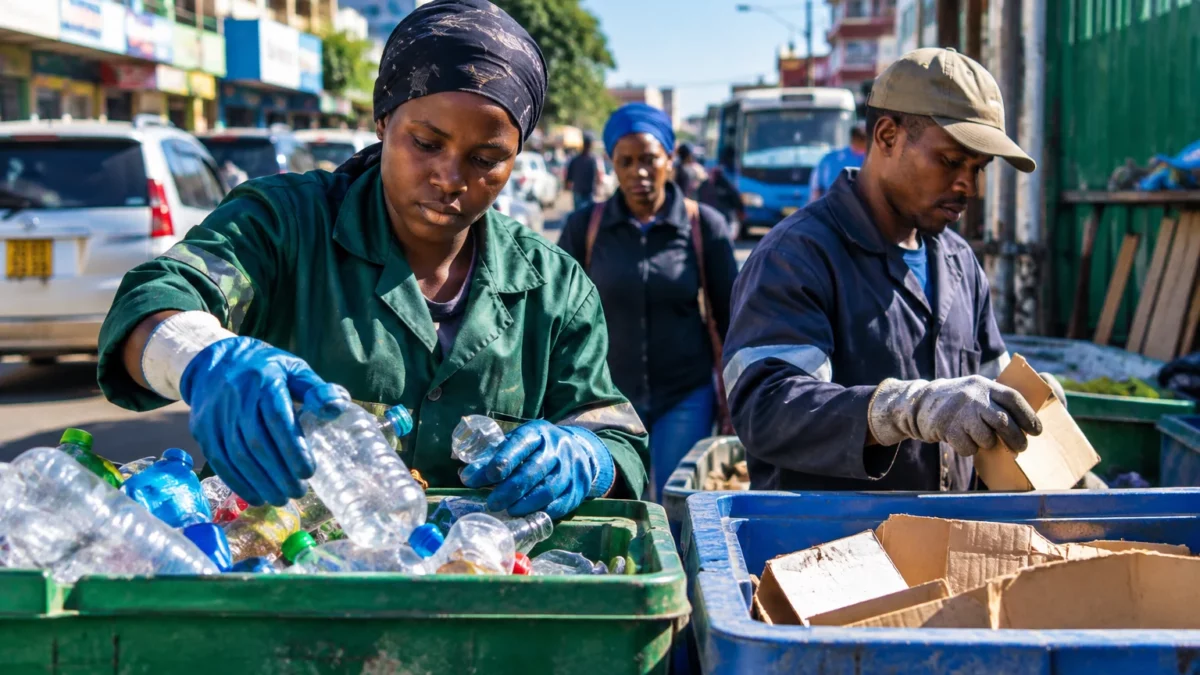
In Kenya, turning waste into raw materials requires much more than sorting centres. It also means organising collection, financing equipment and ensuring an income for people who already recover these materials. The scope of the new national roadmap will be determined at this level.
Launched on 24 November 2026 in Nairobi, the National Circular Economy Strategy and its implementation plan, the CESIP 2027-2032, aim to structure these activities. The document sets priorities and targets, but several outcomes will still depend on funding, action by counties and business participation.
From legal framework to sector organisation
Kenya already has a regulatory foundation. The Sustainable Waste Management Act, which came into force on 26 July 2022, governs waste management and extended producer responsibility, among other areas. This principle requires manufacturers to contribute to the management of their products after use. Regulations adopted in 2024 specify, in particular, obligations relating to packaging and collection. Kenya’s Sustainable Waste Management Act thus provides a legal basis for the strategy, which must now encourage investment and coordinate the sectors.
The CESIP identifies five sectors: agriculture and food systems; plastics and packaging; electrical and electronic equipment; textiles and clothing; and mining, quarrying and construction. In agriculture, the aim is, among other things, to turn organic residues into compost or other products. Elsewhere, the plan focuses on collection, repair, reuse and recycling of materials.
According to the National Environment Management Authority (NEMA), Kenya produced about 25,000 tonnes of waste a day in 2023. Organic materials accounted for 60% and recyclable materials for 30%. These estimates indicate the scale of the waste streams, but do not in themselves show what proportion is actually collected or recovered. NEMA data on waste composition also highlight the potential of composting and materials recovery.
Targets still to be funded and measured
The plan estimates that the circular economy could create economic opportunities worth $800 million. It puts financing needs at 45.4 billion Kenyan shillings, or about $349 million. These figures are estimates, not investments already secured. Another official presentation of circular investment in Kenya cited an opportunity worth $730 million, so figures vary according to the scope and assumptions used. They should not be read as a promise of guaranteed revenue.
The CESIP also targets 30,000 additional jobs by 2032, compared with a baseline that is to be established in 2028. The draft strategy had already identified more than 46,000 jobs linked to the circular economy in 2023, but noted that this estimate needed to be confirmed. The new target therefore measures expected growth, not the total number of jobs the sector is expected to have in 2032. The Kenyan draft strategy and its indicators also provide for monitoring waste separation at source and recycling rates.
Implementation is due to begin with a preparatory phase in 2027, before the operational roll-out planned for 2028 to 2032. The government intends to mobilise counties, the private sector and development partners. The national agency responsible for promoting investment is to facilitate projects and partnerships. It remains to be clarified how funds will be allocated between infrastructure, businesses and local services.
Counties and workers at the heart of implementation
The strategy cannot deliver results from Nairobi alone. Counties organise a large share of local waste collection and management services. Needs differ between large cities, where volumes are high, and rural areas, where distances and the scattered nature of waste make collection more difficult. Without sorting and transport systems adapted to each area, increasing recycling will remain a challenge.
Informal-sector workers, particularly collectors and waste pickers, already play an essential role in recovering materials. Their integration into new value chains will be crucial. Contracts, protective equipment and more predictable incomes could strengthen their economic security. Conversely, systems designed without them could displace their activities in favour of larger operators. Kenya’s environment ministry says preparatory consultations involved informal-sector actors, county governments, businesses and civil society organisations.
For businesses, the challenge is also industrial: reusing more recovered materials can reduce reliance on virgin materials, but requires consistent quality and processing infrastructure. In textiles, electronics and construction, collection is only the first step. Markets and standards are then needed to allow recycled materials to re-enter production.
A test of coordination for East Africa
Kenya is a member of the East African Community (EAC), which brings together several economies facing shared challenges in production, trade and waste management. The CESIP remains a national framework, but the cross-border movement of goods and materials could make compatible approaches useful: recovery rules, recycling standards and markets for secondary materials.
The next step will be to see whether the announced timetable translates into budgets, clearly allocated responsibilities and comparable data. The plan provides for a preparatory year in 2027 and an initial employment baseline in 2028. These milestones will make it possible to assess progress beyond the announcements. For households, businesses and waste recovery workers, outcomes will depend above all on accessible services, real markets for recycled materials and a fair distribution of the value created.