Algeria
 Egypt
 Libya
 Morocco
 Sudan
 Tunisia
 Benin
 Burkina Faso
 Cabo Verde
 Ghana
 Guinea
 Guinea-Bissau
 Liberia
 Mali
 Mauritania
 Niger
 Nigeria
 Senegal
 Sierra Leone
 The Gambia
 Togo
 Cameroon
 Central African Republic
 Chad
 DR Congo
 Equatorial Guinea
 Gabon
 Republic of the Congo
 São Tomé and Príncipe
 Burundi
 Comoros
 Djibouti
 Eritrea
 Ethiopia
 Kenya
 Madagascar
 Malawi
 Mauritius
 Mozambique
 Rwanda
 Seychelles
 Somalia
 South Sudan
 Tanzania
 Uganda
 Angola
 Botswana
 Eswatini
 Lesotho
 Namibia
 South Africa
 Zambia
 Zimbabwe
Attracting foreign capital without losing control of national priorities is one of Côte d’Ivoire’s challenges for the next five years. Frank-Walter Steinmeier’s visit to Abidjan puts this question at the heart of dialogue between Berlin and Yamoussoukro, seat of Côte d’Ivoire’s political capital.
A partnership tested by Côte d’Ivoire’s ambitions
The German president arrived in Abidjan on Sunday 22 November 2026 for an official 24-hour visit. He was welcomed by Vice-President Tiémoko Meyliet Koné. On Monday 23 November, he met President Alassane Ouattara at the presidential palace. The Ivorian news agency AIP and the pan-African agency APA confirm the dates and the purpose of the visit. The announcement of Steinmeier’s arrival in Abidjan also places this stop within a tour of Ghana and then Kenya.
The visit comes as Ivorian authorities seek partners for the National Development Plan (PND) 2026-2030. This framework sets out the country’s priority investments and reforms. The programme envisages 114,838.5 billion CFA francs in investment, of which 70.2% is expected to come from the private sector, according to government figures. Infrastructure, agriculture, energy and industry are among the areas covered. The Ivorian government details the PND’s financial targets.
The visit also forms part of a longstanding relationship: diplomatic relations between the two countries date back to 1960, shortly after Côte d’Ivoire’s independence. According to figures cited during the presidential talks, bilateral trade exceeded €1.4 billion in 2025, following a 21% increase. The figure was reported by several media outlets on the occasion of the meeting. It points to an already significant economic relationship, with further scope to grow.
Concrete projects beyond the announcements
Frank-Walter Steinmeier was accompanied by a delegation of German businesses. For several of them, Côte d’Ivoire represents a market to explore, despite their existing experience elsewhere on the continent. The challenge is to turn diplomatic meetings into sustainable projects with local benefits: jobs, skills, Ivorian subcontracting and more reliable access to essential services.
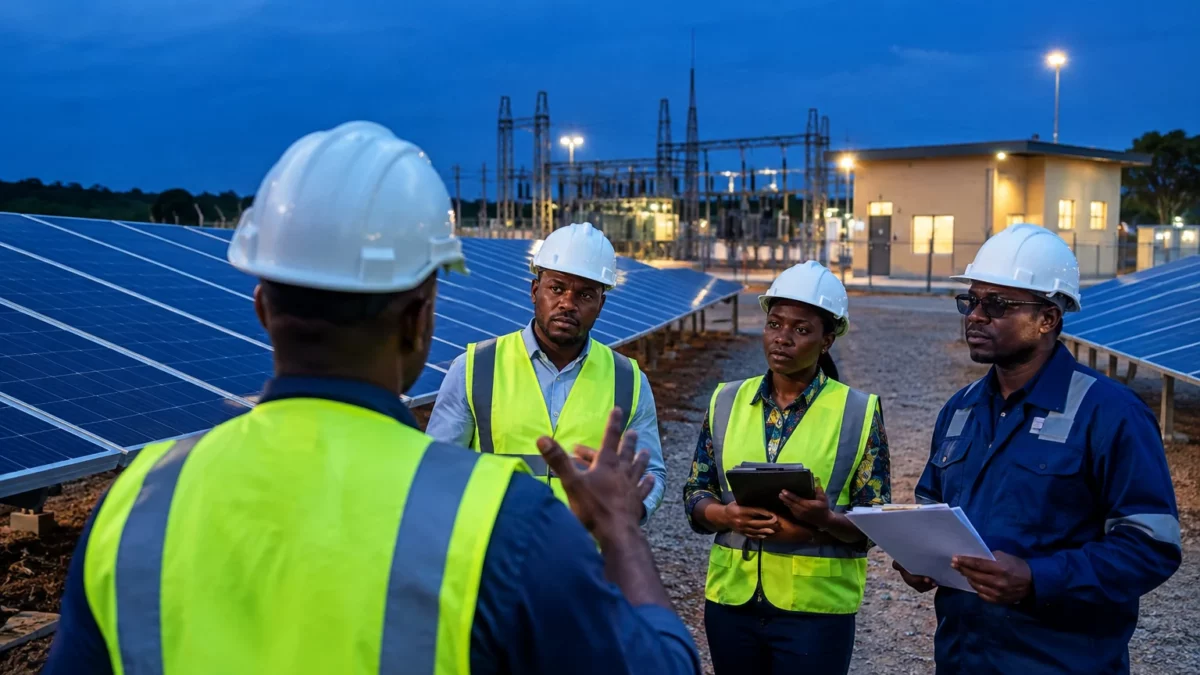
The Boundiali solar power plant illustrates this kind of cooperation. Inaugurated on 3 April 2024 in the north of the country, its first phase has a capacity of 37.5 megawatt-peak. The project receives German support through the public development bank KfW, as well as support from the European Union and the Ivorian state. Its expansion is intended to bring total capacity to 83 MWp. Ivorian authorities say the project is expected to help improve electricity supply, particularly in the localities concerned. CI-Énergies outlines Boundiali’s phases and financing. The Ivorian government also confirms the inauguration date and support from KfW and the European Union. Official information on the solar power plant.
Boundiali also shows the limits of viewing a project solely in terms of the amounts invested. An energy project is measured by its generating capacity, but also by its integration into the grid, the reliability of supply and the benefits to households and businesses. In rural areas, better access can support economic activity. For businesses, it can ease electricity-related constraints. These effects, however, depend on implementation and the effective distribution of energy.
A regional issue for West Africa
Côte d’Ivoire occupies a major position in the West African economy. It is a member of ECOWAS, the Economic Community of West African States, which brings together countries with differing levels of industrialisation and energy needs. Investment in electricity, transport or agribusiness can therefore have regional reach, especially when infrastructure connects markets and strengthens trade.
Co-operation with Germany is not taking place in a vacuum. European, Asian, African and Gulf partners are also seeking to finance infrastructure and gain access to Ivorian markets. For Abidjan, diversifying its partnerships can increase its room for manoeuvre. But an agreement’s value also depends on its terms: skills transfer, the role of local businesses, the cost of financing and the sharing of risks.
The weight given to the private sector in the PND makes this scrutiny particularly important. Announced investments do not automatically translate into stable jobs or a balanced distribution of activity between Abidjan and other regions. The results will depend on contracts, training and the ability of Ivorian businesses to take part in value chains. The authorities will also have to reconcile the needs of growth, access to services and sustainable financing.
African tour provides the next test
After Abidjan, Frank-Walter Steinmeier will continue his visit to Ghana and then Kenya. The tour links three economies with distinct profiles and gives German dialogue a regional dimension, beyond a bilateral relationship. The next announced stop is Ghana, where the German president is due to attend a German-African business forum.
For Côte d’Ivoire, the practical test will be what follows the discussions: which projects will be selected, with what financing and which local partners? The Boundiali plant offers an example that can be assessed. The PND 2026-2030, meanwhile, sets out a much broader ambition. The gap between announcing a partnership and its effects on the real economy will be measured by infrastructure delivered, skills gained and benefits available to the Ivorian population.