
 Algeria
 Egypt
 Libya
 Morocco
 Sudan
 Tunisia
 Benin
 Burkina Faso
 Cabo Verde
 Côte d'Ivoire
 Ghana
 Guinea
 Guinea-Bissau
 Liberia
 Mali
 Mauritania
 Niger
 Nigeria
 Senegal
 Sierra Leone
 The Gambia
 Togo
 Cameroon
 Central African Republic
 Chad
 Equatorial Guinea
 Gabon
 Republic of the Congo
 São Tomé and Príncipe
 Burundi
 Comoros
 Djibouti
 Eritrea
 Ethiopia
 Kenya
 Madagascar
 Malawi
 Mauritius
 Mozambique
 Rwanda
 Seychelles
 Somalia
 South Sudan
 Tanzania
 Uganda
 Angola
 Botswana
 Eswatini
 Lesotho
 Namibia
 South Africa
 Zambia
 Zimbabwe
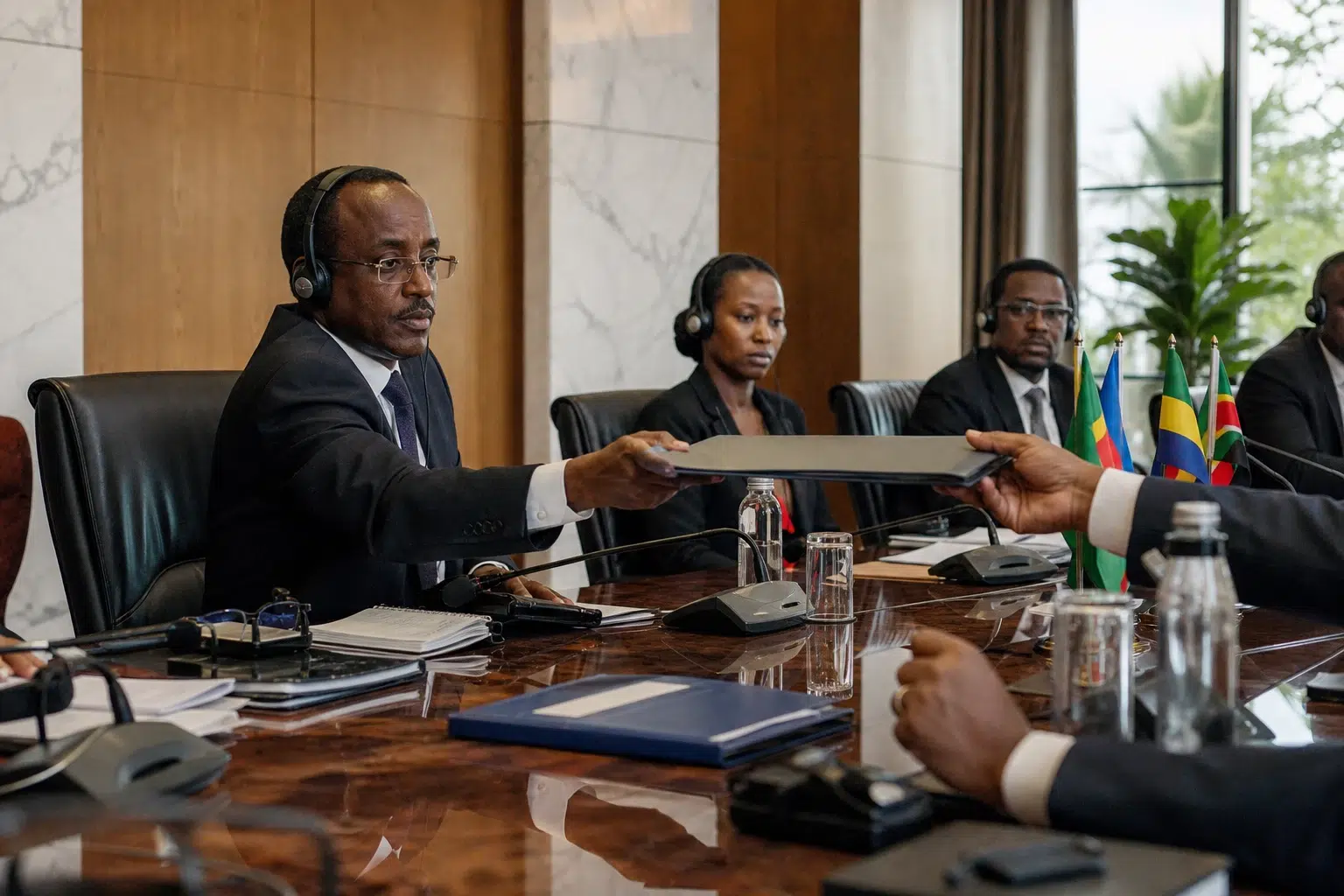
In Kigali, Paul Kagame responds to mounting pressure
In the Great Lakes region, every word carries as much weight as a military communiqué. When a head of state publicly links the fate of an armed movement to that of his country, he is not speaking only to his adversaries. He is also addressing diplomats, neighbours, markets and his own public. That was precisely the significance of the message delivered by Paul Kagame in Kigali on Friday 17 July 2026, as international sanctions over the conflict in the east of the Democratic Republic of the Congo were tightened.
The Rwandan president was speaking before the political bureau of the ruling Rwandan Patriotic Front, in the presence of members of the diplomatic corps. His address came the day after a new set of measures was adopted by the UN Security Council’s sanctions committee on the DRC, targeting six leaders of armed groups active in eastern Congo, including Corneille Nangaa, John Imani Nzenze and Charles Sematama.
A Congolese conflict, a Rwandan perspective and a wider regional stage
The issue is not limited to a bilateral rivalry between Kigali and Kinshasa. It is part of a regional tangle involving the African Union, the East African Community, parallel mediation efforts and direct negotiations between Kinshasa and the AFC/M23 in Doha. In 2026, the AU reiterated that there is no lasting military solution and that the sovereignty of the DRC must be respected.
For Kigali, the position it has defended for several months remains familiar: the Rwandan authorities portray eastern DRC as an area where groups hostile to Rwanda operate, foremost among them the FDLR, and say they are acting in a defensive security capacity. This view is consistent with Rwanda’s official communications. It does not dispel the suspicions that persist in several capitals, but it sheds light on the political logic of Paul Kagame’s speech.
This context also matters for East Africa. Rwanda is a member of the East African Community, where stable borders are essential to trade, the movement of people and the credibility of regional mechanisms. When tensions rise between Kigali and Kinshasa, logistics routes, mining corridors and diplomatic balances are all unsettled, far beyond the front lines.
What Kagame said, and why his words carry weight
At the heart of his address, Paul Kagame said that wanting to make the M23 disappear would, in his view, amount to wanting to make Rwanda disappear. He also repeatedly denounced what he described as an instruction to remain silent, summarising it with the English expression “Shut up”. The tone was markedly combative. The message was clear: Rwanda would not allow itself to be trapped in the role assigned to it by its accusers.
The statement carries significant political weight. It publicly brings the fate of a Congolese rebel movement closer to that of a sovereign state. In a crisis where responsibility is contested, this convergence hardens the debate rather than easing it. It also shows how Kigali is seeking to shift the discussion: away from the facts of the war alone and towards Rwanda’s right to challenge the international framing of the conflict.
The timing adds weight to the speech. A few weeks earlier, Washington had already sanctioned Rwandan entities and individuals over alleged support for the war economy linked to the M23. These were followed, in July 2026, by new UN sanctions targeting figures in the network of armed groups active in eastern Congo. Kigali therefore finds itself at the intersection of growing diplomatic and financial pressure, while Kinshasa is pressing for a more coercive approach towards its adversaries.
A tougher tone that also speaks to the economy, security and prestige
Kigali’s speech is not only about war. It also touches on Rwanda’s image as an organised, stable state capable of exerting influence on regional issues. For years, Kigali has relied on this reputation to attract partnerships, defend its place in regional mechanisms and retain influence in African security matters. A prolonged confrontation with major capitals and multilateral institutions weakens this strategy, even as the Rwandan government continues to project public confidence.
On the ground, the impact is more tangible. In the DRC, sanctions do not bring the fighting to an end, but they signal that the political, military and logistical networks around armed groups are now under scrutiny. For civilians in the Kivus, they are no substitute for a ceasefire or immediate protection. But they may alter the calculations of commanders, funders and local allies. The Rwandan authorities, for their part, are refusing any conflation of Rwanda with the M23 and pointing Kinshasa back to its own security responsibilities.
The episode also illustrates a point that is often underestimated: in conflicts in this region, words serve to protect a national narrative as much as to prepare for negotiations. Kigali wants to avoid being boxed into the category of “external support”. Kinshasa wants the M23 to be more decisively isolated. Between them, the African Union and regional partners are trying to keep several channels of dialogue open. It is a fragile framework, but it is still preventing escalation from turning into a total breakdown.
What to watch now
The continental significance of this statement lies in its role as a test: a test of the strength of sanctions; a test of the ability of African mediation efforts to retain the initiative; and, finally, a test of Kigali’s room for manoeuvre amid international pressure encompassing security, minerals, diplomacy and human rights. As long as substantive negotiations make no progress, each escalation in rhetoric risks weighing on the already unstable balance in Africa’s Great Lakes region.



