Algeria
 Egypt
 Libya
 Morocco
 Sudan
 Tunisia
 Benin
 Burkina Faso
 Cabo Verde
 Côte d'Ivoire
 Guinea
 Guinea-Bissau
 Liberia
 Mali
 Mauritania
 Niger
 Nigeria
 Senegal
 Sierra Leone
 The Gambia
 Togo
 Cameroon
 Central African Republic
 Chad
 DR Congo
 Equatorial Guinea
 Gabon
 Republic of the Congo
 São Tomé and Príncipe
 Burundi
 Comoros
 Djibouti
 Eritrea
 Ethiopia
 Kenya
 Madagascar
 Malawi
 Mauritius
 Mozambique
 Rwanda
 Seychelles
 Somalia
 South Sudan
 Tanzania
 Uganda
 Angola
 Botswana
 Eswatini
 Lesotho
 Namibia
 South Africa
 Zambia
 Zimbabwe
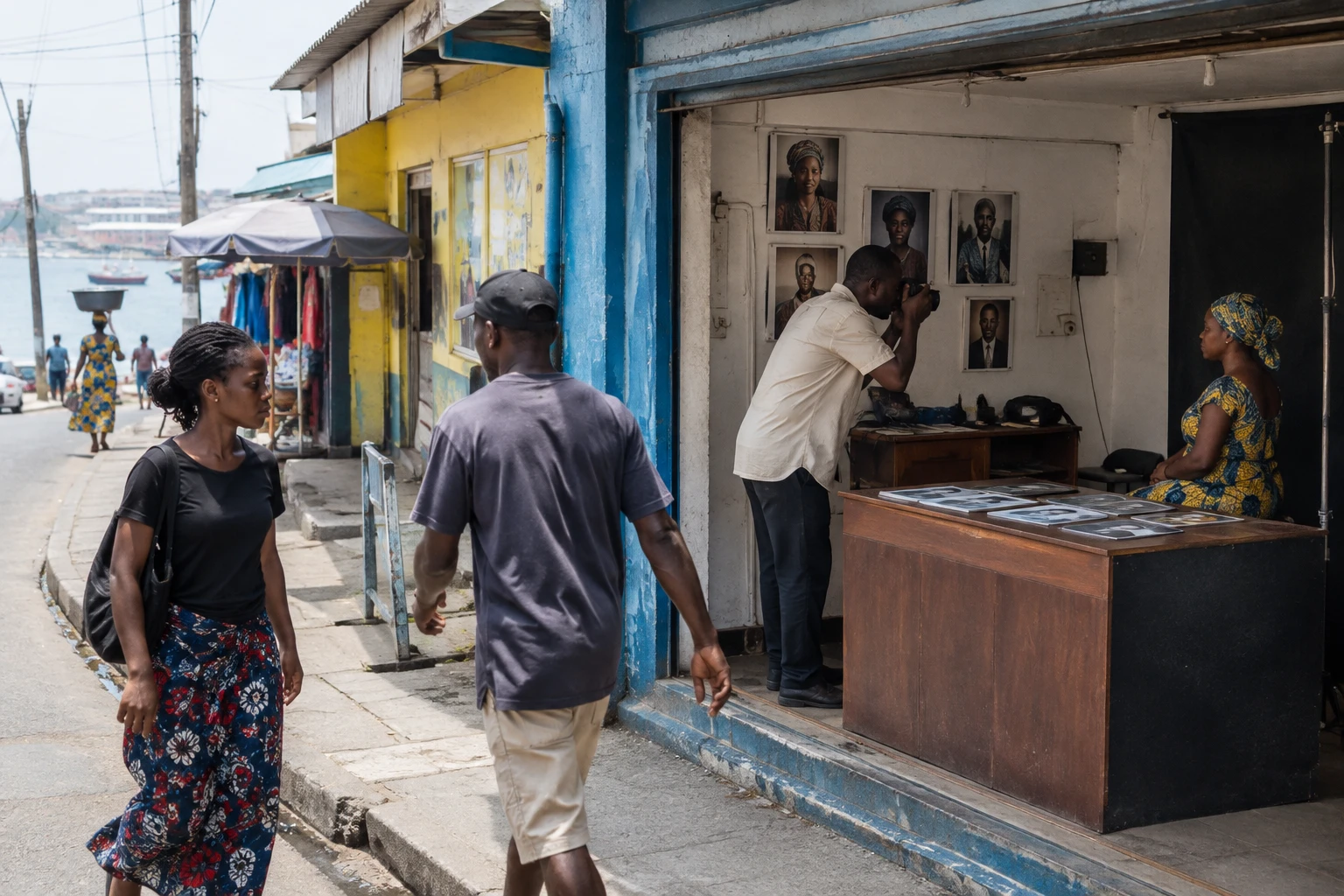
In Jamestown, Accra’s historic district, portraits from the Ever Young studio told stories of individual lives as well as a country’s transformation. Years later in London, James Barnor photographed other Black faces, rarely represented in British magazines. His career thus connects two scenes and two periods of change.
The 97-year-old Ghanaian photographer will receive the “Outstanding Contribution to Photography” award at the 2027 Sony World Photography Awards. The international honour will be accompanied by a display of more than 50 photographs and archival documents at Somerset House in London, from 16 April to 3 May 2027. The ceremony is scheduled for 15 April, according to the organisers.
Accra, at the heart of a society in motion
Born in 1929, Barnor trained under his cousin, portrait photographer J. P. D. Dodoo. In 1950, he became the first staff photographer at the Daily Graphic newspaper. He covered political rallies, street scenes and the events leading to Ghana’s independence, proclaimed on 6 March 1957.
His images form part of a national history in which photography accompanied the construction of a public identity. Ghana became the first country in sub-Saharan Africa to gain independence under British colonial rule. Barnor photographed celebrations and the leader Kwame Nkrumah, among other subjects. The MoMA museum confirms his role as a photographer for the Daily Graphic and that his work is held in the museum’s collections.
In 1953, he opened Ever Young in Jamestown. The studio welcomed students, traders, politicians and judges. These were not only portraits of prominent figures. They also showed ordinary Ghanaians choosing how they wanted to be seen at a time when society was changing rapidly.
This perspective, rooted in everyday life, sets Barnor’s work apart. His images connect the private sphere — a pose, an outfit, a family portrait — with the transformations of urban life. In Accra, the studio became both a workplace and a space where anyone could shape their own image.
From London to Accra, colour as a means of transmission
In 1959, Barnor left for the United Kingdom to deepen his knowledge of photography. He studied at Medway College of Art in Kent, then worked in a colour-processing lab. In London, he collaborated with Drum, a South African magazine devoted in part to Black cultures and known for its anti-apartheid reporting.
He photographed Black models and artists on the streets of the British capital as well as in the studio. Their portraits appeared in Drum’s fashion pages and on its covers. They highlighted their style and presence at a time when Black representation remained limited in parts of the mainstream press.
This work was more than a response to stereotypes. It also documented the life of an African diaspora settled in London and its own visual codes. Barnor’s images circulated representations between Ghana, Britain and the magazine’s readers, including those in southern Africa.
After training with manufacturer Agfa-Gevaert in Belgium and Germany, Barnor returned to Ghana in 1970. He worked there as the company’s representative and established the country’s first commercial colour-processing lab. This technical step expanded the possibilities for photographic production locally. It also made his career part of the transmission of expertise, beyond taking photographs.
International recognition, a Ghanaian legacy
The Sony World Photography Awards announcement highlights the reach of a career spanning Accra and London. But the tribute also matters for the place it gives to the history of Ghanaian photography. International institutions that exhibit Barnor’s work — including MoMA, the Victoria and Albert Museum and Tate — help bring it to new audiences. His recognition did not, however, begin with these collections: it is rooted in decades of work in Ghana and with the diaspora.
This visibility may also foster exchanges between generations of African photographers. The announced London exhibition will bring together works and archival documents spanning several periods of his career. It will trace connections between countries without separating artistic experimentation from the social context in which the images were produced.
For Ghana, the stakes are tangible: preserving and passing on a visual heritage linked to independence, Accra’s evolution and the experiences of Ghanaians living abroad. Such a record is not limited to major political events. It also encompasses the faces, occupations, clothes and places of everyday life.
Across West Africa, Barnor’s career is a reminder that the history of photography on the continent has been shaped by local initiatives, international exchanges and technical choices. His colour lab in Ghana is one example. His career also invites us to consider African archives as central sources for telling the region’s social history, rather than as mere illustrations.
The award will be presented in London on 15 April 2027, before the exhibition opens at Somerset House the following day. These dates will mark a new chapter in public recognition. They do not sum up Barnor’s work; rather, they give an international platform to a perspective shaped between Accra and London over several decades of change.
Sources for verification: official announcement of the 2027 Sony World Photography Awards, Museum of Modern Art profile of James Barnor, Victoria and Albert Museum overview of his work and profile published by Ghanaian media outlet Graphic Online.