Algeria
 Egypt
 Libya
 Morocco
 Sudan
 Tunisia
 Benin
 Burkina Faso
 Cabo Verde
 Ghana
 Guinea
 Guinea-Bissau
 Liberia
 Mali
 Mauritania
 Niger
 Nigeria
 Senegal
 Sierra Leone
 The Gambia
 Togo
 Cameroon
 Central African Republic
 Chad
 DR Congo
 Equatorial Guinea
 Gabon
 Republic of the Congo
 São Tomé and Príncipe
 Burundi
 Comoros
 Djibouti
 Eritrea
 Ethiopia
 Kenya
 Madagascar
 Malawi
 Mauritius
 Mozambique
 Rwanda
 Seychelles
 Somalia
 South Sudan
 Tanzania
 Uganda
 Angola
 Botswana
 Eswatini
 Lesotho
 Namibia
 South Africa
 Zambia
 Zimbabwe
When water finally arrives, everything else changes
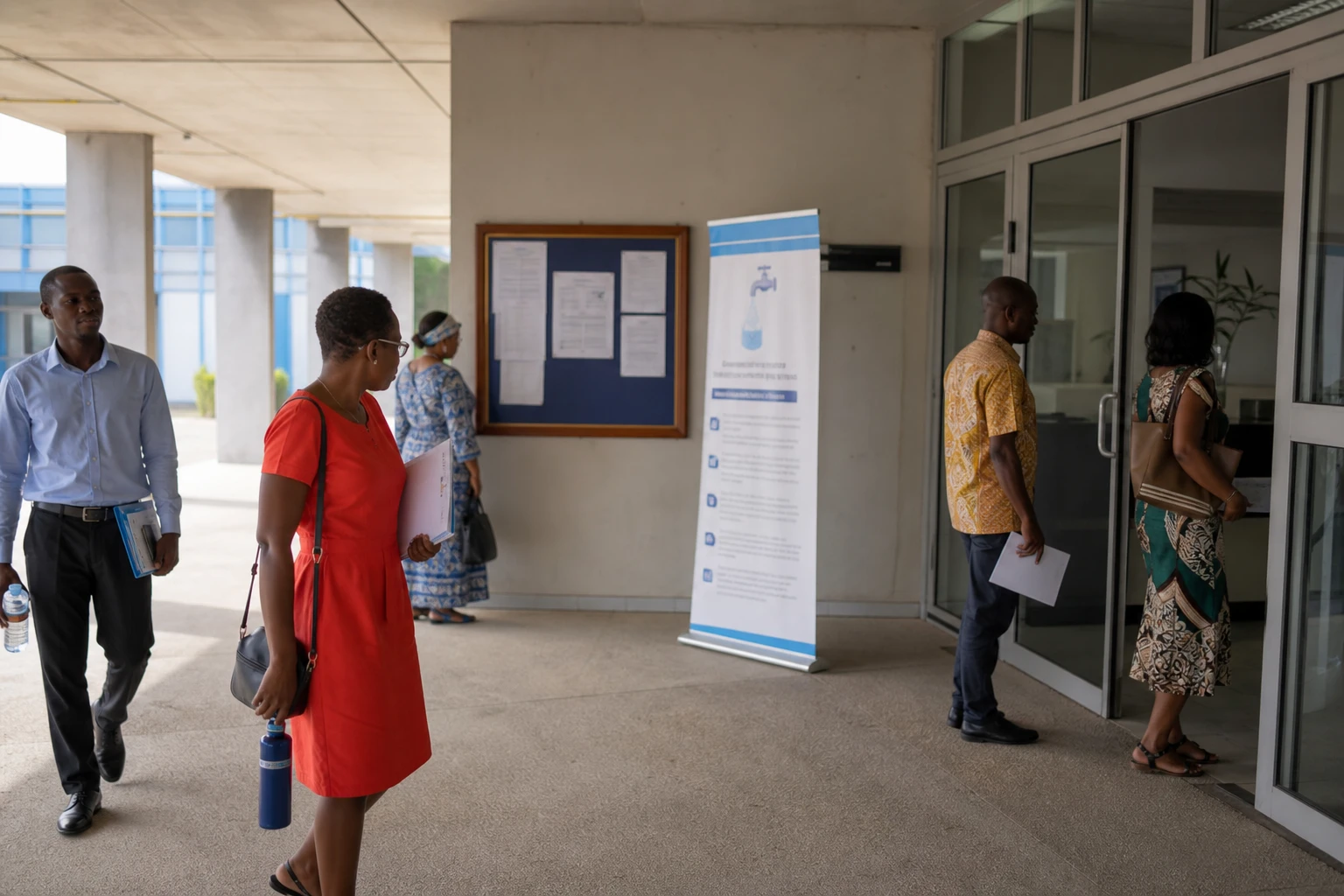
In many Ivorian communities, drinking water is not simply a public service. It is what makes it possible to open a school, keep a health centre running and reduce the hours families lose, especially in rural areas. In Ivory Coast, progress is real. But the question is no longer just how to produce more water. It must now be delivered regularly and safely to households.
That is where the challenge for the coming years lies. The country has embarked on major investments. Yet disparities remain marked between Abidjan and the rest of the country, and between towns connected to denser networks and villages still dependent on boreholes, hand pumps or solar-powered systems. In Yamoussoukro, the political capital, as in the north and west, access to water remains a very tangible measure of territorial equality.
Rapid expansion, but an uneven network
The Ivorian government says daily drinking water production rose from 350,000 m³ in 2011 to 1,004,944 m³ in 2024. The official report published in 2025 confirms this increase and puts the gains in the context of the entire country. Over the same period, the state says it invested 654 billion CFA francs in more than 500 communities to improve production and distribution. These figures appear in the authorities’ 2011-2025 report and in official government publications.
This progress did not happen by itself. It rests on several projects carried out over time: rehabilitating human-powered pumps, drilling boreholes, extending drinking water supply systems and commissioning plants or treatment systems in several towns. In 2024, the government also presented a series of achievements linked to the state’s social programme, with the stated aim of achieving near-universal coverage by 2030.
Progress is visible in mid-sized towns and rural areas that have long lacked adequate infrastructure. Projects in Bouaké, San Pedro, Gagnoa, Sinfra, Bouna, Bondoukou and several communities in the north reflect an effort to address territorial imbalances. The official report also mentions facilities linked to the 2023 Africa Cup of Nations, with modern systems deployed in cities such as San Pedro, Yamoussoukro and Korhogo. In other words, water is no longer just a social issue. It has become a factor in territorial planning and urban appeal.
The real challenge: financing, maintaining and securing the service
The main difficulty is no longer just production. It is continuity of service. In outlying neighbourhoods as well as villages, rehabilitating a pump or completing a borehole is not enough if maintenance is lacking, connections are delayed or networks cannot keep pace with population growth. The government itself acknowledges that current investment remains below 0.5% of GDP, while the Ivory Coast Water Pact 2026-2030 estimates that around 1.5% of GDP would be needed to meet needs sustainably. Total financing needs are put at $7.5 billion.
This budgetary constraint explains the growing reliance on external partners. In 2024, the World Bank approved the Water Security and Sanitation Support Project, known by the acronym PASEA, with a programme framework of $825 million. The aim is to improve access to water and sanitation in targeted regions, particularly in the north and areas considered more vulnerable. The World Bank’s initial financing is $250 million, but the programme’s overall envelope does indeed reach $825 million.
The choice is an important one for the Ivorian state. On the one hand, it speeds up projects. On the other, it requires measurable results in governance, operations and financial sustainability. An expanded network without maintenance deteriorates quickly. This is particularly true in a country where demand is rising, cities are growing and rural areas remain more exposed to outages, distance and infrastructure costs. The authorities have also set specific targets: universal basic access by 2030 and an increase in the share of the rural population benefiting from safely managed water services.
Clear disparities remain between town and country
International data confirms this gap. In 2024, the proportion of Ivory Coast’s population with access to at least a basic drinking water service was estimated at 64.5% by UNICEF databases, while the proportion with safely managed water services remained lower. UNICEF’s tables mainly highlight the gap between rural and urban areas: coverage of safely managed water services was much lower in villages than in cities, with clear disparities in Ivory Coast, as elsewhere in West Africa.
These disparities reveal far more than a simple technical shortfall. They affect women’s domestic workload, school attendance, children’s health and the costs borne by households. They also influence informal economic activity, which depends heavily on the daily availability of water: catering, food processing, small businesses and peri-urban market gardening. In rural areas, a reliable water point can change an entire community’s day. In cities, it reduces queues, emergency purchases and dependence on water vendors.
Ivory Coast is therefore making progress on two fronts at once: increasing supply and addressing an uneven geography of service. The recent certification of Worodougou as the first region free of open defecation also shows progress in another area: sanitation, which is essential to prevent drinking water from being immediately compromised by pollution of the soil and water points. As a member of ECOWAS, Ivory Coast’s trajectory also matters at the regional level: water security is becoming an issue of social stability, public health and territorial competitiveness.
What comes next will test the Ivorian model
The next test is clear. It will be necessary to see whether major public and private financing translates into sustainable services in regions far from major centres. It will also be important to see whether networks keep pace with city growth, whether solar systems and boreholes remain operational, and whether tariffs or management models create new inequalities. The country no longer simply needs more projects. It needs a complete chain: production, distribution, maintenance and governance.
Across West Africa, the water question extends beyond Ivory Coast. It affects climate resilience, demographic pressure and the ability of states to deliver on promises concerning essential services. In Abidjan and in the northern border regions, water is thus becoming a tangible marker of sovereignty. It shows how effectively a state can make visible, in everyday life, what is often decided in plans, budgets and international partnerships.