
 Algeria
 Egypt
 Libya
 Morocco
 Sudan
 Tunisia
 Benin
 Burkina Faso
 Cabo Verde
 Côte d'Ivoire
 Ghana
 Guinea
 Guinea-Bissau
 Liberia
 Mali
 Mauritania
 Niger
 Nigeria
 Senegal
 Sierra Leone
 The Gambia
 Togo
 Cameroon
 Central African Republic
 Chad
 Equatorial Guinea
 Gabon
 Republic of the Congo
 São Tomé and Príncipe
 Burundi
 Comoros
 Djibouti
 Eritrea
 Ethiopia
 Kenya
 Madagascar
 Malawi
 Mauritius
 Mozambique
 Rwanda
 Seychelles
 Somalia
 South Sudan
 Tanzania
 Uganda
 Angola
 Botswana
 Eswatini
 Lesotho
 Namibia
 South Africa
 Zambia
 Zimbabwe
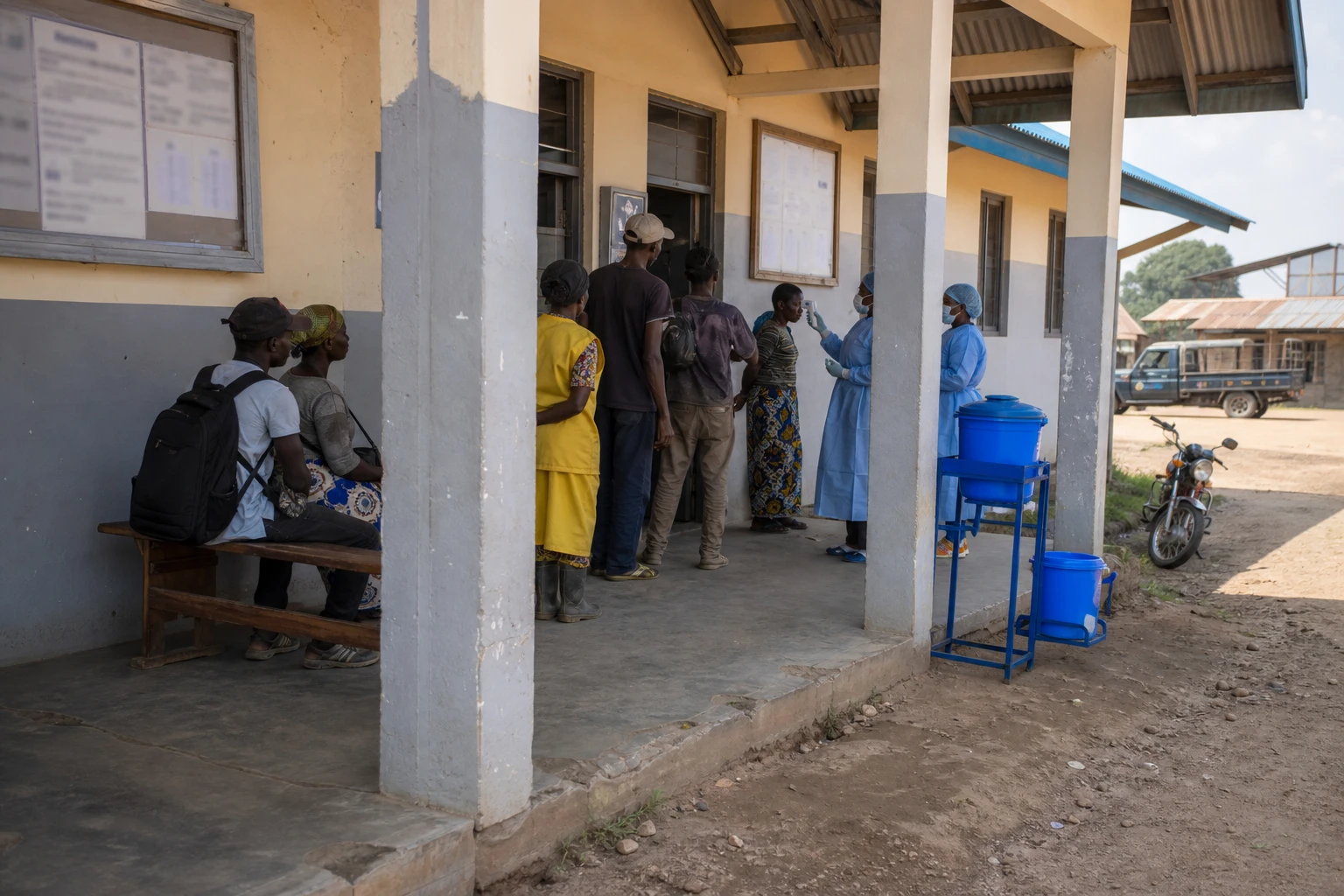
A warning came too late in eastern Congo
When an Ebola outbreak starts in a mining area, the danger lies not only in the virus. It also lies in the delay. In the Democratic Republic of the Congo, the epidemic declared on 15 May 2026 in Ituri showed how delayed detection can allow the disease to take hold before an alert is even formally issued. In an area marked by intense movement between mines, secondary roads and late recourse to healthcare, every lost week matters.
This new outbreak is part of a long history of experience in Congo. Kinshasa has already faced several waves of Ebola, and Ituri remains exposed because of its border with Uganda, local insecurity and frequent population movements. The current outbreak involves the Bundibugyo strain, confirmed by the national reference laboratory in Kinshasa, the INRB. The World Health Organization also says the epidemic quickly took on a regional dimension, with an imported case reported in Uganda and a public health emergency of international concern declared from 17 May 2026.
What the scientific investigation shows
Initial field investigations point to a hypothesis with serious implications: the virus may have begun circulating well before the official announcement, possibly as early as January 2026. Nature Africa reports that a gap of about four weeks between the first deaths and confirmation allowed the virus to gain ground before the outbreak was formally identified. Researchers describe a scenario typical of rural and peri-urban outbreaks in eastern Congo: someone arriving from a distant area and treated in Mongbwalu may have introduced the virus into an initial chain of transmission.
Evidence gathered on the ground lends weight to this account. Investigations identified the case of a 50-year-old woman who died on 25 January after developing symptoms consistent with a haemorrhagic fever. Several people close to her subsequently fell ill. The aim is not to reconstruct an absolute certainty after the fact. But the sequence described by field teams is consistent with silent transmission, all the more likely because early symptoms can be mistaken for other endemic infections such as malaria or typhoid.
The central issue, then, is not only the date of the first case. It is how a serious disease can go undetected when several obstacles coincide: fear of stigma, local beliefs, late recourse to health facilities, an initial diagnosis pointing to other illnesses, and sometimes a lack of tools suited to the variant in circulation. The WHO also stresses that difficulties with early isolation, contact tracing, safe burials and infection prevention in hospitals remain decisive in this crisis.
Ituri, Mongbwalu and the health front line
The main outbreak site remains Mongbwalu, a mining town about 80 kilometres from Bunia. This geographic detail matters. In this part of Ituri, movement is driven by mining, trade and access to nearby healthcare. This creates conditions favourable to the rapid spread of a virus transmitted through direct contact with bodily fluids. On 15 May, Africa CDC had already flagged the density of population movements, gaps in contact tracing and difficulties accessing affected areas. The organisation also highlighted the area’s proximity to Uganda and South Sudan, giving the epidemic an immediate cross-border dimension.
Operational figures have changed substantially since the initial declaration. As of 21 May 2026, the WHO reported 746 suspected cases and 176 suspected deaths in DR Congo; the totals continued to rise in the weeks that followed. By late July, the latest figures reported by Congolese and international media indicated about 3,200 confirmed cases and 1,405 confirmed deaths as of 25 July, while health authorities continued to verify the data. The gap between suspected cases, confirmed cases and attributed deaths remains significant, so these figures should be read with caution and clearly distinguished.
The outbreak also carries a direct social cost. In affected areas, treatment centres have sometimes been targeted or rejected by part of the population, complicating the response. Incidents in Mongbwalu have shown how fragile trust between healthcare workers and communities remains. For residents, the stakes are concrete: preserving access to routine healthcare, preventing funerals from accelerating transmission and maintaining economic activity despite health restrictions. For the authorities, the challenge is twofold: to contain the disease and prevent a health crisis from becoming a local governance crisis.
An alert in Congo with regional implications
DR Congo is not facing only a national epidemic. It is also managing a regional situation. The WHO has confirmed the cross-border nature of the outbreak, and Africa CDC has brought the countries concerned together for emergency co-ordination. The reason is straightforward: the provinces of eastern Congo are linked to Uganda and South Sudan and, more broadly, to trade routes across Central and East Africa. An uncontrolled chain of transmission in Ituri could therefore become a surveillance concern for the entire region, including at border entry points.
The case in Congo also serves as a continental reminder. Countries with experience of Ebola have valuable expertise, but it is not enough without rapid diagnosis, logistical resources and community trust. The 2026 outbreak shows that a cluster detected late can be harder to stop than one identified early. It also underlines that mining areas, border towns and urban outskirts are strategic health settings, not secondary margins. In Kinshasa and Bunia alike, what happens next will depend on the authorities’ ability to strengthen screening, care and local engagement, as regional institutions are already monitoring the risk of further geographic spread.



