Algeria
 Egypt
 Libya
 Morocco
 Sudan
 Tunisia
 Benin
 Burkina Faso
 Cabo Verde
 Côte d'Ivoire
 Ghana
 Guinea
 Guinea-Bissau
 Liberia
 Mali
 Mauritania
 Niger
 Nigeria
 Senegal
 Sierra Leone
 The Gambia
 Togo
 Cameroon
 Central African Republic
 Chad
 Equatorial Guinea
 Gabon
 Republic of the Congo
 São Tomé and Príncipe
 Burundi
 Comoros
 Djibouti
 Eritrea
 Ethiopia
 Kenya
 Madagascar
 Malawi
 Mauritius
 Mozambique
 Rwanda
 Seychelles
 Somalia
 South Sudan
 Tanzania
 Uganda
 Angola
 Botswana
 Eswatini
 Lesotho
 Namibia
 South Africa
 Zambia
 Zimbabwe
In Bunia, the Ebola response depends as much on trust as on medicine
In eastern Democratic Republic of the Congo, treating Ebola is no longer just a matter of isolating patients and following protocols. In Bunia, the capital of Ituri, the fight is also being waged in neighbourhoods, among families and with community leaders. Without their support, the virus spreads faster than prevention messages.
Congolese health authorities and their partners have understood this reality for several years. Ituri is a border province, close to Uganda and South Sudan, where population movements, insecurity and mistrust complicate every health response. In this context, the ability of teams to earn the trust of communities has become a public health tool in its own right.
More patients are coming forward to treatment centres
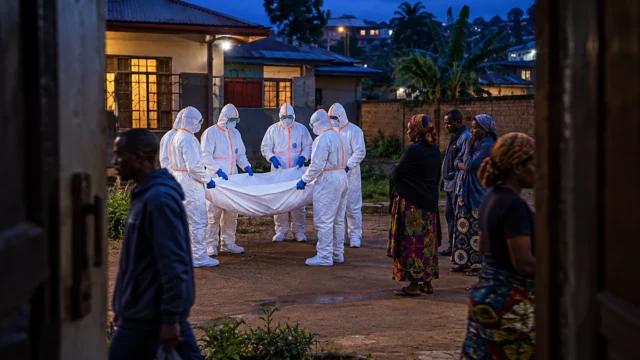
In Bunia, the Ebola treatment centre at the Evangelical Medical Centre is now receiving more people who have come forward on their own for care. This is a significant change. At the start of an outbreak, many families still hesitate to take a relative to a treatment facility. They fear isolation and rumours, or worry they may never see the patient alive again.
On the ground, surveillance and community engagement teams have worked to bridge this divide. They provide information, reassure people, follow up contacts and explain the care process. This patient work is having a tangible effect: patients arrive earlier, remain under care and recover in better conditions. In an Ebola outbreak, this makes all the difference, because patients seen early have a better chance of surviving and limiting transmission.
The message is also political, in the public health sense of the word. In a province marked by armed violence and difficult access, public health cannot be reduced to an order from above. It must rely on local networks, frontline health workers, religious leaders and neighbourhood figures. This is often where the response is won or lost.
The figures show the scale of the challenge
The latest data from the World Health Organization indicate that, as of 14 July 2026, the Ebola outbreak in DR Congo had recorded a cumulative 2,124 confirmed cases and 828 reported deaths in the country, with Ituri the worst-affected province. In the province, the health zones of Bunia, Rwampara, Mongbwalu, Nizi and Nyankunde accounted for most confirmed cases. At the same time, transmission remained active, even though the last known patient had been able to leave the treatment centre after two negative tests.
The immediate precedent shows how quickly the situation can change. In May 2026, the first alerts came from Mongbwalu and Rwampara, then laboratory analyses conducted in Kinshasa at the National Institute of Biomedical Research confirmed an outbreak linked to the Bundibugyo virus. Health authorities then stepped up screening, clinical care and community communication, with support from the WHO and other partners.
This type of response remains vulnerable to insecurity. In some areas, teams cannot move freely. Patients seek care late. Burials sometimes take place without prior notification. And chains of transmission grow longer. That is why trust is not just a matter of rhetoric. It is an operational requirement for finding cases, protecting families and stopping transmission.
What community support changes in Ituri
The growing trust between Bunia’s communities and health workers has several immediate effects. First, patients reach the treatment centre sooner. Then, teams can more easily identify people who have been exposed. Finally, rumours lose ground as families see a relative receive care and recover.
For residents, the point is simple: Ebola is no longer just a matter of figures broadcast on the radio. It is a disease that can be recognised earlier, explained more clearly and treated more quickly. For health workers, the stakes are just as tangible: every day gained against mistrust is a day gained against the virus. In an outbreak that spreads so readily, how quickly people seek care matters as much as the quality of the medical protocol.
This dynamic also has social significance. When health teams engage with neighbourhood chiefs, women’s associations, young people and religious leaders, they narrow the gap between the public health system and the population. This bond is valuable in a country as vast as DR Congo, where Kinshasa does not always immediately see the realities of the east, and local structures often deliver the first response.
A lesson for DR Congo and the Great Lakes region
What is happening in Ituri extends beyond the province. DR Congo shares porous borders with several countries in the Great Lakes region, including Uganda. With every outbreak, the risk of cross-border spread means the response must be coordinated beyond administrative boundaries. Health surveillance, crisis communication and the care of suspected cases thus become regional issues.
The East African Community, of which DR Congo is a member, has a direct interest in monitoring these signals on the ground. An outbreak not brought under control in Bunia could have effects far beyond Ituri, through markets, trade routes and population movements. This is also why treatment centres, contact tracing and community acceptance remain strategic priorities, not merely emergency measures.
In the short term, the key indicator to watch remains how quickly new cases are detected and referred for care. In the medium term, the question will be whether the Congolese health system can build on this renewed trust to strengthen preparedness in the country’s east for the long term. In the fight against Ebola, victory is not measured only by the number of beds available. It is also measured by a community’s ability to work with its health workers.