Algeria
 Egypt
 Libya
 Morocco
 Sudan
 Tunisia
 Benin
 Burkina Faso
 Cabo Verde
 Côte d'Ivoire
 Ghana
 Guinea
 Guinea-Bissau
 Liberia
 Mali
 Mauritania
 Niger
 Nigeria
 Senegal
 Sierra Leone
 The Gambia
 Togo
 Cameroon
 Central African Republic
 Chad
 DR Congo
 Equatorial Guinea
 Gabon
 São Tomé and Príncipe
 Burundi
 Comoros
 Djibouti
 Eritrea
 Ethiopia
 Kenya
 Madagascar
 Malawi
 Mauritius
 Mozambique
 Rwanda
 Seychelles
 Somalia
 South Sudan
 Tanzania
 Uganda
 Angola
 Botswana
 Eswatini
 Lesotho
 Namibia
 South Africa
 Zambia
 Zimbabwe
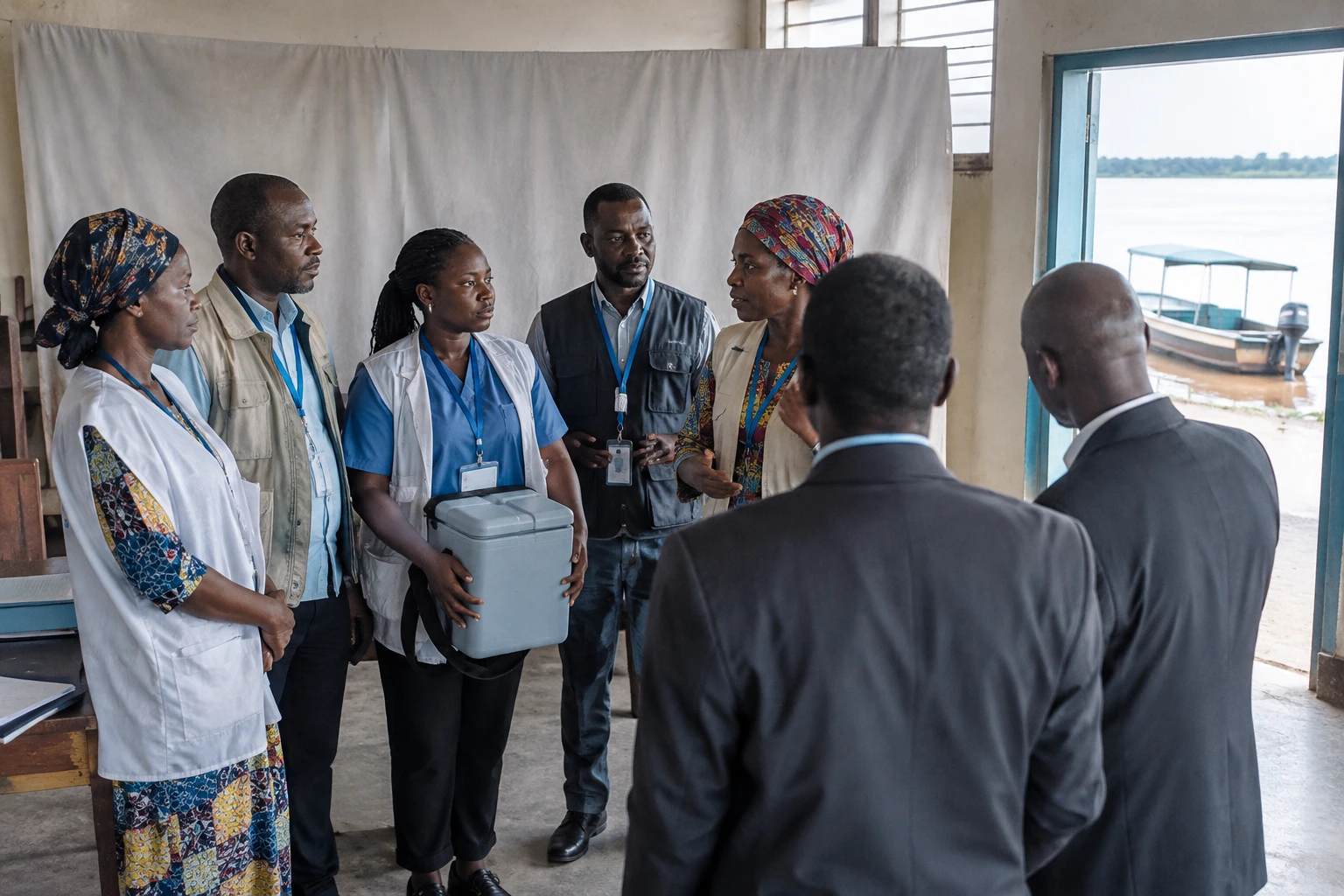
On the Congo River, a health campaign cannot stop at the border. Communities live on both banks and travel between islands, villages and cities. In November 2020, this reality led the Democratic Republic of the Congo (DRC) and the Republic of the Congo to coordinate a cholera vaccination operation.
One corridor, two banks
The river links territories, but also makes access to healthcare more difficult. In settlements scattered across the islands, health teams must reach residents by boat. The campaign planned in the DRC was to target the west of the country, starting with Équateur province, followed by Mai-Ndombe and Kinshasa.
This challenge extends beyond national borders. The DRC’s capital is Kinshasa; the Republic of the Congo’s capital, often called Congo-Brazzaville to avoid confusion, is Brazzaville. The two cities face each other across the river. Health coordination between them therefore concerns an area of daily movement, not merely a line on a map.
In 2020, the DRC was facing several health emergencies, including Covid-19, measles and cholera. The Ebola epidemic in Équateur province had been declared over on 18 November that year. This accumulation of crises placed demands on teams, logistical resources and local facilities. The WHO documented the end of this Ebola epidemic.
A vaccination campaign rolled out in stages
According to information released at the launch of the operation, the first phase began on Tuesday 3 November 2020 in Équateur province. The announced schedule then set Mai-Ndombe from 10 November, followed by Kinshasa on 24 November. The stated goal was to vaccinate two million people in the coming weeks.
The figure of 60,000 cholera cases recorded by the end of October 2020 and the detailed schedule could not be confirmed here by a second, independently accessible source. They are therefore reported as figures announced at the time, rather than as independently verified data. They do not describe the current situation.
Teams were to reach island populations by dugout canoe or motorised boat, with the support of community health workers. This approach addresses a practical constraint: a campaign centred on cities is not enough when people live far from roads and health centres. The joint strategy was described as a first on this scale along the river corridor, following a more localised effort in the Bolobo-Yumbi area of Mai-Ndombe.
Professor Didier Bompangue, then described as the WHO’s cholera focal point in the DRC, stressed that vaccinating only one bank risked leaving neighbouring populations exposed. This analysis is consistent with the cross-border nature of movement, but the statement attributed to him at the time could not be found in a separate independent source. It must therefore remain attributed to its author.
Vaccination does not replace access to water
The oral vaccine can help reduce the risk of infection, but it does not address the underlying causes that allow cholera to spread. Access to safe drinking water, sanitation, rapid case detection and treatment of patients remain crucial. The campaign should therefore be understood as a response tool, not as a lasting solution on its own.
Seasonal rains could also complicate travel, according to statements attributed to Bompangue. Rising water levels and heavy rainfall make journeys more uncertain and can slow the transport of personnel and equipment. Teams must then adapt their routes and rely on community-based health workers. These constraints weigh particularly heavily on island residents, but also on the health workers tasked with reaching them.
The issue is also one of continuity of services. Congolese authorities had increased their investment in vaccines in 2020, according to UNICEF, but buying doses alone does not guarantee their distribution in hard-to-reach areas. Teams, transport, local organisation and information that residents can understand are also needed. UNICEF reported at the time on public funding for vaccines.
Coordination beyond the emergency
The operation highlighted a broader question for Central Africa: how can disease surveillance and response be coordinated in shared river basins? The DRC and the Republic of the Congo belong to the Economic Community of Central African States (ECCAS), a regional cooperation organisation. In this context, rapid information-sharing between health services can help identify outbreaks and organise interventions on both sides of a border.
For residents, effectiveness is measured less by the number of doses announced than by the ability to receive the vaccine, access safe water and obtain care nearby. For the authorities, the operation requires coordination between national administrations, local teams and health partners. Needs may differ between Kinshasa, riverside villages and island settlements: a uniform strategy will not necessarily address the same obstacles everywhere.
The schedule reported in November 2020 describes a planned campaign and, on its own, cannot establish whether the planned stages were carried out as announced. The significance of the effort nevertheless lies in its principle: in the face of a disease that can spread along a shared river, prevention also depends on cooperation between the two banks. In the region, the next challenge is to link one-off campaigns to sustained investment in water, sanitation and local healthcare.