Algeria
 Egypt
 Libya
 Morocco
 Sudan
 Tunisia
 Benin
 Burkina Faso
 Cabo Verde
 Côte d'Ivoire
 Ghana
 Guinea-Bissau
 Liberia
 Mali
 Mauritania
 Niger
 Nigeria
 Senegal
 Sierra Leone
 The Gambia
 Togo
 Cameroon
 Central African Republic
 Chad
 DR Congo
 Equatorial Guinea
 Gabon
 Republic of the Congo
 São Tomé and Príncipe
 Burundi
 Comoros
 Djibouti
 Eritrea
 Ethiopia
 Kenya
 Madagascar
 Malawi
 Mauritius
 Mozambique
 Rwanda
 Seychelles
 Somalia
 South Sudan
 Tanzania
 Uganda
 Angola
 Botswana
 Eswatini
 Lesotho
 Namibia
 South Africa
 Zambia
 Zimbabwe
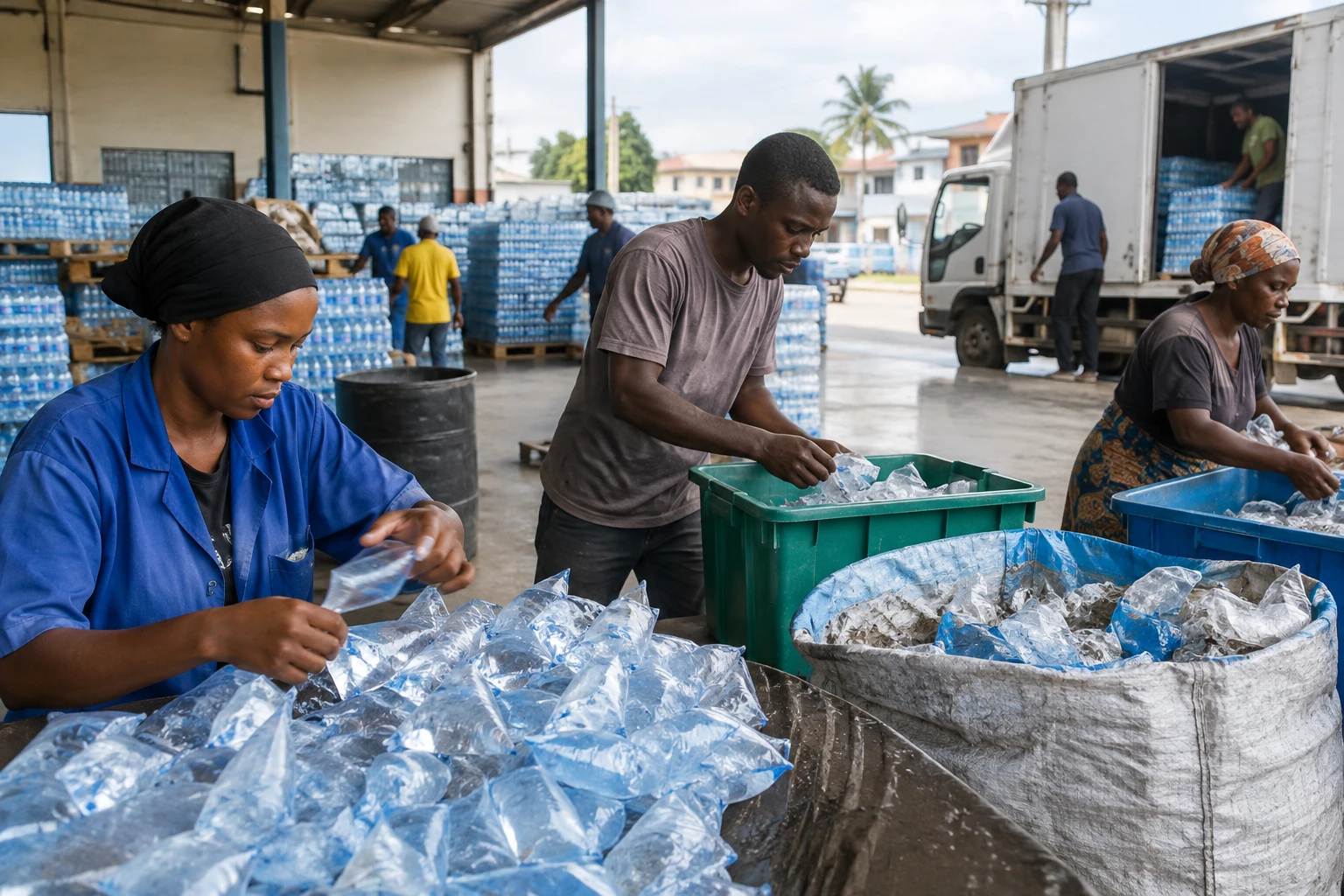
In Conakry, access to drinking water is about more than having a tap. For many consumers, low-cost sachets remain a practical option. But their packaging often ends up in the streets and waterways. Guinea therefore needs to reduce pollution without making water harder to afford.
A ban, then an extension
A Guinean decree dated 21 September 2024 provided for a ban on the manufacture, import, sale and distribution of single-use plastic packaging. It also encourages biodegradable packaging. Water sachets are among the products covered, while PET bottles are among the exceptions set out in the text. The Guinean decree on single-use plastics gave industrial units two years to comply.
As the ban was due to take effect, consumers raised concerns about the lack of available alternatives and the risk of higher prices. M’Bany Sidibé, president of the Guinean Consumers’ Defence Union, notably called for a gradual transition and greater support for small recycling and alternative-packaging businesses. His concerns about costs and replacement options illustrate the gap between the regulatory objective and the choices actually available to households.
On 9 October 2026, Guinea’s Ministry of Industry and Trade confirmed a six-month moratorium, limited to the production of sachets for mineral and mineralised water. Other single-use plastics remain banned. According to the ministry, the period is intended to support producers, promote biodegradable packaging and assist small and medium-sized collection and recycling businesses. The ministry sets out the scope of the moratorium.
The cost of alternatives remains a central issue
Producers point to the cost of biodegradable packaging, which they say is higher than that of conventional plastic. This difference may be passed on in the selling price. It particularly affects people who buy water by the sachet in markets, neighbourhoods and busy public places. The moratorium reduces the risk of an immediate shortage, but does not guarantee that the new packaging will be affordable after six months.
Another option is to develop collection and recycling of existing plastic. Guinean producers have raised the prospect of partnerships with small and medium-sized enterprises. The challenge is to build an industry capable of collecting, sorting and processing waste, rather than shifting pollution to another disposable package. To do so, businesses need markets, equipment and clear rules. The authorities must also verify that products presented as biodegradable meet the required standards.
Increasing the use of bottles does not, by itself, solve the environmental problem. The 2024 decree provides an exception for certain PET bottles, but their use can also generate waste. M’Bany Sidibé warned against replacing sachets on a large scale with bottles without a collection system. Consumers’ choices will also depend on price, the availability of sales outlets and confidence in water quality.
The public water network remains the long-term solution
Over the longer term, access to water supplied through the public network could reduce reliance on individual packaging. But improving infrastructure and service continuity takes time and investment. In April 2025, the World Bank announced funding for water and sanitation services in Guinea. The project includes plans to improve services in Greater Conakry and extend access to drinking water. The project announced for Guinea’s water services aims to reach more than 2.6 million people, including 572,200 who are expected to gain access to drinking water for the first time.
These targets do not mean that difficulties will disappear quickly. Needs vary between Conakry, secondary cities and rural areas. Residents connected to the network may benefit from improved water pressure and service hours; those who are not remain more dependent on vendors and packaged options. A uniform packaging policy will therefore have different effects depending on where people live and their income.
Six months to turn an announcement into solutions
The moratorium is a temporary compromise: it maintains a low-cost source of packaged water while giving the state and industry time to prepare the transition. Its effectiveness will depend on verifiable results: the availability and price of alternatives, effective waste collection and practical support for small and medium-sized enterprises. The ministry has also announced tougher checks on prices, stocks and producers’ licences.
The issue extends beyond manufacturers. It involves the authorities responsible for the environment, industry, trade and water, as well as consumers and local authorities. Across West Africa, where access to water, waste management and informal markets intersect in many cities, Guinea’s experience is a reminder that a ban works better when accompanied by available solutions. In Conakry and the prefectures, the test will be tangible: reducing waste without making households with the fewest options bear the cost of the transition.