Algeria
 Egypt
 Libya
 Morocco
 Sudan
 Tunisia
 Benin
 Burkina Faso
 Cabo Verde
 Côte d'Ivoire
 Ghana
 Guinea-Bissau
 Liberia
 Mali
 Mauritania
 Niger
 Nigeria
 Senegal
 Sierra Leone
 The Gambia
 Togo
 Cameroon
 Central African Republic
 Chad
 DR Congo
 Equatorial Guinea
 Gabon
 Republic of the Congo
 São Tomé and Príncipe
 Burundi
 Comoros
 Djibouti
 Eritrea
 Ethiopia
 Kenya
 Madagascar
 Malawi
 Mauritius
 Mozambique
 Rwanda
 Seychelles
 Somalia
 South Sudan
 Tanzania
 Uganda
 Angola
 Botswana
 Eswatini
 Lesotho
 Namibia
 South Africa
 Zambia
 Zimbabwe
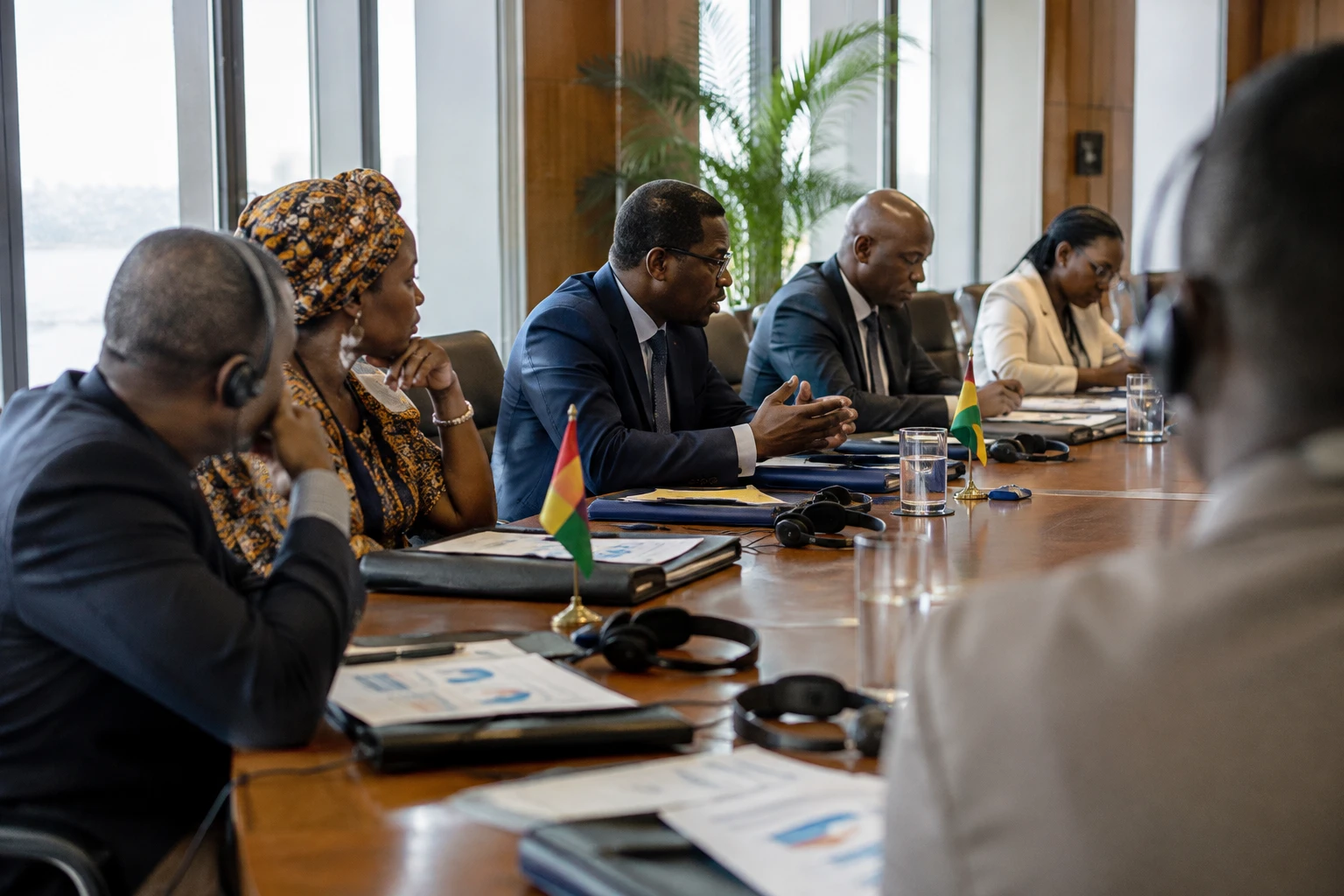
In Conakry and across the regions, a rapid rise in gross domestic product does not automatically translate into more jobs or higher incomes. In Guinea, the arrival of Simandou iron ore could accelerate economic activity. The challenge will be to make it a catalyst that extends beyond mining and benefits businesses and households too.
Simandou changes the economic outlook
Guinea is entering this new phase with an economy already driven by its mineral resources. In 2025, real gross domestic product (GDP) grew by 7.4%, according to the World Bank. The expansion of bauxite, a recovery in services and agricultural growth all contributed to this result. Inflation fell to 3.2%, down from 5.1% in 2024.
Against this backdrop, Simandou iron ore represents a step change. The vast project combines extraction with transport infrastructure, notably a railway and port facilities. It is part of an economic transformation path that Guinea’s authorities aim to extend through the Simandou 2040 programme. But the scale of investment alone does not guarantee a diversified economy.
Guinea is also a member of the Economic Community of West African States (ECOWAS), which brings together countries linked by trade and regional economic concerns. The increase in mineral exports will therefore have effects to monitor beyond Guinea’s borders, particularly on West African infrastructure and trade routes.
High forecasts, but still uncertain
In its economic update published on 7 October 2026, the World Bank forecasts real growth of 8.8% in 2026, followed by 11.6% in 2027 and 10.7% in 2028. The expected average for 2026-2028 is about 10.3%. The institution attributes this acceleration mainly to the ramp-up of Simandou iron ore exports. These are projections, not results already secured.
According to the same forecasts, mining-sector GDP is expected to increase by 20.2% in 2026 and 27.8% in 2027. Per capita growth is projected to average 7.7% over three years. This measure relates economic output to the population; on its own, it does not describe how income is distributed among households.
Estimates published by different institutions or at different times do not always coincide. Forecasts should therefore be compared on a like-for-like basis, with equivalent scope and timing. The World Bank also notes that international tensions, a slowdown in the global economy or higher oil and maritime transport costs could weigh on the outlook.
Some of the additional revenue could come from exports and the activity of businesses linked to the project. Their impact on public finances will, however, depend on the income actually received, its collection and how it is spent. Growth forecasts are not a guarantee of budget revenue.
Growth must extend beyond mining
Mines require substantial capital and expertise, but generate relatively few direct jobs in relation to their economic weight. The benefits for Guineans will therefore also depend on links with local businesses: contracts, subcontracting, training and opportunities for suppliers. Without these connections, economic activity can grow rapidly without doing as much to transform people’s daily lives.
Agriculture, agro-industry and services are central to this challenge. The World Bank identifies them as sectors capable of creating more productive jobs if access to finance, skills, infrastructure and markets improves. In rural areas, better connections and storage capacity can help producers sell their harvests. In Conakry, the challenge also concerns the cost of living and employment opportunities outside the public and mining sectors.
The increase in exports also raises questions about macroeconomic management. An influx of foreign currency can support imports and government revenue. But if mining income pushes up domestic costs or strengthens the currency, non-mining export sectors could become less competitive. This risk is often called “Dutch disease”. It is not an inevitable consequence: fiscal choices, economic policy and investment in productive sectors all matter.
The geographical distribution of gains will be just as important. Communities near the infrastructure may benefit from economic activity and new services, but they may also face pressure on land, transport and local resources. Urban workers, rural producers and formal or informal businesses will not benefit from growth in the same way. The spillover effects will depend, among other things, on accessible jobs and the role given to Guinean suppliers.
The test: turning revenue into lasting capacity
The project’s impact will therefore be measured as much by its effects on the economy beyond mining as by the volume of ore exported. Transparency in collecting and using revenue, the quality of shared infrastructure and investment in skills will all affect this transformation. The 2027-2033 partnership framework announced by the World Bank focuses, among other things, on commercial agriculture, skills development and domestic revenue mobilisation.
For ECOWAS and other economies in the region, Guinea’s experience highlights a challenge shared by producing countries: major export projects can boost national indicators, but their social impact depends on the links established with the rest of the economy. The next developments to watch will be the actual ramp-up of Simandou exports, followed by the translation of this activity into public revenue, jobs and opportunities for Guinean businesses.
The World Bank sets out these prospects in its 2026 economic report on Guinea and growth diversification. The 2027-2033 partnership framework, in turn, sets out investment priorities in agriculture, skills and revenue management.