Algeria
 Egypt
 Libya
 Morocco
 Sudan
 Tunisia
 Benin
 Burkina Faso
 Cabo Verde
 Côte d'Ivoire
 Ghana
 Guinea-Bissau
 Liberia
 Mali
 Mauritania
 Niger
 Nigeria
 Senegal
 Sierra Leone
 The Gambia
 Togo
 Cameroon
 Central African Republic
 Chad
 DR Congo
 Equatorial Guinea
 Gabon
 Republic of the Congo
 São Tomé and Príncipe
 Burundi
 Comoros
 Djibouti
 Eritrea
 Ethiopia
 Kenya
 Madagascar
 Malawi
 Mauritius
 Mozambique
 Rwanda
 Seychelles
 Somalia
 South Sudan
 Tanzania
 Uganda
 Angola
 Botswana
 Eswatini
 Lesotho
 Namibia
 South Africa
 Zambia
 Zimbabwe
For Guineans, the revival of a public telecoms operator will not be measured solely by partnership announcements. It will be judged by network coverage, call quality and data prices, in a market where Orange holds a dominant position.
In Conakry, the authorities are seeking a partner able to provide technical expertise, financing and commercial know-how. But cooperation with a foreign group does not, by itself, guarantee greater competition or improved service for subscribers.
Two state-owned companies, two distinct challenges
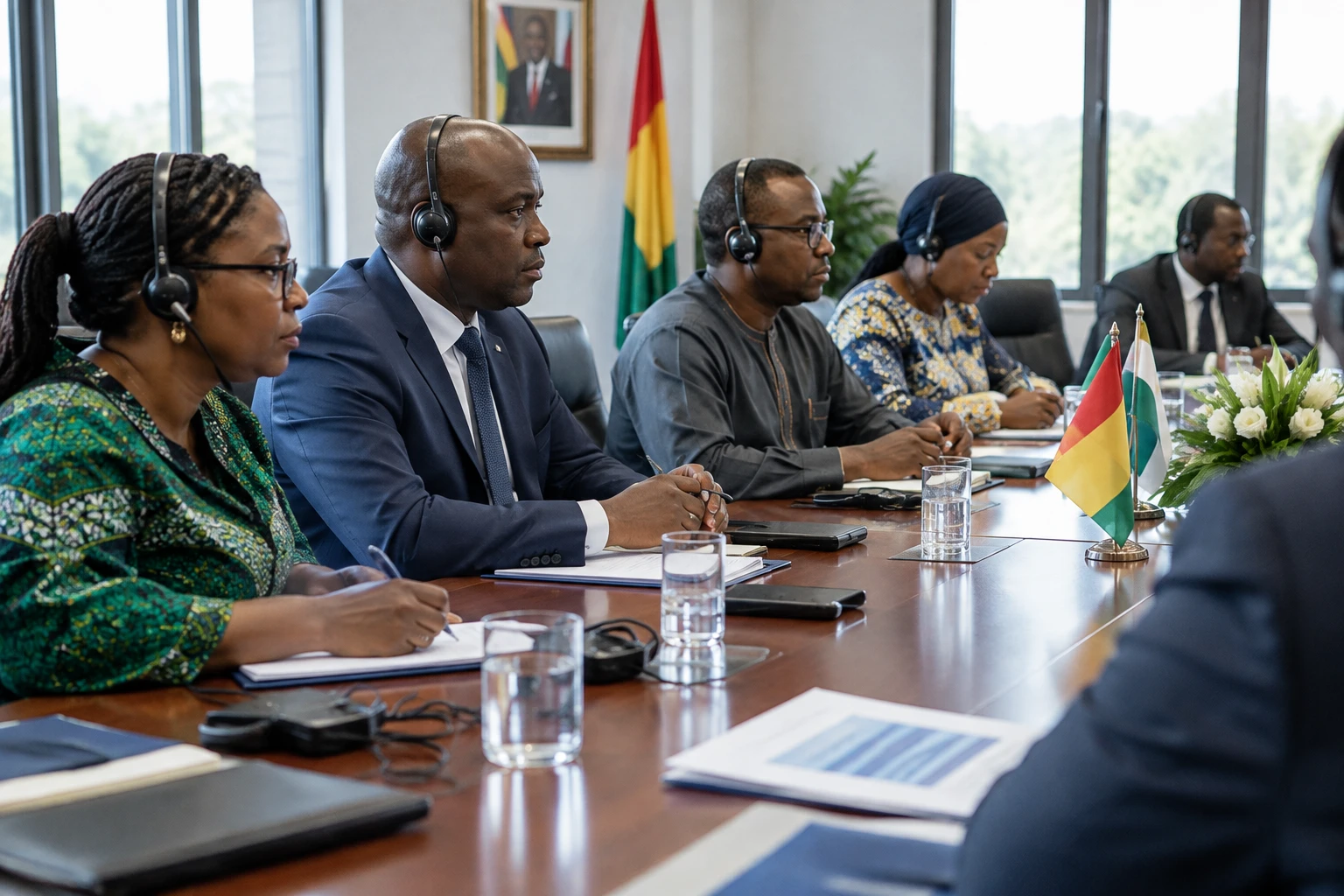
On 11 November 2026, Guinea’s ministers responsible for communications and planning received a delegation from Maroc Telecom. Discussions focused on possible support for Guinée Télécom and Areeba Guinée, as well as the development of digital infrastructure. The ministry referred to prospects for cooperation, without announcing a signed agreement or specifying the financial or operational commitments under consideration. The account from Guinea’s ministry, carried by the Journal Horoya, speaks of opportunities to explore, not a finalised partnership.
Areeba must first stabilise an operating but weakened company. The state bought the 75% stake held by South Africa’s MTN in December 2024. Guinea’s Ministry of Economy and Finance says a diagnosis by consultancy EY found the company to be in a situation of near-insolvency. The assessment justifies a restructuring, but does not, on its own, indicate the amount of debt or the resources needed for a turnaround. The finance ministry sets out Areeba’s acquisition and diagnosis.
Figures from the Posts and Telecommunications Regulatory Authority (ARPT) show the scale of its commercial decline. Between the fourth quarter of 2024 and the second quarter of 2026, Areeba’s share of mobile subscriptions fell from 22.6% to 13.4%, according to the regulator’s observatory. Orange’s share rose from 74.8% to 85.4%. In mobile internet, Areeba’s share fell from 20.4% to 8.5%. These figures describe subscription shares, not network quality or the number of unique subscribers. The ARPT observatory publishes market data.
Guinée Télécom, meanwhile, has yet to return to the market as an operator. The project remains at the planning stage: restructuring, recapitalisation, governance and the partnership model still need to be defined. The distinction matters. For Areeba, the challenge is to halt a decline that is already measurable. For Guinée Télécom, the conditions for an operational restart still have to be built.
A regional partner, but terms still to be clarified
Maroc Telecom has extensive experience across the continent, notably through its Moov Africa subsidiaries. At the end of 2025, the group reported nearly 77 million customers across all its operations. Its international subsidiaries accounted for 54.6 million of those and generated revenue of 19.15 billion dirhams. These results demonstrate its ability to operate at scale, but do not determine the form or cost of any involvement in Guinea. Maroc Telecom’s 2025 results set out these figures.
Guinea’s authorities have not said whether cooperation might take the form of an equity stake, a management contract, technical support or investment in networks. These options involve different trade-offs. A recapitalisation can provide funds, while an assistance contract can transfer skills without changing ownership. In all cases, the allocation of risks and control over decisions will need to be clear.
Its pan-African experience could also open a path to South-South cooperation between actors from the continent. However, this does not remove the need to examine expected results, timelines, oversight mechanisms and service obligations. The partner’s financial capacity, announced investments and their actual delivery will be just as decisive as the announcement itself.
Competition also matters to subscribers
Market concentration affects more than the fate of two state-owned companies. If Areeba continues to lose ground and Guinée Télécom is slow to launch, Orange will have greater influence over the choice of offers and the competitive balance. This does not automatically mean that prices will rise or quality will fall. However, reduced competition makes regulatory oversight of tariffs, coverage and access to infrastructure all the more important.
The effects of a revival would not be the same everywhere. Urban customers can more easily compare several offers when networks are available. In less well-served areas, the priority is often access to stable coverage. Formal businesses need reliable connections for their payments and transactions. Small shops and workers in the informal economy also depend on mobile services, but are particularly sensitive to the cost of calls and data.
The state is also in a dual position: it is Areeba’s shareholder and the authority responsible for the sector’s framework. This calls for a clear separation between ownership decisions and regulatory duties. The ARPT will have to maintain common rules for operators, whether public or private, so that the recovery of one company does not come at the expense of a level playing field.
A Guinean issue watched across West Africa
Guinea is a member of ECOWAS, the Economic Community of West African States, whose regional rules aim in particular to support openness and competition in telecommunications. In this area, operators’ strategies extend beyond national borders. Decisions made in Conakry may therefore interest groups operating in several West African countries, but the recovery of Guinean companies will depend first and foremost on concrete national decisions.
The next step will be to learn the terms of any possible agreement: financing, timetable, governance, coverage targets and the state’s role. ARPT indicators will also need to be tracked to see whether Areeba stabilises its share and whether Guinée Télécom moves beyond the planning stage. For subscribers, this is where the significance of the 11 November discussions will be tested: in more accessible services and a market where several operators can genuinely compete.