Algeria
 Egypt
 Libya
 Morocco
 Sudan
 Tunisia
 Benin
 Burkina Faso
 Cabo Verde
 Côte d'Ivoire
 Ghana
 Guinea-Bissau
 Liberia
 Mali
 Mauritania
 Niger
 Nigeria
 Senegal
 Sierra Leone
 The Gambia
 Togo
 Cameroon
 Central African Republic
 Chad
 DR Congo
 Equatorial Guinea
 Gabon
 Republic of the Congo
 São Tomé and Príncipe
 Burundi
 Comoros
 Djibouti
 Eritrea
 Ethiopia
 Kenya
 Madagascar
 Malawi
 Mauritius
 Mozambique
 Rwanda
 Seychelles
 Somalia
 South Sudan
 Tanzania
 Uganda
 Angola
 Botswana
 Eswatini
 Lesotho
 Namibia
 South Africa
 Zambia
 Zimbabwe
A financial windfall that does not tell the whole story
In Guinea, a record level of investment does not, by itself, guarantee factories in operation, growing SMEs or lasting jobs. The country attracted one of the continent’s largest inflows of foreign investment in 2024, but most of this wave remained concentrated around a single construction site: Simandou, the gigantic iron ore project in south-eastern Guinea.
This paradox lies at the heart of the economic debate in Conakry. On the one hand, capital is flowing in. On the other, local transformation is advancing more slowly than expected. For many Guinean stakeholders, the real question is therefore not just how much money enters the country, but how much stays, circulates and is turned into domestic economic activity.
Simandou, a national engine and regional challenge
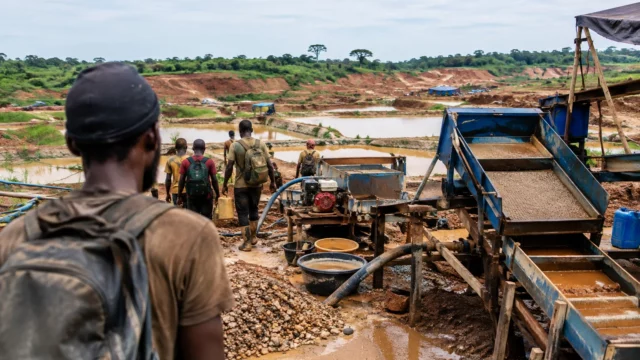
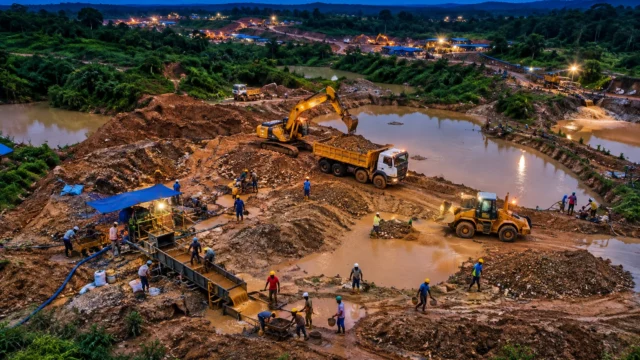
Simandou is not just a mine. It is a mines-and-infrastructure complex linking the mountains of south-eastern Guinea to the Atlantic coast by rail and a deep-water port at Moribaya. This kind of project carries significant weight in the balance of payments, equipment imports and foreign currency. It also puts Guinea at the centre of regional and global competition over iron ore, transport and logistics chains.
The start of actual production was announced in November 2025 by the Guinean authorities, following a ramp-up in construction and equipment work during the year. This timetable confirms that the record figures for 2024 largely reflect a construction phase, rather than fully mature mining production.
The country is also part of a West African environment in which ECOWAS, institutional stability and the credibility of the rules of the game matter in attracting long-term capital. In practice, investors weigh up several countries in the sub-region, as well as mining, energy, ports and rail corridors. Simandou gives Guinea a strategic advantage. It also increases pressure to ensure that revenue, contracts and jobs benefit the local economy more substantially.
Contracts, but limited local capture
On the ground, the immediate benefits remain mixed. Major contracts related to the railways, port and heavy engineering have mainly gone to foreign groups, particularly Chinese and Portuguese ones, according to stakeholders in Guinea’s mining sector. Local companies, meanwhile, have mostly secured contracts for security, catering, light earthworks and occasional subcontracting.
This situation is fuelling very real frustration among Guinean operators. Many say they have received no calls for tenders, invitations or significant contracts for the project’s most lucrative components. The discontent is all the greater because Simandou was meant to herald a new phase of economic sovereignty. Yet without an active local-content policy, procurement flows automatically to established contractors, which are often better equipped, better financed and quicker to deliver.
The sensitive issue is not just industrial. It is financial, too. When project spending passes through accounts outside the country, its impact on Guinean banks, foreign-currency liquidity and the economy’s capacity to finance real activity remains limited. Conversely, when payments are made in Guinea, banking activity deepens, the Guinean franc can be better supported, and essential imports such as rice, flour and sugar become less exposed to exchange-rate pressures.
What the record figure says, and what it conceals
Available data show an impressive but highly concentrated trend. Guinea received $7.973 billion in FDI in 2024, according to UNCTAD’s country fact sheet. The World Bank also puts flows well above previous years, with a significant share linked to major mining projects and associated infrastructure. In other words, this is not a broad-based boom in the Guinean economy, but a mass of money driven by a single project.
This is where the political stakes lie. If investment serves only to build assets controlled and operated mainly by foreign companies, Guinea will remain a financial transit country rather than a country of industrial transformation. If, instead, the next phases require more local subcontracting, domestic procurement, training and national participation, Simandou could benefit the wider economy beyond the mining sector alone.
African and international financial institutions are making the same point: the challenge is no longer just to attract capital, but to increase absorptive capacity, contract transparency and the sharing of gains. The African Development Bank also stresses that Guinea needs to mobilise its domestic resources more effectively and strengthen the mechanisms that turn investment into broader development. The IMF, for its part, emphasises the need to protect the economy from commodity-price volatility and improve public cash management.
The future will be decided along the value chain
For Guinea, the coming months will be decisive. The project’s ramp-up, the gradual commissioning of infrastructure, the actual flow of payments through the local banking system and the quality of contracts awarded to Guinean companies will show whether Simandou becomes a lever for diversification or simply a spike in FDI with no lasting impact.
Across West Africa, the Guinean example already matters. It shows that resource-rich countries do not necessarily lack investors. Their challenge is instead to turn a mega-project into a productive economy, skilled jobs and stable tax revenue. In a region where governments are seeking to fund roads, energy, ports and industrialisation, Guinea’s response to this question will serve as a test for many other African economies.