Algeria
 Egypt
 Libya
 Morocco
 Sudan
 Tunisia
 Benin
 Burkina Faso
 Cabo Verde
 Côte d'Ivoire
 Ghana
 Guinea-Bissau
 Liberia
 Mali
 Mauritania
 Niger
 Nigeria
 Senegal
 Sierra Leone
 The Gambia
 Togo
 Cameroon
 Central African Republic
 Chad
 DR Congo
 Equatorial Guinea
 Gabon
 Republic of the Congo
 São Tomé and Príncipe
 Burundi
 Comoros
 Djibouti
 Eritrea
 Ethiopia
 Kenya
 Madagascar
 Malawi
 Mauritius
 Mozambique
 Rwanda
 Seychelles
 Somalia
 South Sudan
 Tanzania
 Uganda
 Angola
 Botswana
 Eswatini
 Lesotho
 Namibia
 South Africa
 Zambia
 Zimbabwe
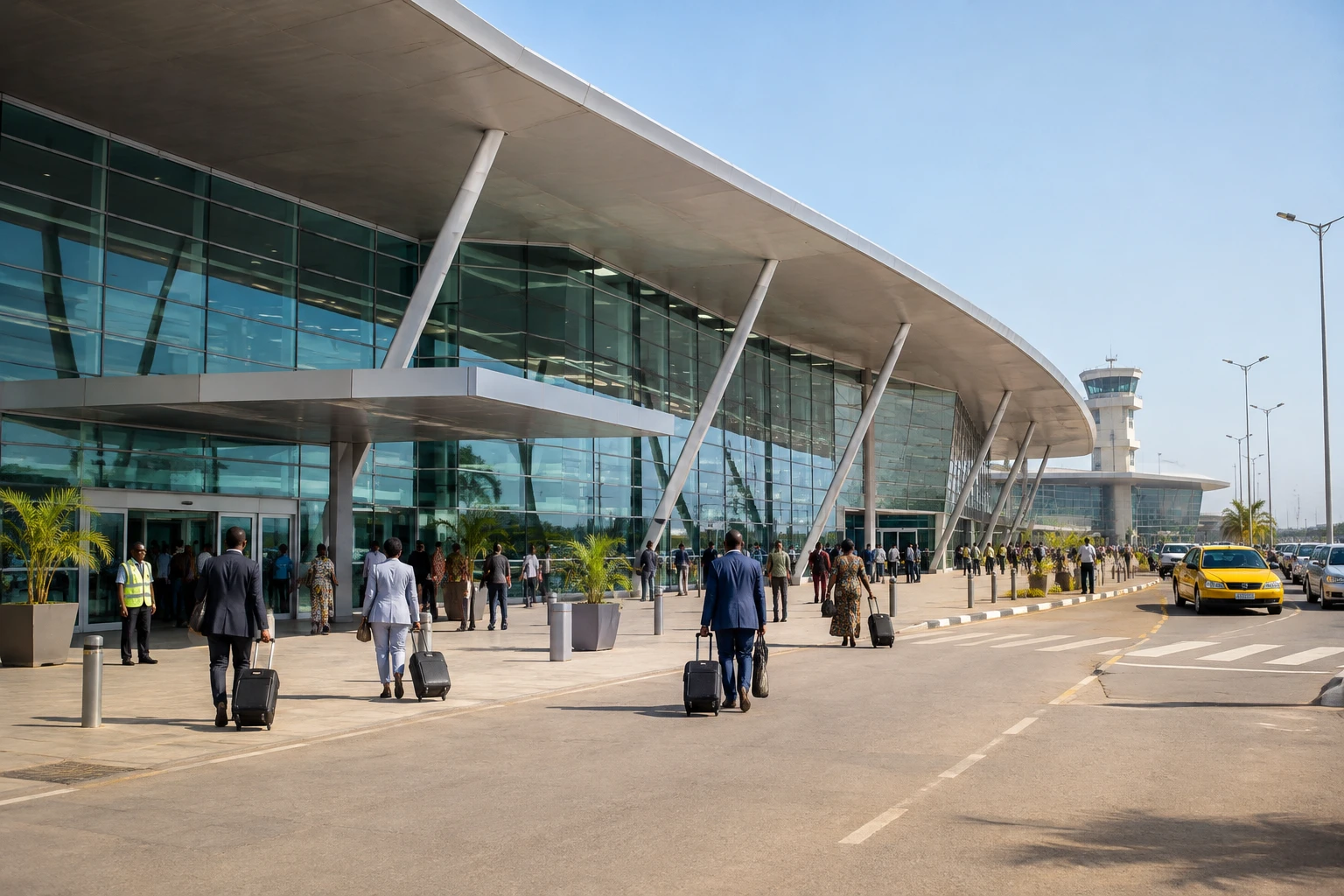
In Conakry, hotels are welcoming more visitors connected to the mining industry. But turning these business trips into a sustainable driver of tourism requires more than additional rooms: it calls for roads, reliable services and benefits that extend beyond the capital.
Air traffic rises, driven by several factors
Ahmed Sékou Touré International Airport in Conakry handled 788,879 passengers in 2024 and then 957,820 in 2025, an increase of 21.4%. These figures, published by the Conakry Airport Management and Operations Company (SOGEAC), confirm a rise in passenger numbers. However, on their own, they do not allow the increase to be attributed to mining activity.
Traffic rose further in the first half of 2026. SOGEAC recorded 545,330 passengers, compared with 446,335 over the same period in 2025, an increase of 22.18%. Domestic traffic also gained ground. The airport therefore reflects business travel, regional connections and travel by Guineans alike.
Professionals in the capital’s high-end hotel sector describe increased demand linked to mining companies and their contractors. Jean-Baptiste Blondin, chief executive of the Riviera Royal Group, said, in particular, that occupancy at his two properties had risen from 30% to 60%. This observation applies to his hotels, not to the sector as a whole.
The increase in activity creates an opportunity for accommodation providers, restaurants and transport operators. It also reveals a limitation: if visitors remain in Conakry for business meetings, the rest of the country does not automatically benefit from their presence.
From Simandou to places to stay: linking investments
The Simandou project gives this issue a new dimension. The iron ore deposit lies in south-eastern Guinea; its infrastructure includes a railway and port facilities at Morébaya, in Forécariah prefecture. Guinea’s Ministry of Transport describes the port as an infrastructure combining several modes of transport and intended to facilitate the movement of goods and people.
Hotel groups are considering locations outside the capital, particularly near economic hubs. For these companies, the arrival of workers, suppliers and delegations may justify new accommodation. But a place to stay associated with a mining project is not yet a tourist destination: it first serves business needs and may depend on the project’s timetable.
The authorities have also discussed investment in beaches near Conakry, the Loos Islands, regional museums and access to remote natural sites, including Mount Nimba. The Guinea Development Board presents several forms of tourism as potential avenues for diversification. Delivering on them will depend on essential services: passable roads, water, electricity, waste management, security and trained staff.
Planning decisions will affect residents in different ways. Near tourist sites, local businesses can attract new customers, provided they can access markets and finance. Coastal communities, meanwhile, must also be involved in decisions affecting beaches, fishing and how the coastline is used. Without consultation, a tourism project can create tensions rather than shared income.
A framework to implement, benefits to measure
Guinea adopted its first Tourism Code in 2026, according to the Ministry of Culture, Tourism and Handicrafts. The legislation aims, among other things, to regulate investment, professions and the classification of establishments. Its adoption establishes a framework; its implementation will determine whether the rules are clear to investors and small Guinean businesses alike.
This step matters in a sector where accommodation capacity and standards can vary widely between the capital and the regions. A useful classification system will need to be accompanied by consistent inspections and arrangements accessible to independent hotels. Otherwise, large brands may be better placed to capture demand and financing.
The question extends beyond tourism. Guinea is seeking to extract greater value from its mineral resources and major infrastructure projects. The rise in business travel can support other activities, but it guarantees neither economic diversification nor an improvement in residents’ daily lives. It will be necessary to track jobs created locally, contracts awarded to Guinean businesses and revenues actually reinvested in the regions.
Across West Africa, ECOWAS — a regional organisation for co-operation between states — remains an important framework for connections, travel and trade. Guinea’s challenge will be to connect its economic hubs and visitor sites while ensuring that infrastructure also serves local communities. The next measure of success will not simply be passenger numbers in Conakry, but the share of benefits reaching the regions.
Traffic data published by SOGEAC, figures for the first half of 2026, the Ministry of Transport’s presentation of the port of Morébaya, the ministry’s information on the Tourism Code and tourism opportunities identified by the Guinea Development Board.