Algeria
 Egypt
 Libya
 Morocco
 Sudan
 Tunisia
 Benin
 Burkina Faso
 Cabo Verde
 Côte d'Ivoire
 Ghana
 Guinea-Bissau
 Liberia
 Mali
 Mauritania
 Niger
 Nigeria
 Senegal
 Sierra Leone
 The Gambia
 Togo
 Cameroon
 Central African Republic
 Chad
 DR Congo
 Equatorial Guinea
 Gabon
 Republic of the Congo
 São Tomé and Príncipe
 Burundi
 Comoros
 Djibouti
 Eritrea
 Ethiopia
 Kenya
 Madagascar
 Malawi
 Mauritius
 Mozambique
 Rwanda
 Seychelles
 Somalia
 South Sudan
 Tanzania
 Uganda
 Angola
 Botswana
 Eswatini
 Lesotho
 Namibia
 South Africa
 Zambia
 Zimbabwe
A show of firmness at the top of the state
In Conakry, a ministerial dismissal is never just a reshuffle. It also reveals the balance of power at the top, the pace of action demanded by the authorities and their tolerance for alleged misconduct. In Guinea, that reading is all the more closely watched because the executive has made “refoundation” a central rallying cry.
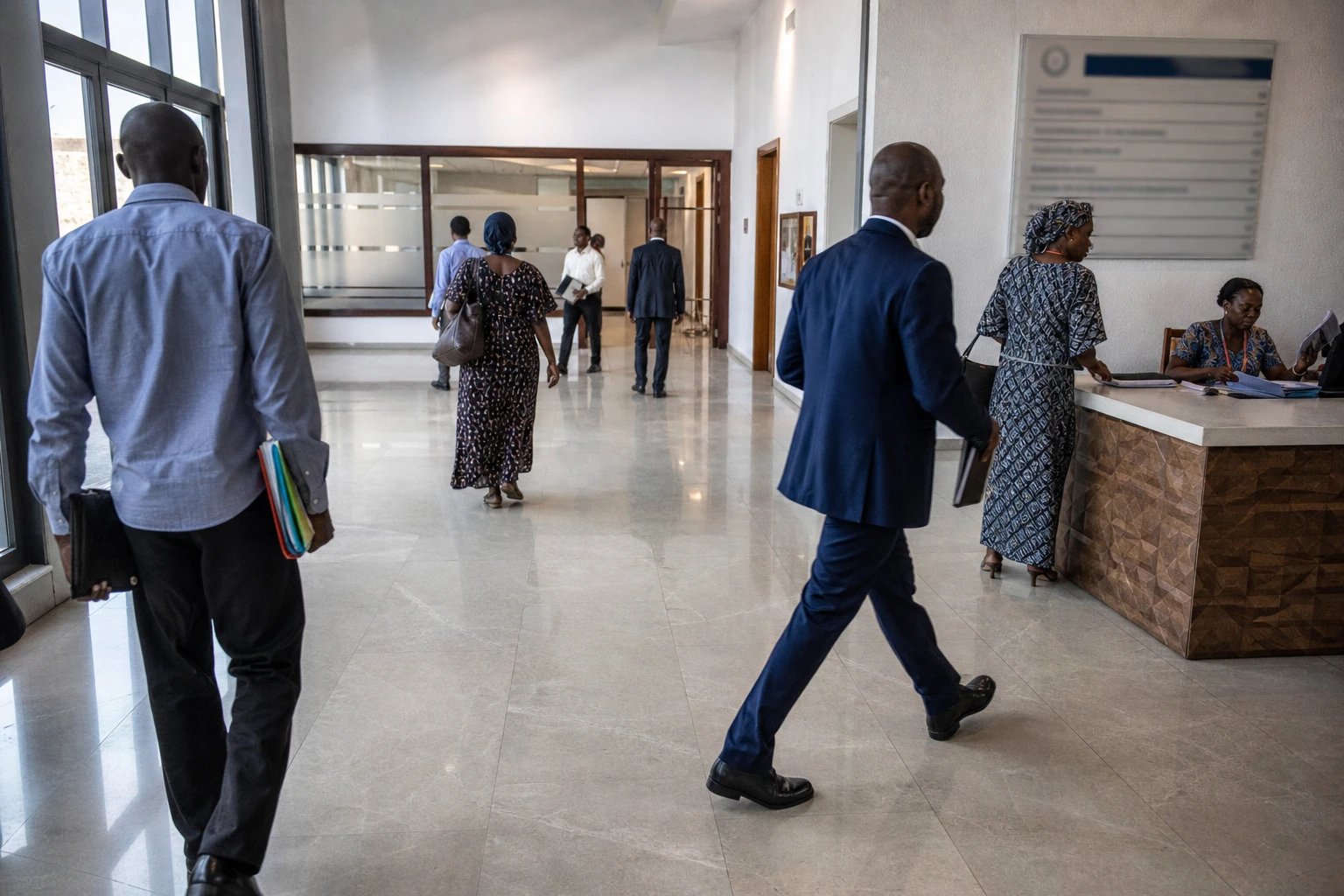
On the evening of Friday 21 August 2026, President Mamadi Doumbouya dismissed two members of the government. They were Mory Condé, then responsible for Employment, Labour and Social Protection, and Mourana Soumah, head of the Ministry of Communication, Digital Economy and Innovation. The departure of another figure, presidential adviser Mahamadou Abdoulaye Diallo, was also announced shortly afterwards. The decrees were read out on national television, with no detailed reason given. The relevant administrative departments took over on an interim basis.
In his public statement, the head of state presented the decision as a reminder of the need to set an example. He said the fight against corruption would make no exceptions and that “Refoundation” must first apply to state officials themselves. This line, reiterated for several months, aims to establish an image of top-down authority, while also showing that, in theory, the inner circle is not a protected space.
A transition still under regional scrutiny
The move forms part of a broader institutional sequence. Since the gradual return to constitutional order, Guinea has remained under close scrutiny from ECOWAS, the Economic Community of West African States. In May 2026, the regional organisation deployed a technical mission to observe the legislative and local elections held on 31 May, which were presented as the final stage of the transition process. It has also reiterated its support for strengthening democratic institutions and the country’s stability.
In recent weeks, the Guinean presidency has for its part stressed the national timetable and the major upcoming events. On 2 October 2026, Guinea is due to celebrate the 68th anniversary of its accession to national sovereignty, a politically sensitive date in a country where the memory of 1958 remains strong. Alongside this symbolic dimension is a period of reorganisation of the state apparatus, with recent government changes and a strong emphasis on administrative discipline.
In this context, the dismissal of two ministers considered close to the head of state, according to several observers of the Guinean political scene, goes beyond simple team management. It also serves as a reminder that political ties offer no lasting guarantee. Supporters of the government may see the message as proof of firmness. For the civil service, by contrast, it imposes a logic of constant vigilance, with every ministry aware that a decision can come without warning. This approach narrows the scope for traditional political compromises and strengthens the influence of the decision-making centre.
Practical effects for the administration and Guineans
On the ground, a dismissal of this kind has immediate effects. Secretaries-general take charge of day-to-day affairs. This may slow some decisions, but it may also speed up arbitration if the presidency wants to signal that it is taking back control. In a country where social expectations remain high, particularly around youth employment, social protection and digital services, every vacancy at the head of a ministry can mean longer waits for service users and businesses.
The Ministry of Labour and Social Protection has a direct bearing on relations between the state, businesses and workers in the formal sector. The Ministry of Communication, Digital Economy and Innovation, meanwhile, has an impact on another strategic front: access to public services, digital regulation, the flow of information and the country’s appeal to investors. In Conakry and the prefectures, these areas concern major institutions as much as the informal economy, which is a prominent part of everyday life in Guinea. A swift replacement of the team may therefore be seen as an effort to retain control over sensitive sectors.
The dismissal also comes in a country where the promise to clean up public life has already been used to justify several major measures since the start of the transition. Guinea’s recent political history shows that anti-corruption announcements can have real effects, but are also often accompanied by internal realignments within the government. The question, then, is not only who is leaving, but who makes the decisions, on what criteria and under what public oversight. That is where the credibility of institutions is at stake.
West African implications not to be underestimated
Across West Africa, Guinea remains a closely watched case. ECOWAS is monitoring the return to constitutional order as a test of regional stability. After several years of transition, the issue is no longer solely electoral. It also concerns the state’s ability to produce clear rules, predictable institutions and governance that does not depend solely on personal relationships at the top. It is in this context that the dismissal has significance beyond Guinea’s government alone.
The next few weeks will determine what happens, with interim appointments, a possible ministerial reshuffle and the continuation of political initiatives launched since the 2025 and 2026 elections. For Guineans, the stakes are tangible: whether the firmness displayed at the top will lead to a more effective administration, greater accountability and more reliable public services. For the region, the question is straightforward: is Guinea finally consolidating a lasting institutional process, or entering a new cycle of rapid adjustments?