Algeria
 Egypt
 Libya
 Morocco
 Sudan
 Tunisia
 Benin
 Burkina Faso
 Cabo Verde
 Côte d'Ivoire
 Ghana
 Guinea-Bissau
 Liberia
 Mali
 Mauritania
 Niger
 Nigeria
 Senegal
 Sierra Leone
 The Gambia
 Togo
 Cameroon
 Central African Republic
 Chad
 DR Congo
 Equatorial Guinea
 Gabon
 Republic of the Congo
 São Tomé and Príncipe
 Burundi
 Comoros
 Djibouti
 Eritrea
 Ethiopia
 Kenya
 Madagascar
 Malawi
 Mauritius
 Mozambique
 Rwanda
 Seychelles
 Somalia
 South Sudan
 Tanzania
 Uganda
 Angola
 Botswana
 Eswatini
 Lesotho
 Namibia
 South Africa
 Zambia
 Zimbabwe
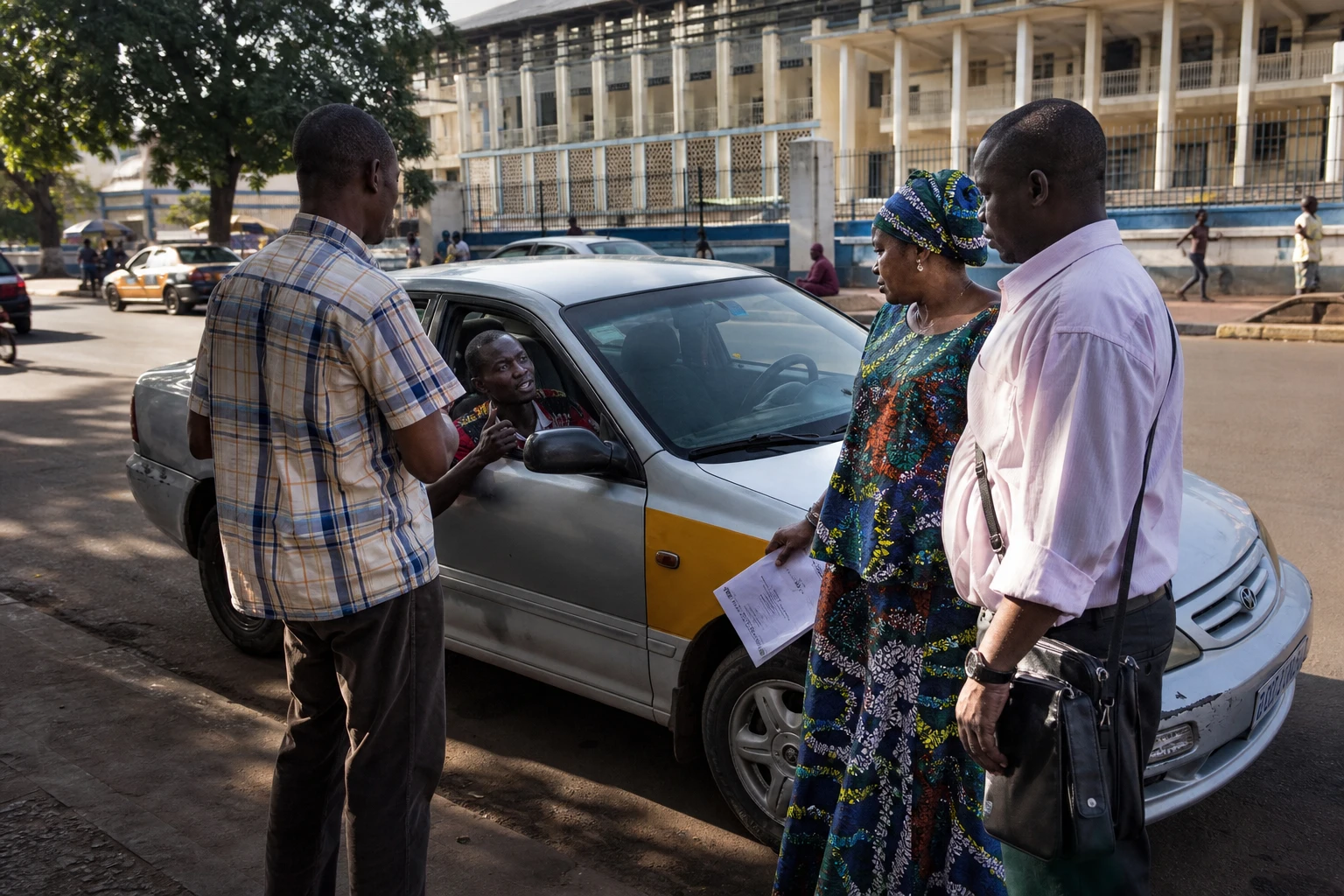
In Conakry, a conversation overheard in a taxi led to nearly a month in detention. On 30 September 2026, the Kaloum Court of First Instance finally ruled that the alleged acts involving Seydouba Soumah did not constitute a criminal offence.
Arrest following a discussion in a taxi
The case dates back to 1 September 2026. Seydouba Soumah was travelling in a shared taxi from the Coyah area to Conakry. A plain-clothes gendarme was also travelling in the vehicle.
According to the evidence presented at the hearing, a discussion began about possible clashes in Guinea in the following months. The passenger reportedly replied to the driver that he had heard about them too. This remark, reported by the gendarme, led to his arrest.
The driver reportedly mentioned information attributed to a serviceman from the Autonomous Battalion of Airborne Troops, the BATA. The unit is part of Guinea’s defence forces. However, the exact content of the conversation was not independently established.
Seydouba Soumah disputed this account. He explained that the exchange was instead about economic measures announced by the authorities. He also denied trying to provoke unrest.
The young man was prosecuted for “attempting to disturb public order”. Another defendant, Ibrahima Camara, was also named in the proceedings. However, he was released during the proceedings, according to several reports by Guinean media outlets, including Guinée28 and Guinée7.
Court rules no criminal offence was committed
The verdict was delivered on Wednesday 30 September at the Kaloum Court of First Instance in Conakry. Judge Mamadou Saliou Diallo acquitted Seydouba Soumah.
In other words, the court found that the facts presented at the hearing did not support the offence charged. It therefore ordered the defendant’s release; he had been detained since his arrest on 1 September.
The decision followed the prosecution’s submissions. The public prosecutor had sought a one-year prison sentence for Seydouba Soumah. He had, however, sought Ibrahima Camara’s acquittal, according to the report published by the Guinean Embassy in Senegal.
After the hearing, the defendant’s brother expressed his relief. He also urged citizens to weigh their words in public. His reaction reflects one immediate effect of the case: even without a conviction, the arrest has made people much more cautious about political and security-related discussions.
The ruling was confirmed by several Guinean media outlets. Mediaguinee reports that the court concluded that “no offence had been made out”. Le Lynx also says the judge found that the facts did not constitute an offence under criminal law.
A case that reflects Guinea’s political climate
The significance of the case extends beyond Seydouba Soumah’s circumstances. Guinea is under a transition launched after the coup of 5 September 2021. General Mamadi Doumbouya has led the country since that institutional rupture.
In this context, rumours about security, clashes or the country’s political future spread quickly. They circulate on public transport, in neighbourhoods and markets, and on social media. Yet a rumour is not automatically an offence. It may become punishable under criminal law if accompanied by specific acts, an incitement to violence or a credible threat. The court’s decision recalls this distinction.
The case also highlights the weight of pre-trial detention. Seydouba Soumah spent nearly a month in prison before the court ruled on the merits. For his family, this period was a financial and psychological ordeal. For the judicial system, it raises the question of whether the deprivation of liberty was proportionate to the seriousness of the alleged acts.
In large cities, shared taxis provide spaces for conversation between employees, traders, students and informal-sector workers. Police action linked to an ordinary discussion can change behaviour far beyond those directly involved. Passengers may choose to stop talking about politics. Drivers, meanwhile, may avoid sensitive topics for fear of legal proceedings.
This caution is not confined to the courts. It also concerns the media, rights organisations and political actors. Any case based on reported remarks therefore demands particular attention to evidence, context and contradictions between witness accounts.
A signal to watch during the transition
Guinea remains a member of the Economic Community of West African States (ECOWAS), the regional organisation that coordinates, among other things, security, governance and movement between several West African countries. Relations between ECOWAS and regimes that came to power in coups have, however, been highly strained in recent years.
Mali, Burkina Faso and Niger announced their withdrawal from the regional organisation in January 2025, after years of disagreements over sanctions and timelines for a return to constitutional order. Guinea, by contrast, has remained in ECOWAS while continuing its own military-led transition.
In this regional environment, the Guinean authorities closely monitor discourse that could fuel tensions. But the Soumah case also shows the need to distinguish between preventing unrest and criminalising words that are not accompanied by acts.
The 30 September verdict does not resolve all questions about the circumstances of the arrest or the detention endured. It does, however, establish a specific legal point: in this case, the Kaloum court did not find that a criminal offence had been committed. The rest of the transition will show whether this requirement for evidence is upheld over time in cases involving political speech and security rumours.