Algeria
 Egypt
 Libya
 Morocco
 Sudan
 Tunisia
 Benin
 Burkina Faso
 Cabo Verde
 Côte d'Ivoire
 Ghana
 Guinea-Bissau
 Liberia
 Mali
 Mauritania
 Niger
 Nigeria
 Senegal
 Sierra Leone
 The Gambia
 Togo
 Cameroon
 Central African Republic
 Chad
 DR Congo
 Equatorial Guinea
 Gabon
 Republic of the Congo
 São Tomé and Príncipe
 Burundi
 Comoros
 Djibouti
 Eritrea
 Ethiopia
 Kenya
 Madagascar
 Malawi
 Mauritius
 Mozambique
 Rwanda
 Seychelles
 Somalia
 South Sudan
 Tanzania
 Uganda
 Angola
 Botswana
 Eswatini
 Lesotho
 Namibia
 South Africa
 Zambia
 Zimbabwe
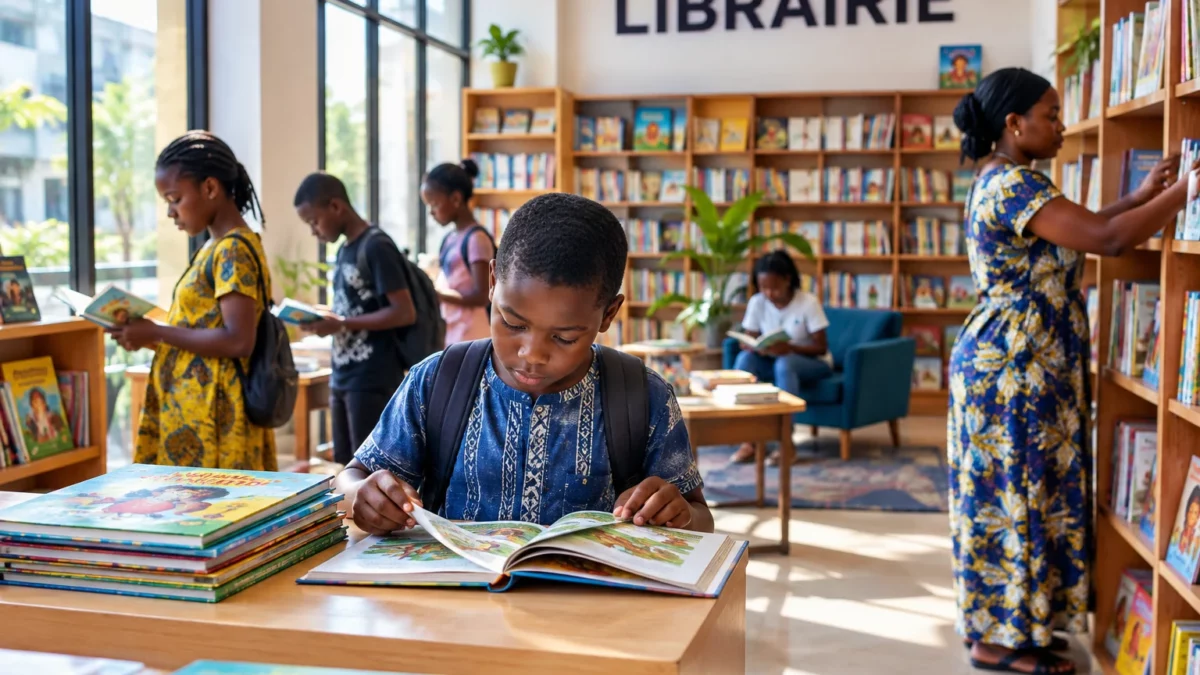
For a Guinean child, learning to read is not enough: they also need to find accessible stories in a language they understand and be able to read them beyond the classroom. In Guinea, children’s publishing raises a practical question of culture, but also of the circulation of goods and public policy.
Getting books from Conakry to the regions
Based in Conakry since 1992, Éditions Ganndal has made children’s literature and educational books a significant part of its catalogue. Its founder, Aliou Sow, champions a sector in which publishing needs to be supported by funding, bookshops and reliable distribution channels.
This diagnosis extends beyond Guinea. In French-speaking West Africa, a book produced in one country does not automatically reach readers in neighbouring countries. Publishers must contend with sparse sales networks, transport costs and formalities that slow exchanges. The free movement provided for under regional frameworks therefore does not, by itself, guarantee that books can circulate easily.
This is not a new finding. An assessment of children’s books in Guinea has already noted the existence of public libraries and reading centres, while highlighting their limited numbers and the slow renewal of their collections. It also identifies the lack of a sufficiently structured national book policy. These needs affect Conakry as much as secondary cities and rural areas, where access to bookshops is more limited.
Co-publishing as a distribution network
To overcome these obstacles, Ganndal is relying on partnerships between African publishing houses. Co-publishing involves producing a book together, while joint distribution draws on each partner’s networks to promote and sell it in different countries. Each publisher thus becomes a local outlet, rather than relying on a single export channel.
This cooperation can also widen the choices available to young readers. Aliou Sow champions bilingual books and Guinea’s national languages, including Pular, Malinké and Susu. A book published in several languages can reach children who do not all read French with the same fluency. It is also a way to give languages spoken in everyday life a place in content for young people.
The challenge is economic as well as linguistic. Designing a book, paying authors and illustrators, printing it and then distributing it all require resources. Without appropriate funding, publishers have less scope to invest in new titles, translations or accessible formats. Braille, audio and digital formats expand the possibilities, but producing and distributing them also requires resources.
A book policy, from paper to phone
Mobile phones offer another avenue. Digital and audio books can reach readers far from a bookshop, provided the content is available on accessible platforms and families have suitable access. Digital media therefore do not replace libraries or printed books: they add a channel, particularly for reading for pleasure, which schools cannot support on their own.
In an interview with Guinéenews in 2026, Aliou Sow once again called for a national book and reading policy. The challenge is to coordinate public responsibilities: support for creativity, book purchases for libraries and schools, the development of public reading, circulation between cities and consideration of accessible formats. State action can also help stabilise demand without taking the place of independent publishers.
Guinea already has an event devoted to these issues. The 10th edition of the Conakry International Children’s Book Fair was held from 4 to 7 November 2026, according to the Guinean Press Agency and the Ministry of Culture. The programme included workshops for young authors and discussions on printed, digital, audio and Braille books. The fair provides a showcase for professionals; on its own, it does not resolve the ongoing difficulties of funding and distribution.
A regional issue of cultural diversity
The presence of Guinean publishers in Montreuil addresses another need: making their catalogues visible to booksellers, distributors and readers outside the continent. African participation in this fair should not be reduced to a mere cultural showcase. It can open up new markets, provided professional meetings lead to distribution agreements and the lasting circulation of rights and books.
For Guinea and its West African neighbours, children’s books thus connect several policy areas: education, culture, languages and trade. ECOWAS, the regional organisation for West Africa, provides a framework for cooperation between states; the practical work of facilitating the circulation of cultural goods and supporting local industries remains to be done.
Progress will be measured less by announcements than by results: books available beyond Conakry, co-publishing partnerships reaching bookshops and libraries, and children able to read in several languages and formats. It is at this level, in neighbourhoods as well as regions, that a book policy can become tangible.