Algeria
 Egypt
 Libya
 Morocco
 Sudan
 Tunisia
 Benin
 Burkina Faso
 Cabo Verde
 Ghana
 Guinea
 Guinea-Bissau
 Liberia
 Mali
 Mauritania
 Niger
 Nigeria
 Senegal
 Sierra Leone
 The Gambia
 Togo
 Cameroon
 Central African Republic
 Chad
 DR Congo
 Equatorial Guinea
 Gabon
 Republic of the Congo
 São Tomé and Príncipe
 Burundi
 Comoros
 Djibouti
 Eritrea
 Ethiopia
 Kenya
 Madagascar
 Malawi
 Mauritius
 Mozambique
 Rwanda
 Seychelles
 Somalia
 South Sudan
 Tanzania
 Uganda
 Angola
 Botswana
 Eswatini
 Lesotho
 Namibia
 South Africa
 Zambia
 Zimbabwe
A mine can support the livelihoods of thousands of people without directly employing thousands of workers. That is the challenge facing mining training in West Africa: giving young people skills in demand without promising jobs that sites cannot all provide.
Needs extend beyond mining jobs alone
The issue was debated in Abidjan on Thursday 19 November 2026, during a panel at the International Exhibition of Extractive and Energy Resources (SIREXE). The meeting focused on local content and youth training. The official programme lists representatives of industry and technical education among its speakers. The SIREXE 2026 programme places skills at the heart of discussions on extractive and energy resources.
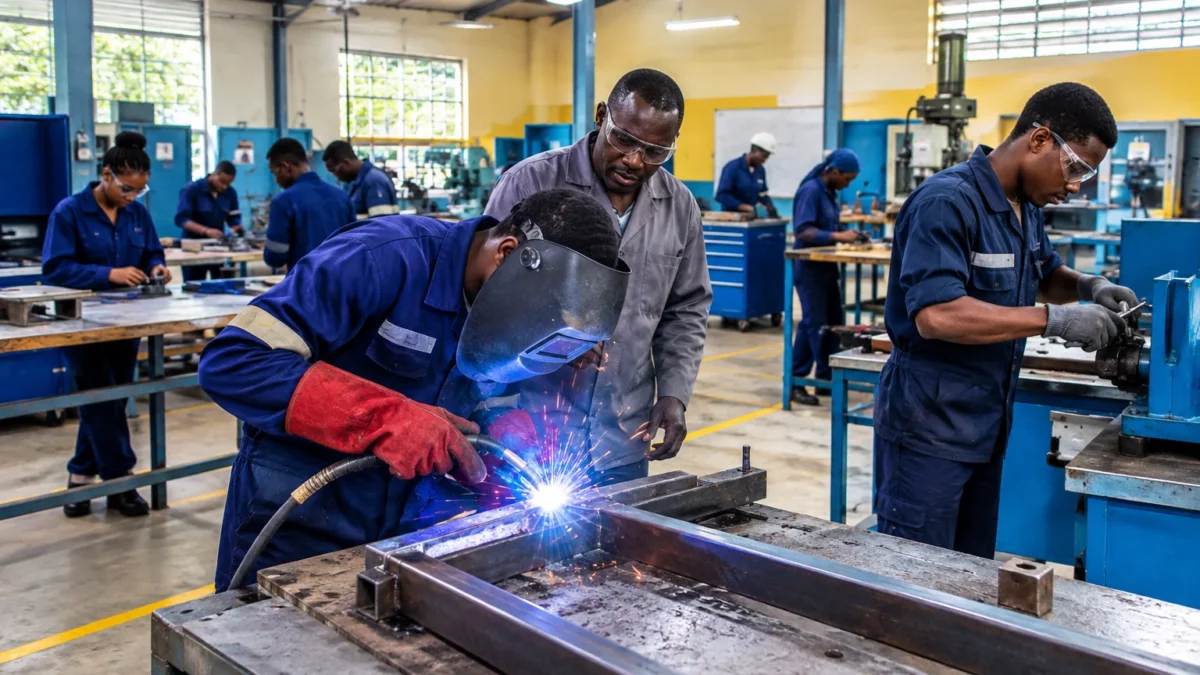
A mining operation does not recruit geologists alone. It also needs heavy-equipment operators, mechanics, electricians, welders and laboratory technicians. These roles are complemented by jobs in security, logistics, law, accounting and human resources. Needs vary according to the project and its stage: building a mine requires different teams from those needed to operate it.
This diversity calls for tailored training pathways. In Côte d’Ivoire, the École supérieure des mines et de géologie has a history of training dating back to 1973. It offers higher technician and engineering programmes, with practical work and internships. In Senegal, the foundation stone for the Institut supérieur d’enseignement professionnel de Kédougou was laid on 7 February 2026 in Bandafassi. The institution plans to offer programmes in areas including mining, energy and agriculture. The Senegalese presidency presents the project as training rooted in the region’s needs.
Working with companies without reducing training to recruitment
Education providers cannot always keep pace on their own with changes in equipment and processes. Employers therefore have a role in shaping programmes, hosting interns and providing on-the-job training. In Guinea, the SimFer capacity development centre, a partner in the Simandou iron ore project, provides training in technical fields. The company says the cohort launched in 2025 completed its first year and a new intake was welcomed in 2026. Information published by SimFer about its training centre describes practical learning, including maintenance and welding.
This experience does not, by itself, resolve the question of access to jobs. Training linked to a specific project can open doors, but the number of positions depends on the construction schedule, outsourcing decisions and the skills the employer actually selects. It is also important to know whether the skills acquired can be used at other mines, in industry or in technical services.
Closer ties also depend on providing information about vacancies and internships. Digital tools can help connect candidates, education providers and companies, provided that listings are accessible and regularly updated. For young people far from urban centres, distance, transport costs and internet access remain practical obstacles. The success of a training policy should therefore be measured not only by the number of courses available, but also by whether people can attend them and turn a qualification into work experience.
Mining growth does not guarantee a corresponding rise in jobs
Declared mining employment in Côte d’Ivoire has risen over the past decade. Figures published in an official national planning document show 8,291 direct jobs in 2016 and 15,775 in 2020. The figure of 16,325 positions for 2024, cited in the data provided for this article, could not be confirmed here by a second independent source. It should therefore be treated with caution. The diagnostic in Côte d’Ivoire’s National Development Plan also highlights the importance of national workers’ participation.
The scale of investment does not automatically translate into large numbers of jobs. Industrial operations rely on heavy equipment and substantial capital. Construction phases can employ many people for a limited period, after which staff numbers fall when operations begin. Communities in mining areas may then face hiring expectations that exceed the site’s long-term capacity.
Guinea illustrates the gap between economic weight and direct employment. According to the World Bank, agriculture accounted for 58% of employment in Guinea in 2023, compared with 3% for mining. These proportions underline the need for mining benefits to spread to other activities, including transport, maintenance, processing, services and local businesses. World Bank data on employment in Guinea shed light on the difference between the sector’s share of investment and its share of employment.
Preparing pathways for after construction ends
Working conditions matter too. Sites can be far from towns, shift rotations can complicate family life and tasks can expose teams to occupational risks. Training must therefore cover safety and labour rights, not just how to operate a machine. It must also anticipate retraining for people whose jobs disappear when construction ends or during a restructuring.
Automation adds another uncertainty. It can reduce some labour needs while increasing demand for skills in maintenance, monitoring and systems management. A study by the International Institute for Sustainable Development on new mining technologies finds that local entry-level jobs may be particularly exposed to technological change. The study on the effects of new technologies in mining calls for workers to be prepared for changing tasks, rather than trained only for today’s jobs.
For countries in the Economic Community of West African States (ECOWAS), the challenge therefore goes beyond local recruitment at each site. It is about building transferable training, bringing schools and companies into closer alignment and ensuring that contracts awarded to subcontractors also create opportunities for national skills. As gold, bauxite and iron ore projects advance, their social impact will be judged as much by the quality of jobs and career pathways as by the volume extracted.