Algeria
 Egypt
 Libya
 Morocco
 Sudan
 Tunisia
 Benin
 Burkina Faso
 Cabo Verde
 Côte d'Ivoire
 Ghana
 Guinea
 Liberia
 Mali
 Mauritania
 Niger
 Nigeria
 Senegal
 Sierra Leone
 The Gambia
 Togo
 Cameroon
 Central African Republic
 Chad
 DR Congo
 Equatorial Guinea
 Gabon
 Republic of the Congo
 São Tomé and Príncipe
 Burundi
 Comoros
 Djibouti
 Eritrea
 Ethiopia
 Kenya
 Madagascar
 Malawi
 Mauritius
 Mozambique
 Rwanda
 Seychelles
 Somalia
 South Sudan
 Tanzania
 Uganda
 Angola
 Botswana
 Eswatini
 Lesotho
 Namibia
 South Africa
 Zambia
 Zimbabwe
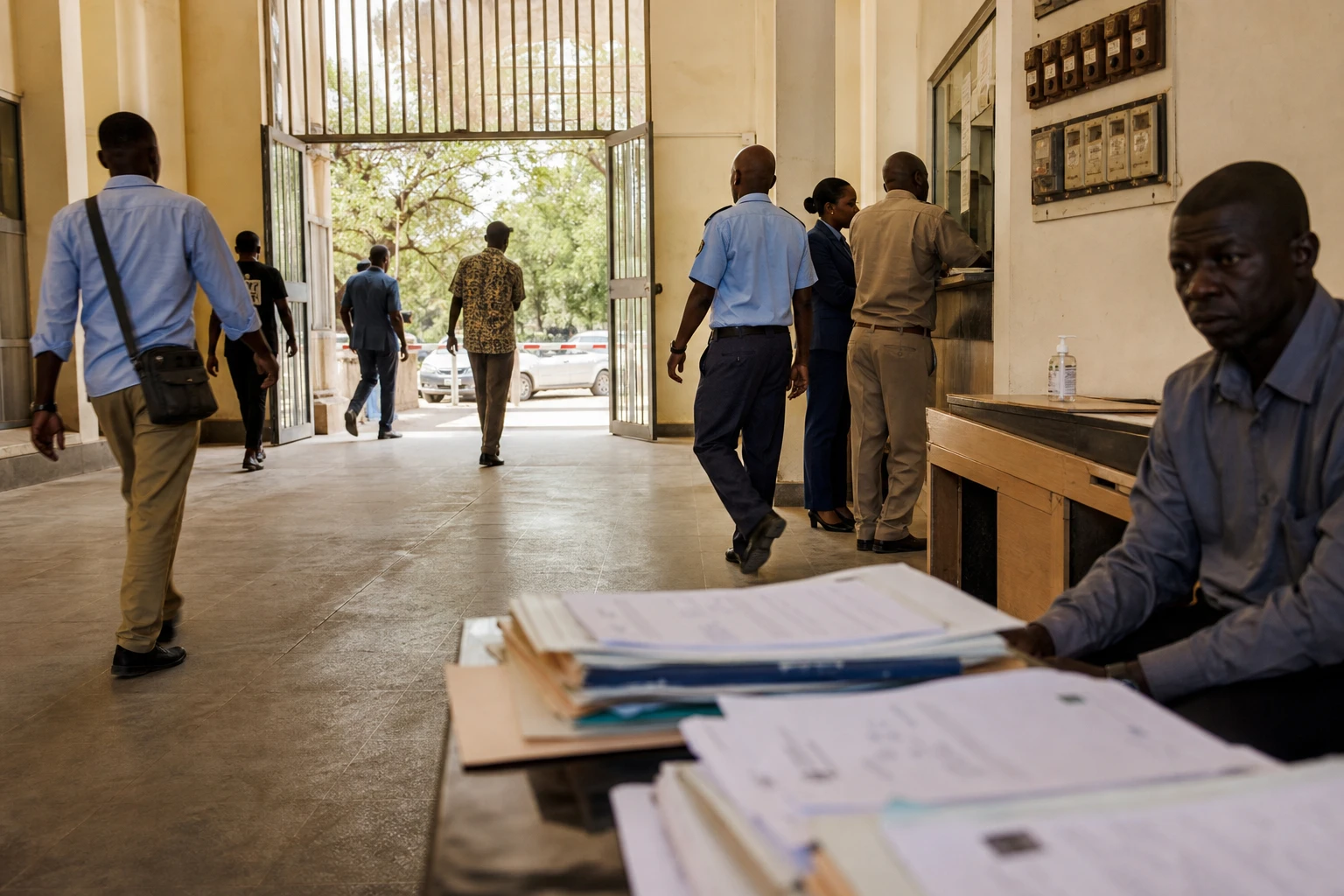
In Bissau, a text meant to reassure instead revives questions over the sharing of power
In Guinea-Bissau, the promise of institutional “clarification” has chiefly revived a familiar concern: who really controls the state when the transition is writing the rules of the game itself? In Bissau, the debate is not only about a constitution. It concerns the balance between the executive, parliament and political parties in a country where every political deadlock has often opened the door to arbitrariness.
The chosen timetable also sets the tone. The transitional authorities have scheduled a constitutional referendum for 30 August 2026, after the draft was adopted by the National Transitional Council on 13 January 2026. This sequence comes less than a year after the coup of 26 November 2025, which halted the electoral process and installed General Horta Inta-a at the head of the transition.
A transition born of a coup and watched by the region
Guinea-Bissau remains a country where institutional stability depends largely on the balance of power between civilians and the military. After the November 2025 seizure of power, ECOWAS suspended the country from its decision-making bodies and called for a swift return to constitutional order. The African Union took the same position, reiterating its rejection of unconstitutional changes of government and calling for an inclusive transition.
This regional framework matters because Guinea-Bissau does not exist in a vacuum. It is part of West Africa, where ECOWAS is still trying to uphold a doctrine of zero tolerance for coups, even as several military-led transitions have weakened democratic norms in the sub-region. In this context, every decision taken in Bissau is seen as a test of the credibility of regional institutions.
What the draft put to a vote proposes
The constitutional text does more than reorganise institutions. It shifts the country from a semi-parliamentary system to a strong presidential one. According to information published by African and international media, the president could appoint and dismiss the prime minister without regard to a parliamentary majority, while the National Assembly would lose some of its role as an arbiter. The head of state would also have the power to dissolve parliament in the event of a “deep political crisis”.
The draft would also reduce the National Assembly from 102 to 65 MPs, changing political representation in a country where small parties have long served as conduits between voters and shifting coalitions. Another sensitive innovation: parties that fail to secure 4% of the vote in legislative elections could be dissolved. The presidential term would remain five years, renewable once.
Supporters of the text make a simple argument: to prevent deadlocks. But in practice, the mechanism concentrates power in the president’s hands. In a system where parliament is smaller and minority parties are more exposed, the equation favours disciplined executives at the expense of pluralism.
Very real political consequences for parties, parliament and voters
For transitional leaders, the draft is a tool for resolving the crisis. For some in the opposition and civil society, it looks more like an outright entrenchment, drawn up by an unelected government to extend its hold over the transitional period. This distrust is reinforced by the fact that the reform was prepared in a political environment upended by the coup and the suspension of the electoral process.
The consequences for party politics would be immediate. Parties able to survive a higher electoral threshold would gain influence, while local or regional parties, often essential to political balances in Guinea-Bissau, could be marginalised. In the short term, this could reduce fragmentation. Over the medium term, however, it could also impoverish representation and shift political negotiations to the top of the state.
For citizens, the debate is more tangible than it may appear. In an economy where the state remains an employer, a redistributor and an indispensable arbiter, the concentration of powers could speed up decision-making. But it could also weaken checks and balances just as the population expects greater predictability, public services and legal certainty.
A sequence in Guinea-Bissau with implications beyond the country
Guinea-Bissau is thus becoming a test case for West Africa. ECOWAS and the African Union are closely watching this kind of transition, as they seek to prevent the end of a coup from leading to another institutional imbalance, this time dressed up in the veneer of a referendum. The timetable announced by the transitional authorities, with a constitutional vote on 30 August 2026 and elections scheduled for 6 December 2026, will therefore be scrutinised closely.
The significance extends beyond Guinea-Bissau itself. In a region where several countries have experienced constitutional ruptures, the question is no longer simply when to return to the ballot box. It is also about what kind of electoral system will be restored, with what safeguards and what degree of genuine pluralism. In Bissau, the answer will say much about the ability of West African institutions to survive military transitions without being hollowed out.