
 Algeria
 Egypt
 Libya
 Morocco
 Sudan
 Tunisia
 Benin
 Burkina Faso
 Cabo Verde
 Côte d'Ivoire
 Ghana
 Guinea
 Guinea-Bissau
 Liberia
 Mali
 Mauritania
 Niger
 Nigeria
 Senegal
 Sierra Leone
 The Gambia
 Togo
 Cameroon
 Central African Republic
 Chad
 Equatorial Guinea
 Gabon
 Republic of the Congo
 São Tomé and Príncipe
 Burundi
 Comoros
 Djibouti
 Eritrea
 Ethiopia
 Kenya
 Madagascar
 Malawi
 Mauritius
 Mozambique
 Rwanda
 Seychelles
 Somalia
 South Sudan
 Tanzania
 Uganda
 Angola
 Botswana
 Eswatini
 Lesotho
 Namibia
 South Africa
 Zambia
 Zimbabwe
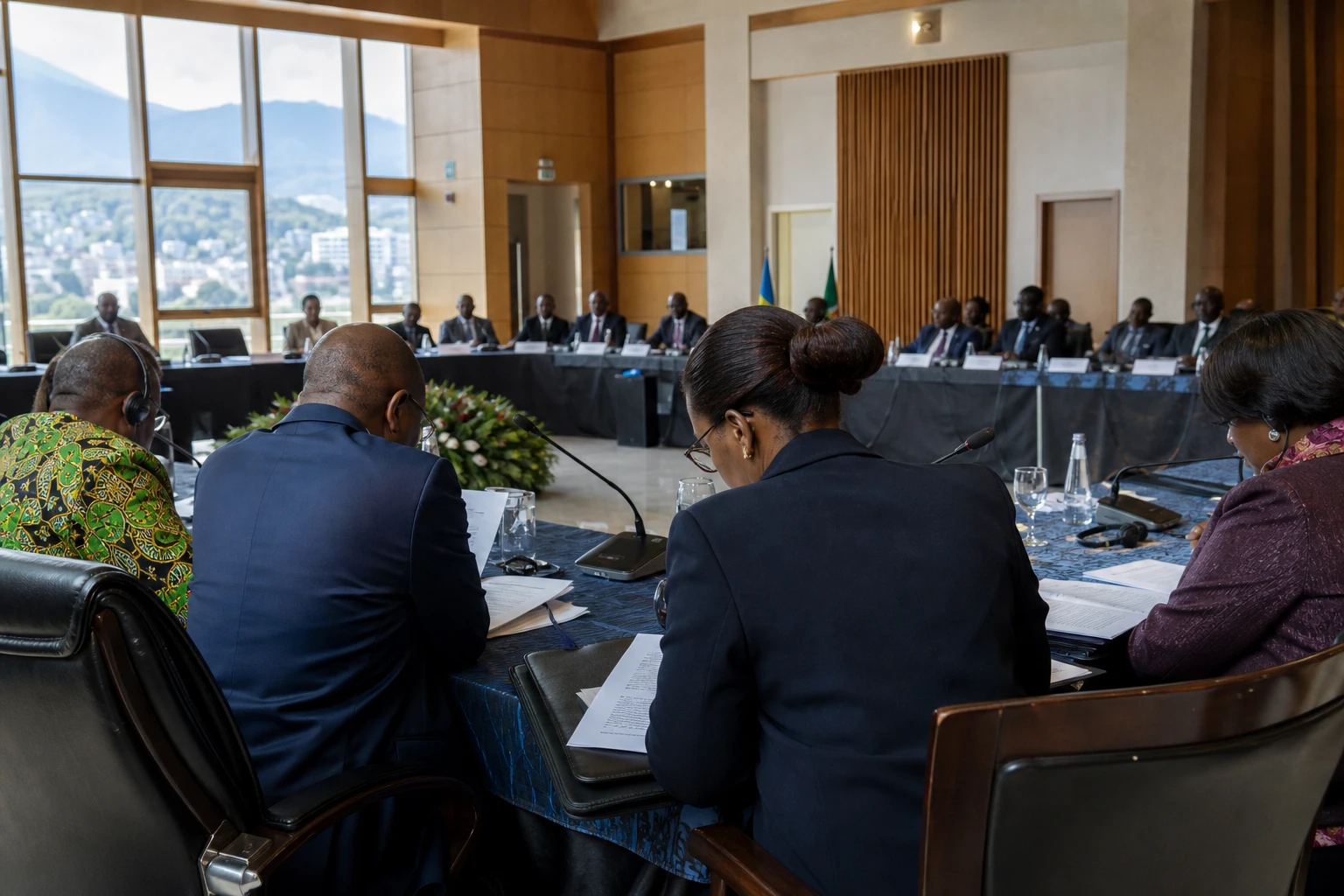
In Goma, African mediation is finally engaging face to face with one of the actors controlling part of the east of the Democratic Republic of the Congo. This presence on the ground tests the African Union’s ability to turn declarations into concrete discussions, as diplomatic initiatives multiply without silencing the guns.
An African mission at the heart of the balance of power
On Monday 5 October 2026, three former African heads of state arrived in Goma, the provincial capital of North Kivu. The city is controlled by the AFC/M23, a politico-military coalition led politically by Corneille Nangaa. The delegation was due to discuss the peace process and the security situation with the movement’s leadership.
The group in Goma included Uhuru Kenyatta, former president of Kenya, Mokgweetsi Masisi, former president of Botswana, and Sahle-Work Zewde, former president of Ethiopia. They are members of the African Union’s panel of facilitators, tasked with supporting efforts to resolve the Congolese crisis.
Available information confirms that Corneille Nangaa received the delegation, alongside Bertrand Bisimwa and Freddy Kaniki, among others. The discussions focused on ways to achieve a political solution and on developments in the east of the DRC. The mission was also due to meet representatives of the United Nations Organization Stabilization Mission in the DRC, Monusco.
This is the panel’s first such step in eastern Congo. Its members had already met the authorities in Kinshasa and Kigali. Their trip to Goma is therefore intended to establish direct contact with AFC/M23 leaders in an area where political decisions are intertwined with military control of territory.
Congolese media Radio Okapi, Enquête.cd and Opinion-Info reported the arrival and the composition of the delegation. The available corroborating information thus establishes the date, location and main participants.
African mediation amid competing initiatives
The African Union’s initiative comes amid a fragmented diplomatic landscape. Several channels are seeking a ceasefire or a political agreement between Kinshasa, Kigali and the AFC/M23. Qatar is facilitating direct talks between the Congolese government and the armed movement. The United States is meanwhile supporting dialogue between the Democratic Republic of the Congo and Rwanda.
There are also initiatives by the East African Community, the EAC, and the Southern African Development Community, SADC. The two regional organisations had tried to coordinate their approaches before reviewing the role of their security and diplomatic mechanisms. The African Union is now seeking to bring these efforts together within a clearer continental framework.
Togo’s President of the Council, Faure Gnassingbé, is leading the African mediation. The panel of facilitators operates within this framework. It brings together several former leaders to sustain dialogue with the different parties and give the process a pan-African dimension.
This arrangement addresses a central challenge. External actors sometimes have substantial financial resources or political leverage. The African Union, by contrast, relies mainly on its political legitimacy and knowledge of regional dynamics. Its room for manoeuvre therefore depends on its ability to speak with one voice and secure verifiable commitments.
Goma, a place for negotiation but also pressure
The meeting is not taking place in a neutral setting. Goma is a major Congolese city and an essential commercial and administrative centre for North Kivu. The AFC/M23’s control of it gives the movement considerable political leverage. Hosting an African Union delegation also allows the group to present itself as an unavoidable interlocutor.
For Kinshasa, the challenge is to prevent this de facto recognition from turning into legitimacy for a parallel administration. In a decision adopted in 2026, the African Union Assembly called on states not to recognise such an administration and stressed the need to coordinate African peace processes. The text also calls for the implementation of commitments made in Washington and Doha.
The African Union document is available on the organisation’s official website. It recalls that diplomacy cannot be separated from respect for Congolese sovereignty and the protection of civilians.
On the ground, the impact of a new diplomatic phase will be judged by concrete results. Residents first want a reduction in fighting, the reopening of transport routes and regular access to essential services. In rural areas, the priorities remain safe travel and the ability to farm, trade or reach a health centre.
In Goma, formal businesses are suffering from disruptions to trade and transport. In working-class neighbourhoods and neighbouring territories, the informal economy depends more heavily on the movement of people and goods. Negotiations that have no effect on these realities risk remaining far removed from Congolese expectations.
The next test will be verification
The 5 October visit did not produce an agreement. No detailed commitments by the parties were made public after the reported discussions. It is therefore important to distinguish the continuation of dialogue, which represents a diplomatic step, from effective de-escalation, which would require measures that can be monitored on the ground.
The panel will need to clarify the status of existing ceasefires, monitoring mechanisms and the conditions for a possible withdrawal of forces from occupied positions. It will also have to address the administrations established in territories controlled by the AFC/M23, without setting aside the security concerns raised by the different parties.
The question of Rwanda will remain central. Kinshasa accuses Kigali of supporting the M23, while the Rwandan authorities cite their security concerns and reject certain allegations. The United Nations and several regional organisations have, for their part, documented the cross-border dimension of the crisis. Any credible roadmap will therefore have to link Congolese dialogue with a regional monitoring mechanism.
The significance of the meeting extends beyond Goma. It tests the ability of the African Union, the EAC and SADC to prevent competition between mediation efforts. It also underscores that a lasting solution cannot rest solely on meetings between leaders. It must provide guarantees for the population, verifiable commitments from the forces involved and a political timetable that Congolese people can understand.



